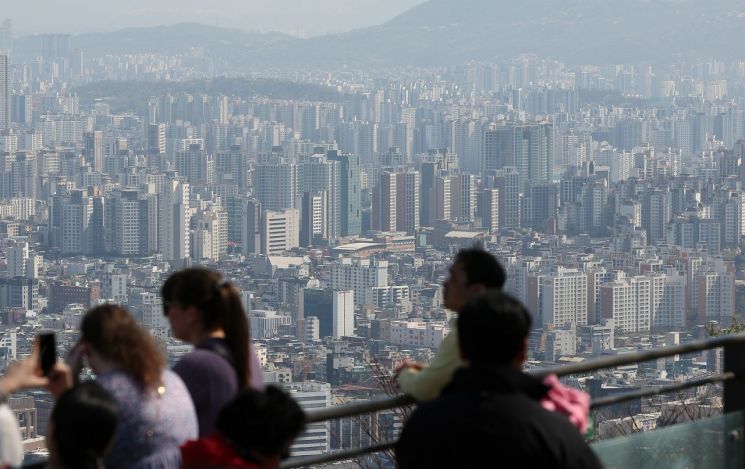
As the accumulated urgent sale properties are depleted, the decline in Seoul apartment sale and jeonse prices is narrowing. Additionally, with the Bank of Korea holding the base interest rate steady for two consecutive times, mortgage loan interest rates have stabilized, leading to the highest transaction volume in a year and a half.
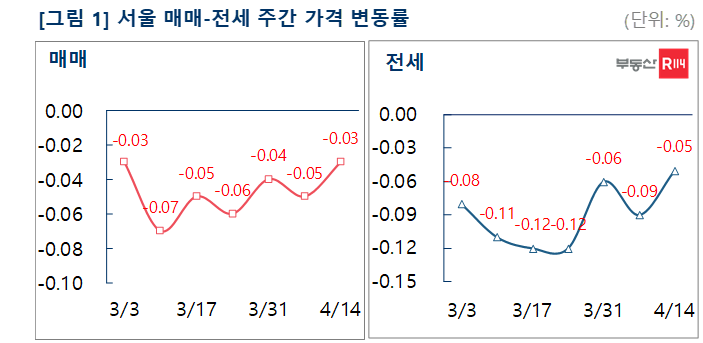
According to Real Estate R114 on the 16th, this week Seoul apartment prices fell by 0.03%, a 0.02 percentage point smaller drop compared to last week. By region, non-Gangnam areas such as ▲Gwanak (-0.10%) ▲Gwangjin (-0.09%) ▲Geumcheon (-0.08%) ▲Nowon (-0.08%) ▲Seongbuk (-0.08%) ▲Guro (-0.07%) ▲Dobong (-0.06%) led the weakness.
New town apartment sale prices fell by 0.02%. By region, ▲Pyeongchon (-0.06%) ▲Jungdong (-0.05%) ▲Bundang (-0.03%) ▲Ilsan (-0.03%) ▲Sanbon (-0.01%) ▲Dongtan (-0.01%) declined.
Gyeonggi and Incheon apartment prices dropped by 0.04% this week. By region, ▲Gunpo (-0.11%) ▲Incheon (-0.09%) ▲Anyang (-0.07%) ▲Paju (-0.07%) ▲Yongin (-0.05%) ▲Gwangmyeong (-0.04%) ▲Suwon (-0.04%) ▲Ansan (-0.04%) ▲Osan (-0.04%) fell.
With the government's regulatory easing policy in effect and many regulatory areas lifted, along with significant relaxation of tax and loan regulations, it is highly likely that the depletion of urgent sale properties due to increased transaction volume and the narrowing of price declines will continue. The government began changing the atmosphere by lifting regulatory status for all areas except Gangnam, Seocho, Songpa, and Yongsan districts in Seoul under the 1.3 measures and easing punitive tax and loan regulations targeting multi-homeowners. As a result, transactions mainly focused on high-quality urgent sale properties have continued, breaking down the transaction freeze.
In fact, according to the Seoul Real Estate Information Plaza, the total number of apartment sale transactions in Seoul in March was 2,675. This is the largest scale in 18 months since September 2021 (2,694 transactions). Consequently, Seoul apartment transaction volume recorded over 2,000 units for two consecutive months following February (2,461 transactions).
Meanwhile, the large-scale apartment move-in volume, which had been concentrated in specific areas such as Gangnam in Seoul over a short period, is expected to be somewhat dispersed in the second quarter, leading to an anticipated narrowing of the decline in jeonse prices sensitive to this.
The jeonse market maintained a similar rate of decline compared to the previous week or showed a slight reduction in the drop. Seoul fell by 0.05%, new towns by -0.03%, and Gyeonggi·Incheon by -0.04%. In Seoul, declines were seen in ▲Gangdong (-0.17%) ▲Nowon (-0.14%) ▲Gwangjin (-0.13%) ▲Gwanak (-0.11%) ▲Songpa (-0.11%) ▲Eunpyeong (-0.11%) ▲Gangbuk (-0.10%).
New towns saw declines in ▲Jungdong (-0.15%) ▲Pyeongchon (-0.08%) ▲Bundang (-0.07%) ▲Pangyo (-0.02%) ▲Ilsan (-0.01%). Gyeonggi·Incheon experienced drops in ▲Paju (-0.18%) ▲Anyang (-0.12%) ▲Incheon (-0.10%) ▲Osan (-0.10%) ▲Gwangmyeong (-0.08%) ▲Uijeongbu (-0.04%) ▲Uiwang (-0.03%).
Yoon Ji-hae, Research Team Leader at Real Estate R114, stated, "The economy is so sluggish that the Bank of Korea cannot raise the base interest rate, and concerns about a macroeconomic downturn due to instability in the U.S. financial market are high. It is expected to take some time before the gap between the prices buyers and sellers want narrows."
© The Asia Business Daily(www.asiae.co.kr). All rights reserved.
![Clutching a Stolen Dior Bag, Saying "I Hate Being Poor but Real"... The Grotesque Con of a "Human Knockoff" [Slate]](https://cwcontent.asiae.co.kr/asiaresize/183/2026021902243444107_1771435474.jpg)
















