A man in his 40s who operated a sports center was sentenced to a heavy prison term for stabbing a plastic rod about 70cm long into the anus of an employee, causing the employee's death.
The Supreme Court's 3rd Division (Presiding Justice No Jeong-hee) on the 13th dismissed the appeal of Han Mo (42), who was charged with murder, and upheld the original sentence of 25 years in prison.
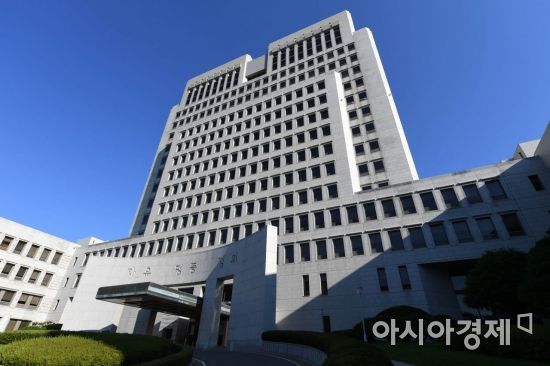
Han repeatedly claimed in his appeal to the Supreme Court that he was intoxicated and mentally impaired at the time of the incident and argued that the sentence was excessive, but his claims were rejected.
Han was indicted on charges of repeatedly assaulting employee A (26) with a vacuum cleaner rod (plastic material, approximately 80cm long, 4cm wide) and an exercise rod (plastic material, approximately 70cm long, 3cm wide) at the sports center he operated in Seodaemun-gu, Seoul, in the early morning of December 31, 2021, and stabbing the exercise rod into A’s anus, causing organ rupture and death.
The night before the incident, after finishing a year-end party with the center’s employees, Han and A drank more alcohol together while waiting for a designated driver. When the driver was delayed, A attempted to drive under the influence, and Han became very angry while trying to stop him.
Afterwards, the two returned to the center and continued drinking past midnight, during which Han’s assault on A began. Initially, Han climbed onto A’s neck while A was sitting or punched him, but after 2 a.m. on the 31st, Han started assaulting A using the plastic rods.
From around 2:14 a.m., Han pushed the exercise rod into A’s anus while A was lying on the floor, and continued to repeatedly punch A’s face and push the rod further inside the anus.
At the final moment, Han even kicked the exercise rod lodged in A’s anus multiple times with great force to fully insert it into A’s body.
Eventually, the plastic rod penetrated A’s rectum, liver, and heart, resulting in A’s death from blunt force trauma to the chest and abdomen.
In court, Han claimed he was heavily intoxicated and mentally impaired at the time of the crime, but this was not accepted. Evidence included Han’s partial memory of the crime scene and the fact that he himself called 112 after the incident.
The first trial court sentenced Han to 25 years in prison, and the appellate court upheld this decision, dismissing Han’s appeal.
The appellate court stated, "The crime is unbelievably bizarre and brutal," and noted, "The fear and shame experienced by the victim must have been indescribably severe."
However, regarding Han’s motive, the appellate court differed from the first trial court’s classification of the crime as a "murder with blameworthy motive" (Type 3) and instead classified it as a "murder with ordinary motive" (Type 2).
Murder with blameworthy motive includes revenge killings, random murders, or killings to prevent detection of other crimes. Although Han’s methods were bizarre and brutal, the court found no evidence that Han planned to kill A from the start or showed a disregard for human life.
The Supreme Court also found no problem with the appellate court’s judgment.
Meanwhile, the Supreme Court rejected Han’s appeal on the grounds of excessive sentencing.
First, the Supreme Court ruled that the appellate court’s reclassification of Han’s motive from "murder with blameworthy motive" to "murder with ordinary motive" was merely a different evaluation of sentencing factors already presented and considered in the first trial, and did not constitute a change in sentencing circumstances.
Additionally, Han’s deposit of 41 million won for the victim’s family during the second trial was not considered a sufficient change in circumstances to alter the sentence, given the nature of Han’s crime, the harm suffered by victim A and his family, and the bizarre and brutal nature of the crime.
This case also sparked controversy over the police’s inadequate initial response at the time of the incident.
On the morning of the incident, around 9:05 a.m., police who responded to the report along with firefighters confirmed Han’s statement that he assaulted A, who had been drinking and tried to drive, to stop him. They covered A, who was lying without pants, with clothes, checked his pulse, and then left the scene.
Even after A’s death, the police initially charged Han with assault resulting in death, but only applied murder charges and requested an arrest warrant after receiving the first autopsy report from the National Forensic Service indicating death due to organ damage.
© The Asia Business Daily(www.asiae.co.kr). All rights reserved.
![Clutching a Stolen Dior Bag, Saying "I Hate Being Poor but Real"... The Grotesque Con of a "Human Knockoff" [Slate]](https://cwcontent.asiae.co.kr/asiaresize/183/2026021902243444107_1771435474.jpg)















