The aviation industry, which is recovering from COVID-19 and entering normalization, has encountered unexpected challenges in the form of rising exchange rates and oil prices. Exchange rates and oil prices are factors that undermine airlines' operating profits. If the upward trend continues in the second half of the year, it is expected to have a negative impact on the airlines' performance improvement.
On the 12th, the won-dollar exchange rate rose by 3.5 won from the previous trading day to 1,325.7 won. It increased by nearly 100 won in about two months from 1,227 won on February 2. The widening interest rate gap between Korea and the United States and the continued trade deficit influenced this rise.
A strong won-dollar exchange rate is a typical negative factor for airlines. Airlines pay aircraft lease fees and fuel costs in dollars. When the exchange rate rises, profitability deteriorates. For example, when the exchange rate rises by 10 won, Korean Air and Asiana Airlines incur foreign exchange valuation losses of 30 billion won and 28.4 billion won, respectively.
Rising oil prices are also a burden for airlines. West Texas Intermediate (WTI) crude oil rose more than 10 dollars in about a month from 66.74 dollars per barrel on the 17th of last month to close at 81.53 dollars per barrel on this day. The main reason is that OPEC Plus, a consultative group of major oil-producing countries including OPEC and Russia, decided to cut production starting next month.
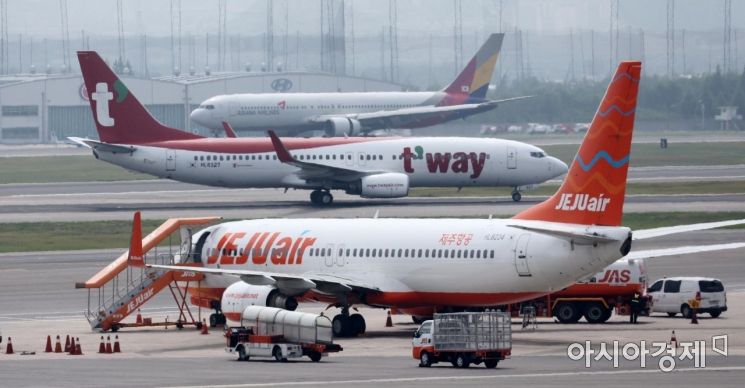
Fuel costs account for 20-30% of airlines' cost of sales, making it a significant fixed cost. When oil prices rise, airlines also suffer losses in operating profit. In the case of Korean Air, a 1 dollar increase per barrel in oil prices results in a loss of about 26 million dollars (34.4 billion won).
Moreover, when oil prices rise, fuel surcharges also increase, which can increase the burden on consumers purchasing airline tickets. Fuel surcharges are additional fees added to airfare depending on oil price fluctuations.
This month, the international fuel surcharge (based on Korean Air) ranges from 21,000 to 161,000 won, slightly down from 24,700 to 193,700 won last month. However, since oil prices have been continuously rising recently, there is a possibility that fuel surcharges will rise again. If this happens, the amount consumers pay for airline tickets will increase. In other words, consumers may feel burdened when purchasing airline tickets, which could reduce air travel demand.
© The Asia Business Daily(www.asiae.co.kr). All rights reserved.
![Clutching a Stolen Dior Bag, Saying "I Hate Being Poor but Real"... The Grotesque Con of a "Human Knockoff" [Slate]](https://cwcontent.asiae.co.kr/asiaresize/183/2026021902243444107_1771435474.jpg)















