Yoo Hee-dong, the head of the Korea Meteorological Administration, said, "Climate change is an extremely dangerous situation that can be described as nearing the end of the world."
At the 2nd National Issue Grand Debate held on the 11th at the National Assembly Members' Office Building in Yeouido, Seoul, titled 'Climate Crisis Seen Through 100 Years of Meteorological Data: What Are the Response Tasks?', Director Yoo, who appeared as a presenter, stated, "Global climate change and various future projections are worsening."
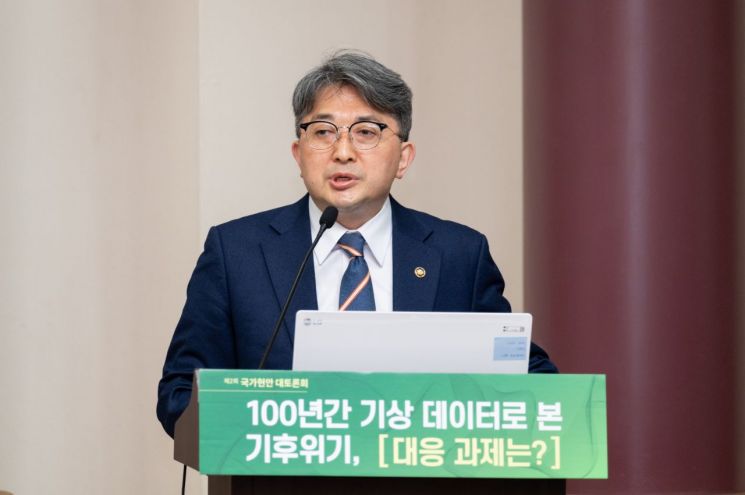
According to Director Yoo, the global average temperature in 2020 was 14.88 degrees Celsius, which is 0.98 degrees higher than the 20th-century average. In particular, South Korea has experienced changes at a faster rate than the global average. From 1912 to 2020, the annual average temperature in Korea rose by 0.2 degrees every 10 years, which is three times the global average increase of 0.07 degrees.
Compared to the past 30 years (1981?2010), the recent 10 years (2011?2020) saw tropical nights lengthen by 4.6 days and heatwave days increase by 2.8 days. Between 1991 and 2020, the sea surface temperature around the Korean Peninsula also rose from 18.32℃ to 18.53℃, an increase of 0.21℃. This rise was greater than the global average sea surface temperature increase of 0.12℃ (from 18.18℃ to 18.53℃) during the same period.
Earlier, the Intergovernmental Panel on Climate Change (IPCC) also warned in the comprehensive report of its 6th Assessment Report published on the 20th of last month that "Human activities through greenhouse gas emissions have increased the global surface temperature by 1.1℃ compared to 1850?1900 (current period 2011?2020)," and "At the current rate, the Earth's surface temperature will rise by 1.5℃ above pre-industrial levels by 2040."
Director Yoo argued that the response to the climate crisis should begin by making meteorological and climate data available to the public through open APIs. He emphasized, "The hazardous weather caused by climate change is exponentially affecting various sectors of society," and "Developing effective response measures must start from scientific data." Open API refers to a method of information disclosure that allows anyone to access, analyze, and process the data.
Jo Cheon-ho, former director of the National Institute of Meteorological Sciences and the second presenter, explained, "If a 1.5℃ increase is like driving at 150 km/h on a highway, then 2℃ is like driving at 200 km/h, and 3℃ is like driving at 300 km/h." He added, "An increase of more than 3℃ means the collapse of civilization." He further noted, "Political and policy choices made in the next decade are crucial to succeeding in 'climate resilient development.'"
Meanwhile, the grand debate was attended by Kim Jin-pyo, Speaker of the National Assembly; Jo Myeong-hee (People Power Party) and Lee So-young (Democratic Party), members of the National Assembly's Special Committee on Climate Crisis; and Yang Ui-seok, Deputy Director of the Korea Energy Economics Institute, among others.
© The Asia Business Daily(www.asiae.co.kr). All rights reserved.
![Clutching a Stolen Dior Bag, Saying "I Hate Being Poor but Real"... The Grotesque Con of a "Human Knockoff" [Slate]](https://cwcontent.asiae.co.kr/asiaresize/183/2026021902243444107_1771435474.jpg)















