Lower Rainfall and Higher Temperatures than Usual... Frequent Hwangsa
"Hwangsa Lands on Korean Peninsula on the 11th... Impact Continues on the 12th"
The Chinese capital Beijing has once again been covered by a large-scale yellow dust storm. The yellow dust originating from China is expected to affect the Korean Peninsula on the 12th as it flows in with the northwesterly winds. Due to lower-than-average rainfall causing severe drought and rising spring temperatures, large-scale yellow dust occurrences have become more frequent.
On the 11th, a large-scale yellow dust storm occurred in Beijing, recording the worst air quality index (AQI) level 6, classified as 'Severe Pollution.' The Beijing Meteorological Observatory upgraded the yellow dust alert from blue to yellow the previous afternoon. China's yellow dust alerts are divided into four levels: blue, yellow, orange, and red. The main pollutant is particulate matter (PM 10).
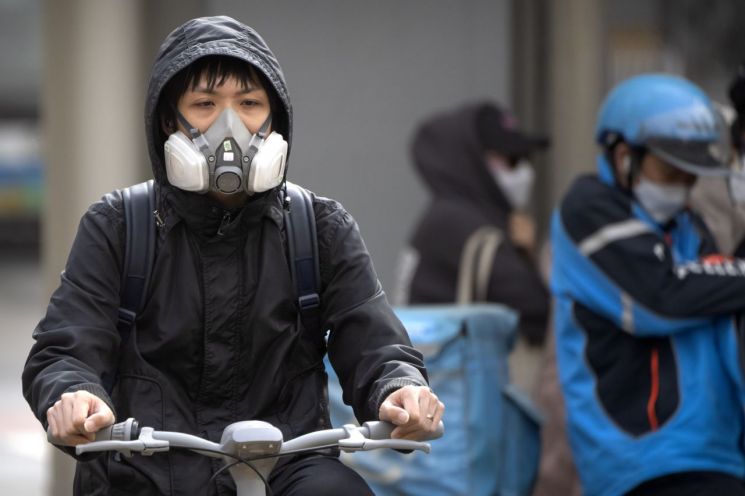 On the 11th, when a yellow dust warning was issued in Beijing, China, a citizen is riding a bicycle wearing a dust mask. According to the Beijing Environmental Protection Monitoring Center, at 8 a.m. that day, the Air Quality Index (AQI) across Beijing recorded the worst level 6, classified as "Severe Pollution." This yellow dust event is the fifth largest this year. Photo by AP Yonhap News
The Environmental Protection Monitoring Center announced that the average AQI in Beijing that morning was 500㎍/㎥. China's AQI is divided into six levels: Excellent (0?50㎍/㎥), Good (51?100㎍/㎥), Light Pollution (101?150㎍/㎥), Moderate Pollution (151?200㎍/㎥), Severe Pollution (201?300㎍/㎥), and Very Severe Pollution (301?500㎍/㎥). A value of 500㎍/㎥ is the highest level currently displayable.
The China Central Meteorological Observatory reported that, in addition to Beijing, 12 provinces and regions including Shanxi Province, Shandong Province, Jiangsu Province, Anhui Province, Henan Province, Hubei Province, Inner Mongolia, Shanghai, and Tianjin are affected by yellow dust and fine particulate matter.
This yellow dust event is the fifth largest this year. The frequent occurrence of large-scale yellow dust storms this spring is due to decreased rainfall and rising temperatures in northern China and Mongolia's deserts, causing frequent sandstorms. Liu Bingzhang, Director of the Atmospheric Environment Bureau at China's Ministry of Ecology and Environment, recently told foreign media that "sandstorms have increased fourfold compared to the 1960s."
This yellow dust is also affecting geographically close South Korea. The yellow dust from China landed on the Korean Peninsula on the afternoon of the 11th and is expected to continue flowing in on the 12th.
The National Institute of Environmental Research expects high concentrations of yellow dust to flow into most central and southwestern regions.
The National Institute of Environmental Research stated, "Since the afternoon of the 9th, yellow dust has been continuously originating from the Gobi Desert and the Inner Mongolian Plateau," adding, "Riding the northwesterly winds and moving southeast, it is expected to increase fine particulate matter concentrations mainly in western regions from the afternoon of the 11th." They further noted, "However, the extent, concentration levels, and duration of domestic impact on the 12th are variable depending on additional emissions on the 11th and airflow patterns."
© The Asia Business Daily(www.asiae.co.kr). All rights reserved.
![Clutching a Stolen Dior Bag, Saying "I Hate Being Poor but Real"... The Grotesque Con of a "Human Knockoff" [Slate]](https://cwcontent.asiae.co.kr/asiaresize/183/2026021902243444107_1771435474.jpg)















