Lawmakers' Passionate Calls for Political Reform
Public Attention Falls Short of Expectations
Hopes Remain for Concrete Plans Through Further Extensions
The National Assembly's plenary committee for electoral system reform proceeded with a free-flowing debate, suggesting that substantive discussions on electoral system reform will take place in the future. While the necessity of redistricting was confirmed by individual lawmakers, skepticism grew regarding their role as a 'game changer' capable of driving shifts in public opinion.
According to the National Assembly on the 11th, the YouTube video (live broadcast) of the plenary committee session, which was aired by the National Assembly Broadcasting Service the previous day, garnered only about 4,600 views. The National Assembly Broadcasting Service provided separate videos for each of the 28 lawmakers who spoke, with People Power Party lawmaker Heo Eun-ah and Democratic Party lawmaker Lee Tan-hee recording over 4,000 views each. However, many lawmakers had fewer than 100 views. In the plenary committee discussions, no 'star' emerged to inspire or provoke debate among the public.
This plenary committee was convened for the first time in 20 years since the 2003 debate on the 'Iraq War dispatch consent bill.' Initially, there were high expectations that this plenary committee would become a new forum for electoral reform discussions, different from previous reforms.
According to the procedures for operating the plenary committee devised by the Speaker's Office and others, the National Assembly planned to prepare a separate amendment to the resolution of the Political Reform Special Committee after two weeks of plenary discussions. The amendment would then be approved by the plenary session, followed by drafting work in the Political Reform Special Committee, with the final approval scheduled for a plenary session in April. For now, the emergence of a 'star' in the plenary committee was key to building public consensus, but so far, it appears to have failed to attract extraordinary public attention.
During the plenary committee session the previous day, lawmakers passionately appealed for the need for political reform, with remarks such as "a state of nationwide unrepresented citizens, a state of political disappearance" (Democratic Party lawmaker Lee Tan-hee) and "the National Assembly has become a bastion of veto-ocracy" (People Power Party lawmaker Choi Hyung-doo). Various ideas were presented, ranging from the necessity of political reform to specific methodologies. However, since the plenary committee was operated in a format of about seven-minute statements, it was limited to confirming lawmakers' views.
Initially, the planned timing of the plenary committee was delayed by about a week, and the duration was shortened from two weeks to one week. Although speaking time was limited, the discussion topics were free, resulting in a free-flowing debate without a clear focus, which made it difficult to concentrate on the discussion. Additionally, controversy over the ruling party leader's proposal to reduce the number of lawmakers further dampened public interest in the plenary committee. While about 200 lawmakers attended at the beginning, the number gradually decreased to around 60 by the end of the first day.
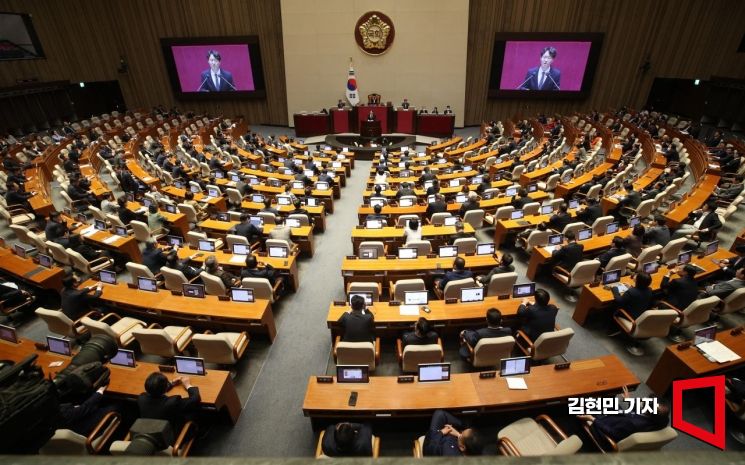 The full committee of the National Assembly convened for four days starting on the 10th at the National Assembly in Yeouido, Seoul, to discuss the election system reform plan (amendment to the Public Official Election Act) to be applied in next year's general election, where ruling and opposition party members engaged in heated debates. This is the first time in 20 years that the full committee has been held since the discussion on the 'Iraq War Dispatch Extension Agreement' in 2003. Photo by Kim Hyun-min kimhyun81@
The bipartisan Political Reform Lawmakers' Group (hereafter, the Group), which is leading political reform discussions within the National Assembly, attaches significance to the fact that the plenary committee confirmed the need for political reform. Kim Jong-min, a Democratic Party lawmaker and a member of the Group's steering committee, said, "Until now, lawmakers have never expressed their own views during electoral reform discussions," adding that the plenary committee's purpose is not to reach a single agreement but to serve as a forum for a variety of opinions in a free-for-all manner. Lawmaker Kim predicted, "Many discussions about the need for electoral reform are emerging, and after four days of discussion here, representatives from both parties will likely be formed to negotiate based on the plenary discussions."
Jo Hae-jin, People Power Party lawmaker, chair of the Political Reform Special Committee's bill subcommittee, and a member of the Group's steering committee, said, "The possibility of an amendment emerging from the plenary committee is only about 30%," but added, "Since only one day of discussion has taken place, the plenary committee could be extended by bipartisan agreement for further discussion, or a subcommittee could be formed to draft an amendment."
© The Asia Business Daily(www.asiae.co.kr). All rights reserved.
![Clutching a Stolen Dior Bag, Saying "I Hate Being Poor but Real"... The Grotesque Con of a "Human Knockoff" [Slate]](https://cwcontent.asiae.co.kr/asiaresize/183/2026021902243444107_1771435474.jpg)















