'Fake Outlet' Boom on City Outskirts
Attracting Customers with Keywords like Auction and Duty-Free
Counterfeit Goods Openly Displayed in Actual Stores
"Overseas Luxury Brands Prada, Gucci, Burberry Auction, Supreme 90% Sale"
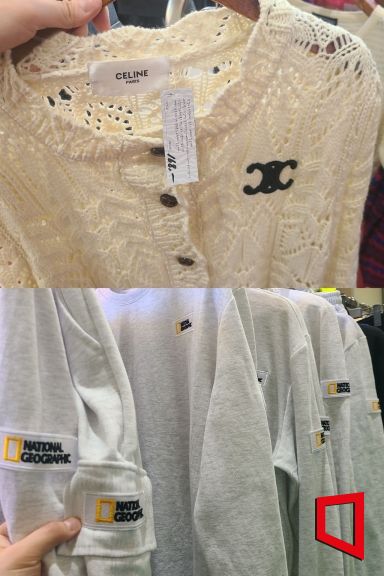 Counterfeit clothing of famous brands being sold at a clothing store in Wolgot-myeon, Gimpo-si, Gyeonggi Province.
 [Photo by Song Seung-yoon]
On the afternoon of the 8th, on a road in Wolgot-myeon, Gimpo-si, Gyeonggi Province. Passing by a road lined with restaurants and gas stations, banners with phrases such as 'Overseas Luxury Brand Auction' and 'Overseas Luxury Duty-Free Warehouse' caught the eye on one side of the road. Banners featuring logos of famous overseas luxury brands like Gucci, Prada, and Burberry were also spotted here and there. There were also temporary buildings made from containers and Mongolian tents with display tables. At first glance, this place resembles an ordinary luxury discount outlet, but it is an illegal store selling counterfeit goods. Within a radius of several kilometers around this area, there are two such places.
Entering one of these stores, clothing from popular luxury brands in Korea such as Chanel, Louis Vuitton, Celine, Moncler, and Loewe were lined up. Upon closer inspection, the tags resembled authentic ones but were of poor quality. Most products were of lower quality than so-called 'mirror-grade' (products almost identical to genuine ones as if reflected in a mirror) or S-grade items commonly found in the counterfeit market. However, these clothes were being sold here for prices ranging from 100,000 to 200,000 KRW.
An employee here said, "Most are counterfeit, but some used items are genuine," and added, "Mainly middle-aged and older customers visit." Indeed, during the approximately 30 minutes spent here, most visitors were middle-aged or older. There were also frequent scenes of customers buying items without asking whether they were genuine or counterfeit, simply because the prices were cheap. Besides luxury brands, there was also a container selling famous sports brands like Nike and Adidas. Genuine-looking products and counterfeits were mixed and sold there as well. Local residents testified that these stores have been operating for at least over a year.
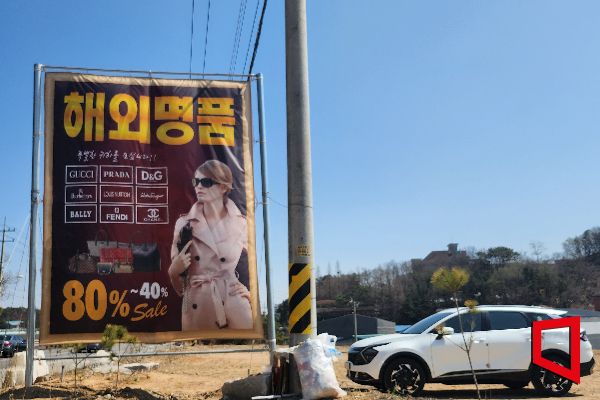 On the afternoon of the 8th, a promotional sign advertising luxury brand products was placed at the entrance of a clothing store in Wolgot-myeon, Gimpo-si, Gyeonggi Province.
 [Photo by Song Seung-yoon]
As crackdowns on counterfeit distribution both online and offline, such as the Dongdaemun 'counterfeit market' in Seoul, have intensified, the channels for selling counterfeit goods have diversified. Especially offline, besides traditionally established markets, methods involving building temporary structures on the outskirts of urban areas to sell counterfeits are rampant. They promote themselves with phrases like 'duty-free,' 'auction,' and 'customs clearance,' deceiving customers into thinking they are selling genuine products that have gone through official customs procedures. The main target group is middle-aged and older people who find it difficult to distinguish between genuine and counterfeit products. Within the metropolitan area, such places have been rapidly appearing mainly in suburban areas and are understood to be operating openly.
Distributing and selling counterfeit goods under the guise of famous brands can lead to punishment under the Trademark Act. The current Trademark Act stipulates that infringement of trademark rights or exclusive usage rights can result in imprisonment of up to seven years or a fine of up to 100 million KRW.
An industry insider said, "Reports of counterfeit distribution online are occasionally received, but I did not know such places existed offline," adding, "Since this is a clear violation of the Trademark Act, relevant authorities should conduct thorough crackdowns."
© The Asia Business Daily(www.asiae.co.kr). All rights reserved.
![Clutching a Stolen Dior Bag, Saying "I Hate Being Poor but Real"... The Grotesque Con of a "Human Knockoff" [Slate]](https://cwcontent.asiae.co.kr/asiaresize/183/2026021902243444107_1771435474.jpg)
















