Reusable Cups Provided at Cafes, but Officials Often Use Disposable Cups
Ordinance Mandates '3-Year Plan' but None Established Yet
District Official: "Eco-Friendly Culture Is Taking Root... Will Promote More Publicity and Education"
Abnormal weather events such as floods and droughts are occurring consecutively worldwide. The rise in the Earth's temperature is cited as the main reason. In response, the call for 'carbon neutrality'?where the amount of carbon dioxide is absorbed naturally or artificially removed to reach 'zero'?is growing louder. Since the government's '2050 Carbon Neutrality Declaration' in 2020, roadmaps and implementation strategies have been announced, and Gwangju Metropolitan City has even declared its goal to achieve carbon neutrality by 2045, five years ahead of the government's target.
There are various methods to achieve carbon neutrality, but the practice of 'reducing disposable products' in daily life is spreading widely. Various public institutions and companies are signing agreements or launching campaigns to reduce disposable products. However, Dong-gu, Gwangju Metropolitan City, a local government that should lead by example, still seemed like a distant story.
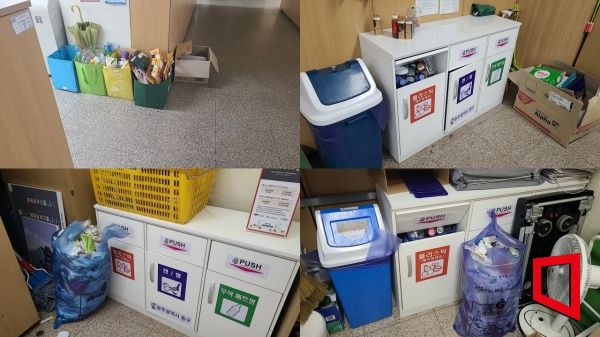 Disposable waste is overflowing in the trash bins of each department at the Dong-gu Office building in Gwangju Metropolitan City.
 [Photo by Jin-Hyung Park]
On the morning of the 6th at the Dong-gu Office in Gwangju, signboards encouraging the use of reusable cups, such as 'Today is a day without disposable products,' were prominently installed, but most of the officials were actually carrying disposable plastic cups filled with coffee.
Although a project is underway to collaborate with coffee shops to provide reusable cups for takeout orders to curb disposable product use, it was easy to see people bringing disposable cups with drinks inside the office building.
When asked why they did not use reusable cups, they responded with a short sigh, then averted their gaze and hurried away.
Even the second-floor offices housing the Climate Environment Division and the Cleaning Administration Division, the departments that should lead by example, showed traces of disposable product use that accelerate the climate crisis.
The recycling bins placed in the office corridors were piled high with bottled water PET bottles and disposable plastic cups from cafes. There were also 'unconscientious cases' that caused frowns, such as not removing labels from empty bottles or failing to separate cups and paper holders, resulting in messy disposal.
Not only these two departments but also various places inside the office building were littered with disposable plastic cups, straws, paper cups, and other trash to the point of being underfoot.
A group of officials who reportedly held a discussion activity in the basement first-floor lounge were eating delivery disposable lunch boxes, and a department ordered 7 to 8 drinks delivered to the office cafe without using reusable cups.
Although not a convenience facility installed to encourage disposable product use, the long paper cup collection bin next to the coffee vending machine on the first floor of the annex was about one-third full with layers of trash.
The scene at the Dong-gu Office that morning was somewhat distant from the Ministry of Environment's practical guidelines that prohibit the use of disposable cups and PET bottles inside offices.
This situation, which does not seem to be a recent occurrence, has been pointed out as a result of Dong-gu's lack of mid-term environmental measures and plans, effectively leaving the issue unattended.
The 'Dong-gu Public Institution Disposable Product Use Restriction Ordinance' stipulates that the district mayor must establish an annual implementation plan and evaluate the performance each year. It also requires the establishment of a three-year plan every three years tailored to local conditions, including tasks related to disposable product use and surveys on the actual situation.
However, it has been confirmed that Dong-gu has not formulated any three-year plans since the ordinance was enacted in July 2019.
A district official explained, "Further verification is needed regarding why the three-year plans were not established," adding, "We have been establishing and implementing annual implementation plans every year."
He also said, "Compared to the past, the frequency of disposable product use by officials has drastically decreased," and "We will continue to improve the insufficient parts through projects such as the 'Reusable Cup Usage Promotion Project.'"
© The Asia Business Daily(www.asiae.co.kr). All rights reserved.

















