Government-Opposition Clash Over Space Development Governance Reform
Vice Minister-Level Space Aviation Agency Under Ministry of Science and ICT vs Minister-Level Space Strategy Headquarters Directly Under the President
Experts and Industry: "Let's Reconsider the Reasons Why It Was Needed"
The government and opposition parties are clashing head-on over the reorganization of the space development governance system. Experts and industry insiders point out that it is necessary to return to the basics and consider what measures are truly needed to revitalize South Korea's space development and industry, which face limited resources, a narrow market, and lagging technological capabilities. So far, the need for reforming space development governance has been raised mainly from three perspectives. First, there is a need for an independent space development control tower with strong authority that is not swayed by political winds, and an institution that leads cross-government policy coordination and cooperation with the private sector. Second, there have been calls to strengthen the expertise and stability of the responsible organizations and personnel. Third, it is essential to enhance credibility and representation in international space development diplomacy to ultimately improve negotiation power. In fact, on the 15th of last month, Kim Byung-jin, chairman of Satrec Initiative, attended a public hearing hosted by the Ministry of Science and ICT and urged, "The most important things are inter-ministerial coordination ability and diplomatic skills," adding, "Rather than technology and research experts, people with excellent communication, negotiation, and coordination language skills should work at the Space Agency, spending more energy on negotiations and coordination between foreign and domestic institutions."
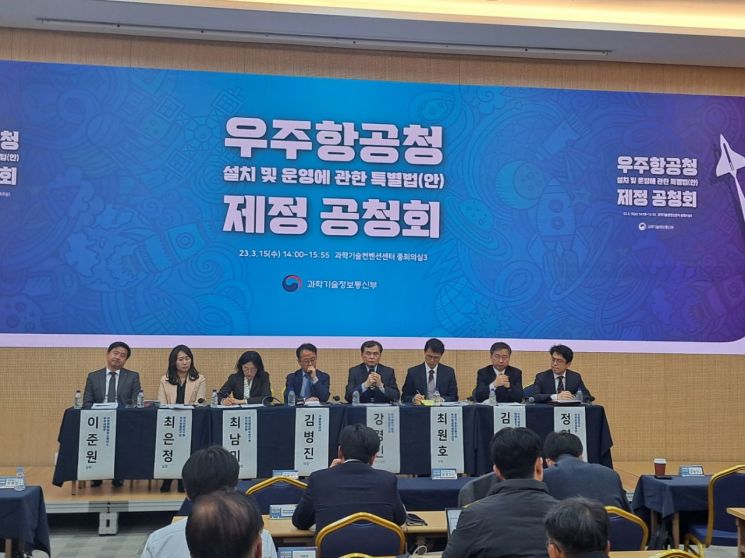
First, there is a significant difference between the government’s proposal and the Democratic Party’s proposal regarding the establishment of an independent space development control tower and strengthening inter-ministerial coordination and private sector cooperation. In summary, the government proposes an indirect approach, while the opposition party proposes a direct approach. The "Special Act on the Establishment and Operation of the Space Aviation Agency," approved by the Cabinet on the 4th, centers on establishing an external agency under the Ministry of Science and ICT. External agencies under ministries are vice-ministerial level institutions that cannot submit independent legislative amendments under the Government Organization Act and cannot create their own enforcement rules, resulting in weak status and independence. The government’s proposed Space Aviation Agency is the same. As a vice-ministerial institution, it has limitations in status and function and may lack influence in consultations with other ministries. However, the special act compensates for this by utilizing the National Space Committee, which legally coordinates and oversees space development tasks at the government level. The existing National Space Committee chairman, the Prime Minister, will be elevated to the President, and the head of the Space Aviation Agency will serve as vice-chairman to oversee practical affairs, thereby empowering the organization. However, some criticize that having a vice-ministerial official as vice-chairman operating the National Space Committee, whose members include ministers such as the Ministry of Science and ICT minister, who is a direct superior, is legally inconsistent. The government proposal also guarantees independence by granting authority over organizational restructuring at the division level and budget reallocation.
On the 5th, opposition lawmakers led by Cho Seung-rae of the Democratic Party proposed a bill (partial amendment to the Space Development Promotion Act) to establish a separate ministerial-level organization directly under the President to strengthen status, functions, and roles more directly. Like the government proposal, the President would serve as the National Space Committee chairman, but a ministerial-level Space Strategy Headquarters would be created directly under the President. Jeong Areum, secretary to Rep. Cho Seung-rae, explained, "Even though the Ministry of Science and ICT currently leads the space sector, as seen in the recent inter-ministerial conflict over the Defense Ministry’s space launch vehicle test launch, it was difficult to coordinate and reconcile differences," adding, "Coordination and reconciliation among space-related ministries cannot be achieved through an external agency under a ministry, so we saw the need for a new organizational form within the current framework." She added, "By making the headquarters chief a ministerial-level official, they are given authority to oversee space-related tasks, coordinate and reconcile among ministries, and establish basic plans related to space development."
Regarding strengthening the expertise and stability of the responsible organization, the direction is similar but there are some differences in details. Under the existing Ministry of Science and ICT system, non-experts and a small number of general public officials have been responsible for core policy and support functions of the space development system, exposing many limitations. Conflicts with the field have also been frequent. The government proposal aims primarily to enhance the expertise of public officials by establishing a separate agency and to hire a large number of foreign and private experts as "term-limited public officials." To this end, it removes salary caps and exempts them from the stock blind trust system. The government also plans to establish a separate headquarters for research and development (R&D), which has been led by national research institutes such as the Korea Aerospace Research Institute (KARI), to entrust some tasks to experts. The opposition proposal differs. It opts for direct hiring of private sector personnel rather than term-limited public officials to strengthen expertise. This avoids controversies over preferential treatment and legality related to the stock blind trust exemption in the government’s term-limited public official hiring method, as well as discrimination issues with other ministries. Additionally, it adjusts some functions in the government proposal to focus solely on space administrative tasks. It excludes space development R&D functions and delegates only administrative matters such as policy oversight, coordination, budgeting, and support. Functions related to aviation R&D are also excluded.
What about enhancing international space diplomacy negotiation power through improved external representation and credibility? The opposition side advocates for a "ministerial-level dedicated organization directly under the President." They argue that their proposal is more suitable, noting that worldwide, dedicated space development agencies are increasingly established as ministerial-level organizations directly under the highest-ranking officials or decision-making bodies. Secretary Jeong said, "It will be perceived that Korea is trying to do something by creating a new cross-ministerial coordinating body like NASA," expressing confidence in enhancing negotiation power.
Regarding these issues, the Ministry of Science and ICT generally states that there are "no problems" or that they will "supplement during the enactment or amendment of subordinate laws and regulations." The ministry said, "The special act includes principles, functions, and exceptions for establishing the Space Aviation Agency as a central administrative agency overseeing policies, research and development, and industrial promotion in the space aviation field, and operating it as a professional and flexible organization conducting research and development," adding, "We will fully reflect the opinions of space aviation experts when preparing detailed matters related to establishment and operation in subordinate laws and regulations. We will do our best to become an innovative central administrative agency dedicated to space aviation that plays a pivotal role in the development of Korea’s space aviation technology and industry."
© The Asia Business Daily(www.asiae.co.kr). All rights reserved.
![Clutching a Stolen Dior Bag, Saying "I Hate Being Poor but Real"... The Grotesque Con of a "Human Knockoff" [Slate]](https://cwcontent.asiae.co.kr/asiaresize/183/2026021902243444107_1771435474.jpg)















