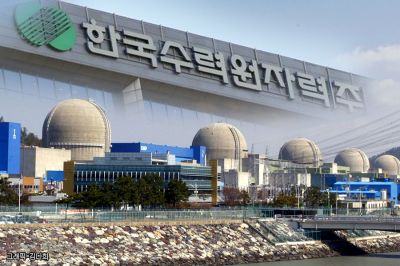
Korea Hydro & Nuclear Power (KHNP) reported the export of nuclear power plants to the Czech Republic to the U.S. government, but the report was rejected. The U.S. effectively put the brakes on the possibility of independent exports of the Korean-type nuclear power plant, citing that the obligation to comply with nuclear export controls lies with U.S. companies. KHNP has become inevitably required to negotiate with the U.S. nuclear company Westinghouse, which is currently involved in litigation over the issue of technological independence, to secure the Czech nuclear power plant contract. If the two sides fail to reach an agreement or if discussions are prolonged, there is a possibility that the export of nuclear power plants to the Czech Republic itself could be blocked. Following the setback in last year's 40 trillion won-scale Polish nuclear power plant contract, concerns are emerging that the Czech project’s difficulties could also hinder the Yoon Suk-yeol administration's goal of becoming an exporter of 10 nuclear power plants by 2030.
According to major foreign media and the energy industry on the 5th, KHNP submitted information related to the Czech nuclear power plant bid to the U.S. Department of Energy (DOE) in December last year but received a rejection notice in January this year. This is in accordance with U.S. federal regulations that designate specific nuclear technologies as export-controlled items and impose DOE approval or reporting obligations when transferring them abroad. In a letter sent to KHNP, the DOE stated, "According to regulations, the DOE report must be submitted by a U.S. person (entity)." The obligation to comply with export controls is limited to U.S. companies that take U.S. technology overseas. This means that the U.S. is effectively not recognizing the technological independence of KHNP’s nuclear technology.
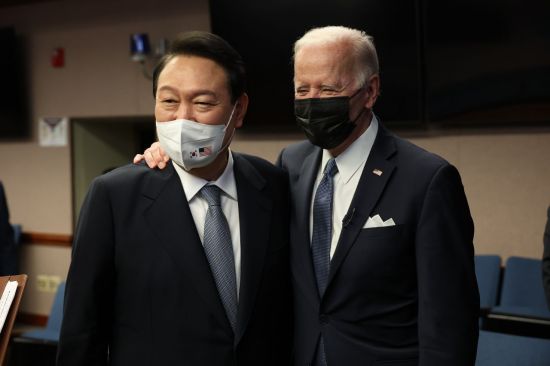 Bright Expressions of the South Korea-US Leaders (Pyeongtaek=Yonhap News) Photo by Seomyeongon = President Yoon Suk-yeol and US President Joe Biden visited the Korea Aerospace Operations Center (KAOC) at Osan Air Base on the afternoon of the 22nd, wearing bright expressions. 2022.5.22 seephoto@yna.co.kr (End)
 Debate Over the Independence of Korean-type Nuclear Power Plant 'APR-1400' Reignited
The core issue in KHNP’s rejected report for the Czech nuclear power plant bid lies in whether the technology of the Korean-type nuclear power plant 'APR-1400' is independent. The main point of contention is whether the technology was developed independently by Korea or derived from Westinghouse technology. This conflict reignited last October when Westinghouse filed a lawsuit against Korea Electric Power Corporation (KEPCO) and KHNP regarding the independence of the technology. Westinghouse maintains that its technology was applied to the APR-1400 and thus it is not purely Korean technology. The APR-1400 is a third-generation reactor developed with Korean technology. The APR-1400 design is said to have been influenced by the 'System 80+' reactor of Combustion Engineering (CE) in the U.S. In 2000, Westinghouse acquired Combustion Engineering, thereby inheriting the System 80+ technology.
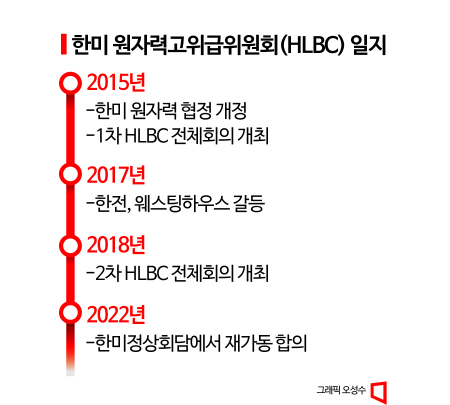
Accordingly, Westinghouse argues that intellectual property rights (IP) apply to the core technology of the APR-1400, and therefore Korea cannot independently export the nuclear power plant. Previously, KEPCO also had conflicts with Westinghouse over the IP of the APR-1400 in 2017, but the two sides did not reach a full agreement. This conflict escalated into the 'Korea-U.S. High-Level Bilateral Commission on Nuclear Energy (HLBC),' a major channel for nuclear cooperation between Korea and the U.S., in 2018. After the second plenary meeting, the HLBC was effectively dormant for four years until the Korea-U.S. summit last year agreed to reactivate the commission. Expectations grew that the summit would resolve conflicts and strengthen the Korea-U.S. nuclear alliance, but the third HLBC plenary meeting has yet to set a concrete schedule.
Goal of Becoming a Nuclear Export Power Hampered by the U.S.
The problem is that as the conflict between the two countries over whether the APR-1400 technology is original prolongs, Korea is suffering direct losses. A representative example is the defeat in the 40 trillion won-scale Polish nuclear power plant contract battle last October, in which KHNP participated. Earlier, the Polish government decided to use Westinghouse technology for the first phase of its first nuclear power plant construction project. The Polish new nuclear power plant project is a large-scale project to build six pressurized water reactors with a capacity of 6 to 9 gigawatts (GW). At the time, KHNP, Westinghouse, and France’s EDF submitted proposals. For the Korean government, it meant losing a project it had been working hard to secure to the U.S. side. Some analysts suggested that KHNP’s ongoing intellectual property lawsuit with the U.S. side was somewhat a burden in Poland’s choice of Westinghouse.
Concerns are growing that the Czech nuclear power plant contract could repeat the Polish case. If the U.S. court sides with Westinghouse, it will inevitably disrupt the Korean government’s goal of becoming a nuclear export powerhouse. The new government has set a goal of exporting 10 nuclear power plants overseas and has expressed confidence in securing new nuclear power plant construction projects in the Czech Republic and Poland. It is explained that the nuclear export path can only open if the dispute with Westinghouse over nuclear technology is resolved in some way.
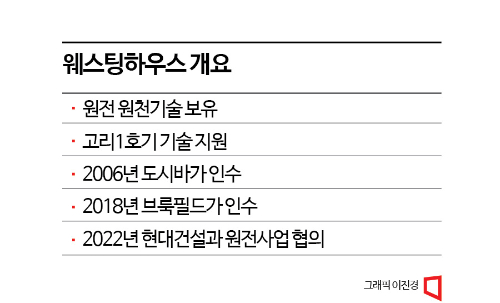
Experts have analyzed that this incident is an extension of U.S. nationalism policies. Professor Jeong Beom-jin of Kyung Hee University’s Department of Nuclear Engineering said, "Looking at Biden’s policies, there is a will to prioritize national interests even at the expense of international relations," adding, "Westinghouse is supposed to cooperate with the reporting, but since cooperation is not mandatory, it may continue to resist." He further analyzed, "Brookfield Renewable, which owns 51% of Westinghouse shares, is playing tug-of-war to raise Westinghouse’s value for sale." In response, KHNP stated in a letter sent to Westinghouse in February that it shares the DOE’s rejection process and is preparing for discussions. A KHNP official said, "The Czech nuclear power plant project currently has nearly a year left until the final supplier selection, so there is enough time to resolve the issue, and we plan to continue discussions with Westinghouse."
© The Asia Business Daily(www.asiae.co.kr). All rights reserved.
![Clutching a Stolen Dior Bag, Saying "I Hate Being Poor but Real"... The Grotesque Con of a "Human Knockoff" [Slate]](https://cwcontent.asiae.co.kr/asiaresize/183/2026021902243444107_1771435474.jpg)

















