A survey found that measures expanding workers' choice of working hours, such as activating vacation use and implementing flexible working hours, help improve work productivity and work-life balance (WLB). It was also evaluated to be effective in reducing unnecessary working hours.
The Federation of Korean Industries (FKI) announced on the 5th that these results came from a "Working Hours System Operation Status Survey" commissioned to the polling firm Research & Research, targeting HR and labor managers of the top 1,000 companies by sales.
According to the survey results, 7 out of 10 responding companies (67.0%) agreed on the necessity of introducing systems to improve productivity and work-life balance. The systems that companies have introduced or are considering to enhance productivity and work-life balance include ▲measures to activate vacation use such as diversifying vacation types and promoting annual leave usage (27.6%) ▲flexible working hours systems such as flexible, selective, discretionary work hours, and staggered commuting (27.0%) ▲establishment and strengthening of working hours recording and management systems (21.4%).
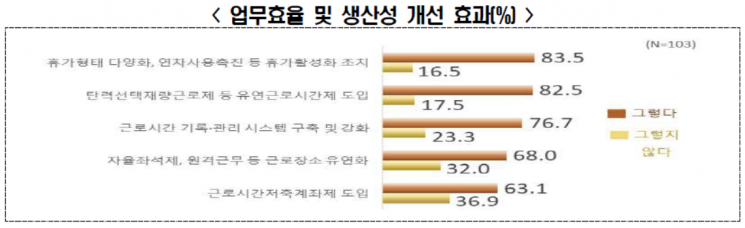
The system that companies considered most effective for improving work efficiency and productivity was vacation activation measures (83.5%). The system that was answered to be effective in reducing unnecessary overtime was flexible working hours systems (73.8%).
The FKI explained that the more flexible working hours systems are utilized, the more overtime hours tend to decrease. Looking at data from the Ministry of Employment and Labor, the utilization rate of flexible working hours systems steadily increased from 4.6% in 2015 to 16.0% last year, while the average monthly overtime hours of regular workers decreased from 10.7 hours to 8.2 hours.
The FKI stated, "Even considering the reduction in working hours due to the implementation of the 52-hour workweek system in 2018, overtime hours have decreased alongside the increase in the utilization rate of flexible working hours systems since before then," and analyzed that "the use of flexible working hours systems appears to help reduce unnecessary overtime and efficiently manage working hours.”
A survey on total working hours, combining basic working hours and overtime of full-time workers last year, showed an average of 45.7 hours per week. Specifically, the distribution was ▲39.8% working 44 hours or more but less than 48 hours per week ▲34.0% working 48 hours or more but less than 52 hours per week ▲20.4% working 40 hours or more but less than 44 hours per week.
Choo Kwang-ho, head of the Economic and Industrial Headquarters at FKI, said, "Many companies that have expanded workers' choice of working hours are feeling the effects of improved work-life balance and productivity," and added, "The National Assembly and government need to create an environment that enhances work efficiency and improves workers' quality of life through flexible working hours."
© The Asia Business Daily(www.asiae.co.kr). All rights reserved.
![Clutching a Stolen Dior Bag, Saying "I Hate Being Poor but Real"... The Grotesque Con of a "Human Knockoff" [Slate]](https://cwcontent.asiae.co.kr/asiaresize/183/2026021902243444107_1771435474.jpg)











