Joint Statement of China-Russia Summit, China's Embrace Toward North Korea
Simultaneous Suspension of North Korean Ballistic Missiles and ROK-US Joint Exercises Excluded
In the joint statement from last month's China-Russia summit, the principle for resolving the North Korean nuclear issue advocated by China, known as 'Ssangjungdan (雙中斷·simultaneous cessation of North Korea's ballistic missile launches and South Korea-US joint military exercises),' was omitted. This has been analyzed as indicating a more accommodating stance by China toward North Korea. Under the 'new Cold War' framework, North Korea, China, and Russia are becoming increasingly close. Experts express concerns that the closer ties among North Korea, China, and Russia could increase our security costs and make peaceful reunification more difficult.
Professor Joo Jae-woo of Kyung Hee University analyzed in a column contributed to the March issue of the North Korean Economic Review published by the Korea Development Institute (KDI) on the 4th, "China and Russia have recently shown that they recognize North Korea's continuous missile test launches and the anticipated 7th nuclear test as North Korea's legitimate right to self-defense."
After holding a summit in Moscow on the 21st of last month (local time), China and Russia expressed in their joint statement, "Both sides express concern over the situation on the Korean Peninsula and urge all parties to maintain calm and restraint and to work toward de-escalation." However, the statement drew attention because it did not include 'Ssangjungdan,' which China has proposed as a principle for resolving the North Korean nuclear issue.
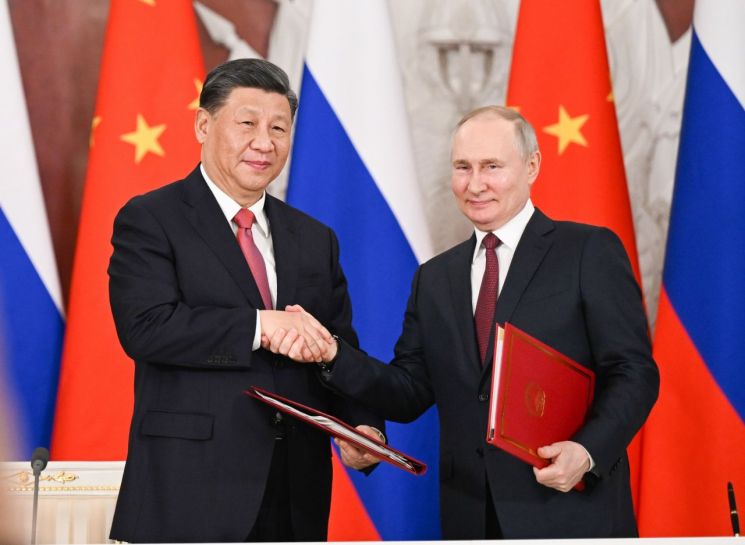
'Ssangjungdan' is a principle that China has presented since 2017 for North Korea, alongside 'Ssangkwae Byeonghaeng' (parallel progress of the denuclearization process and North Korea-US peace agreement negotiations). It means that if North Korea stops launching ballistic missiles, South Korea-US joint military exercises will also be suspended. Until June last year, China stated that "the principle of denuclearization on the Korean Peninsula is unwavering," affirming the validity of the Ssangjungdan and Ssangkwae Byeonghaeng principles, but these were not included in last month's China-Russia joint statement.
Professor Joo explained the omission of Ssangjungdan from the joint statement by saying, "It means that while the US conducts the South Korea-US alliance and joint military exercises, it will tolerate North Korea's missile test launches," adding, "This explains why the international community, led by the US, failed to pass a resolution to strengthen sanctions against North Korea at the UN earlier this year." The fact that China and Russia requested US responsiveness to "North Korea's legitimate and reasonable concerns" in the joint statement is also in this context.
China and Russia's tolerance of North Korea's missile test launches can also be interpreted as North Korea, China, and Russia becoming closer under the 'new Cold War' framework. Signals of the North Korea-China-Russia closeness are being detected here and there. Last month, it was revealed that Wang Yajun, the Chinese ambassador to North Korea, was appointed to Pyongyang after two years of being designated, and on the 1st, Kim Yo-jong, deputy director of the Central Committee of the Workers' Party of Korea, criticized Ukrainian President Zelensky in a statement, showing support for Russia.
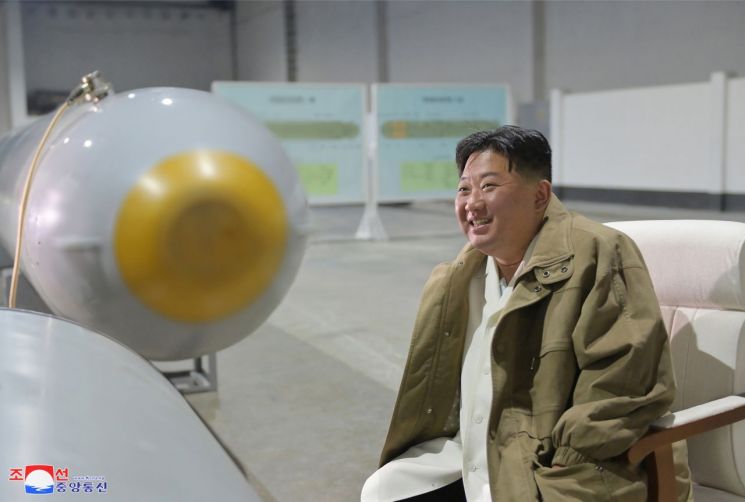
The closeness among North Korea, China, and Russia could pose a new security crisis for us.
Professor Kim Yong-hyun of Dongguk University's Department of North Korean Studies said on last month's BBS program 'Jeon Young-shin's Morning Journal,' "In the mid to long term, moving toward a structure of South Korea-US-Japan versus North Korea-China-Russia is clearly undesirable," expressing concern that "China is a neighboring country almost sharing a border, South Korea's trade dependence and a significant portion of exports and imports are with China, and China's role is certainly an important part in resolving North Korea's nuclear issue."
Former President of the Korea National Diplomatic Academy, Hong Hyun-ik, also said on KBS's 'Choi Kyung-young's Strong Current Affairs,' "If the conflict structure between North Korea-China-Russia and South Korea-US-Japan is reproduced, resolving the North Korean nuclear issue, establishing a peace regime on the Korean Peninsula, peaceful reunification, and smooth handling of sudden changes in North Korea will all become more difficult," adding, "We need to make more efforts to have a friendlier relationship with China."
© The Asia Business Daily(www.asiae.co.kr). All rights reserved.
![Clutching a Stolen Dior Bag, Saying "I Hate Being Poor but Real"... The Grotesque Con of a "Human Knockoff" [Slate]](https://cwcontent.asiae.co.kr/asiaresize/183/2026021902243444107_1771435474.jpg)

















