Gangsuhun Gwangju City Council Member Holds 'Policy Debate'
A proposal was made to continuously discover neighborhood commercial districts considering local characteristics and to strengthen digital transformation education suitable for the 4th Industrial Revolution era, aiming to establish a strong small business promotion policy unique to Gwangju City.
According to Gwangju Metropolitan Council on the 4th, Councilor Kang Su-hoon held a policy forum titled "Cheer Up, Strong Small Business Promotion" the day before.
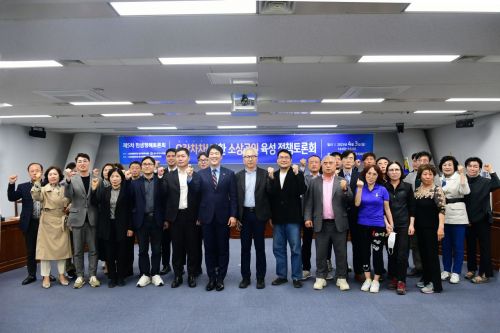
This forum was promoted as part of a livelihood policy discussion jointly hosted by the Gwangju Metropolitan City Party of the Democratic Party of Korea and the Gwangju Metropolitan Council.
Since the management situation of small business owners has worsened due to COVID-19 and rapid price increases, the forum was held as a time to seek policy measures for fostering and supporting small business owners.
Councilor Kang Su-hoon served as the chair, with presentations by Professor Mo Jong-rin of Yonsei University Graduate School of International Studies and Han Kyung-rok, head of the Convergence Industry Research Office at the Gwangju-Jeonnam Research Institute. Following them, Lee Cheong-soo, officer of the Small Business Growth Promotion Division at the Ministry of SMEs and Startups, Yoon Hyun-seok, CEO of Culture Network Co., Ltd., Kim Hong, head of the Small Business Management Support Center in Seo-gu, Gwangju, and Seol Hyang-ja, team leader of the Small Business Team in Gwangju City, participated as discussants.
Professor Mo Jong-rin stated, "The alleyway commercial districts in Mapo, Yongsan, and Seongsu-dong have established themselves as cultural districts where anyone wants to visit, and the core of this is fostering local creators," adding, "Just as Gwangju has Dongmyeong-dong and Yangnim-dong, there is sufficient driving force for local creators to grow."
He continued, "For small business policies to succeed, walkable and business-friendly streets must be reflected in urban planning," emphasizing, "Policies considering small business growth engines, local corporate ecosystems, and creator economy platforms must be prepared."
Han Kyung-rok said, "As the online distribution market has rapidly grown, digital transformation utilizing artificial intelligence, blockchain, and the like is a timely requirement for small business owners," and added, "Services that read consumers' minds, such as delivery innovation, product recommendations, and simple payments based on digital technology, will become the core competitiveness of the distribution industry."
He also proposed, "Institutionally, it is necessary to supplement the Gwangju Metropolitan City's Distribution Industry Digital Transformation Support Ordinance by adding provisions supporting digital transformation to existing small business-related ordinances."
Lee Cheong-soo, who participated in the discussion, said, "Recently, creative small business owners have been creating new industries that did not exist before, such as the Gangneung Coffee Street and Yangyang's surfing industry," and added, "Small business owners are our future and play a role in inducing new industries."
CEO Yoon Hyun-seok stated, "Recently, the government supports various promotion programs for small business owners, but our region is not ready to accept these," and argued, "Since a new perspective on local small business owners is needed, efforts should be made starting in Gwangju to advance from store-type small business owners to corporate-type small business owners through dedicated organizations and professional workforce development."
Center Director Kim Hong emphasized, "The meaning of strong small business owners is to create value and satisfaction for customers through various products and services with a solid brand," and added, "To achieve this, committed small business owners must gather to create alleyway commercial districts through local creating, embedding culture and stories to make neighborhoods where people want to stay and visit."
Seol Hyang-ja, team leader of the Small Business Team, said, "Gwangju City is doing its best to create distinctive and competitive commercial districts in line with the Ministry of SMEs and Startups' comprehensive plan for revitalizing alleyway commercial districts," and stated, "We will actively strive to discover and foster local creators and create alleyway commercial districts with Gwangju's unique color and sensibility linked to culture and tourism."
Lee Byung-hoon, chairman of the Democratic Party Gwangju City Party, said, "The damage to small business owners due to the spread of non-face-to-face culture over the past three years is immeasurable," and added, "Policy support centered on the government and local governments is necessary to protect small business owners. We will continue on-site communication with small business owners and carefully review related policies to continuously supplement any shortcomings."
Councilor Kang Su-hoon said, "Gwangju has a small business owner ratio of 94% among all businesses, and small business workers account for more than half, so it is not an exaggeration to call it a 'small business city,'" and added, "Through this policy forum, I hope it will be a foundation for preparing Gwangju's unique small business policies that seek and apply content, space, and community technologies to secure online and offline competitiveness beyond individual support for small business enterprises."
© The Asia Business Daily(www.asiae.co.kr). All rights reserved.
![Clutching a Stolen Dior Bag, Saying "I Hate Being Poor but Real"... The Grotesque Con of a "Human Knockoff" [Slate]](https://cwcontent.asiae.co.kr/asiaresize/183/2026021902243444107_1771435474.jpg)















