Bio Association Hosts 'Microbiome Industry Seminar'
Microbial Changes May Cause Cancer, Obesity, Brain Diseases
Tumor Size and Body Shape Changes Confirmed in Mouse Experiments
Government Shows Strong Support
Preparing Preliminary Feasibility Study for 'Microbiome Technology Development Project'
Could an era open where microorganisms can treat not only intestinal diseases but also skin, cardiovascular, and brain disorders? Following the approval of the first microbiome therapy by the U.S. Food and Drug Administration (FDA) last year, there is growing anticipation that an oral therapy will be approved within this month, raising expectations that such a future will soon become a reality.

At the 'Microbiome Industry Seminar' held on the afternoon of the 4th at Shinhan WAY Hall, Shinhan Investment Corp., Yeouido, Yeongdeungpo-gu, Seoul, the actual clinical effects of microbiome therapies, development trends, and directions for government policy support were introduced. This seminar was co-hosted by five domestic microbiome therapy companies: CJ Bioscience, Genome & Company, GoBiolab, Immunobiome, and HEM Pharma, with joint sponsorship from the Ministry of Trade, Industry and Energy, the Korea Disease Control and Prevention Agency, and Shinhan Investment Corp., and organized by the Korea Bio Association.
Microbiome is a compound word of microbiota and genome, referring to the tens of trillions of microorganisms and their genes residing in the body. It is known that a 70 kg adult carries about 38 trillion microorganisms. It has been revealed that various diseases such as psoriasis, atopy, obesity, colitis, cardiovascular diseases, and autism spectrum disorder are associated with each individual's microbiome, drawing attention as a new modality (therapeutic approach).
Changes in Microorganisms in the Body Cause Diseases from the Gut to the Brain
Professors Jin-Ho Park (Seoul National University Hospital) and Beom-Jo Oh (Seoul National University Boramae Medical Center), both from the Department of Family Medicine, presented on how the microbiome actually influences disease onset and how it can be treated.
Professor Park emphasized, "There are aspects of health problems that cannot be explained solely by genetics, environment, and lifestyle," adding, "We were pleased that infectious diseases caused by bacteria disappeared over the past 100 years, but instead, immune-mediated diseases such as Crohn's disease (CD), multiple sclerosis, type 1 diabetes, and asthma have surged." He stated, "Genes cannot change within a few decades," and explained, "While environment and lifestyle do not change genes, they do alter the microbial environment," suggesting that changes in the microbiome have led to shifts in causes of death. He also noted that although humans share 99.9% genetic homogeneity, the reason for stark differences among individuals is that microbial homogeneity in the body is only about 10%.
Professor Park continued, "In clinical trials of a recurrent Clostridium difficile infection (CDI) treatment developed by Seres Therapeutics, 40% of the control group relapsed, whereas only 12% of the experimental group did," highlighting that "this means we can now prevent the disease, and functional dyspepsia, irritable bowel syndrome, and inflammatory bowel disease are also considered to be caused by changes in microorganisms as a key mechanism." In the U.S., following the FDA approval of Ferring Pharmaceuticals' microbiome-based CDI treatment 'Rebyota' last November, the approval decision for Seres Therapeutics' 'SER-109' for the same indication is expected this month.
Professor Park pointed out that cancer, obesity, and atherosclerosis are also closely related to microorganisms. In mice, when housed together, they eat each other's feces, and depending on which feces they consume, tumor size varies and body shape changes occur. He introduced research results showing that atherosclerosis is partly caused by choline in meat being converted into trimethylamine (TMA) in the body, and administering microorganisms that block this conversion prevented atherosclerosis.
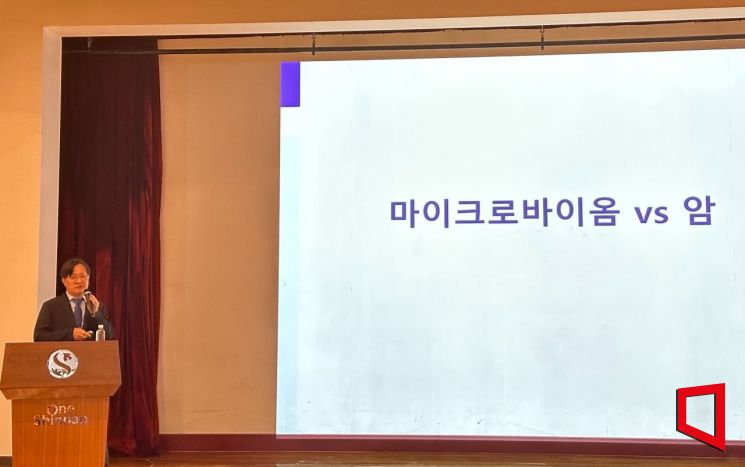 Professor Park Jin-ho of the Department of Family Medicine at Seoul National University Hospital is presenting related content at the 'Microbiome Industry Seminar' held on the afternoon of the 4th at Shinhan Investment Corp. in Yeouido, Yeongdeungpo-gu, Seoul.
 [Photo by Lee Chun-hee]
Professor Beom-Jo Oh, who gave the next presentation, suggested the potential of microbiome therapies based on his own experience. Professor Oh said, "I always get diarrhea when I take certain antibiotics," and added, "When probiotics were administered to others with similar symptoms, although there was considerable individual variation, some protective effects could be expected." He also mentioned, "My stomach hurts whenever I try to run," and stated, "I believe that diseases related to the brain, such as depression, schizophrenia, autism spectrum disorder, and Parkinson's disease, are influenced by gut microorganisms." He further noted that Parkinson's disease, being a motor nerve disorder caused by changes in neurotransmitters, has a high potential for therapy development through the microbiome.
Government Prepares 'Cross-Ministerial Support Project'... Industry Says "We Can Lead Globally"
Meanwhile, at the seminar where major industry representatives gathered, the growth potential of the microbiome therapy market was presented, and the government expressed its willingness to actively support research and development (R&D). Ji-Soo Bae, CEO of Genome & Company, said in the opening remarks, "Although the domestic bio industry is a latecomer, the biologics industry has taken the lead through bold investment," emphasizing, "The microbiome industry is also an industry where Korea can take the lead globally."
Young-Jin Song, Director of the Bio Convergence Industry Division at the Ministry of Trade, Industry and Energy, said, "Research has continued in various fields including humans, animals, and plants, and recently, interest has increased as the first new drug was approved in pharmaceuticals," adding, "Therapies have expanded from focusing on intestinal diseases to immune, anticancer, and brain diseases." He continued, "The government plans to continue expanding support," and added, "In addition to existing support projects, we are preparing a preliminary feasibility study for a cross-ministerial microbiome project and will do our best to ensure it proceeds well."
Currently, the Ministry of Trade, Industry and Energy, along with the Ministry of Science and ICT and the Ministry of Health and Welfare, are making efforts to convert the existing 'National Microbiome Initiative' into the 'Microbiome Technology Development Project for Overcoming Human Diseases' if the preliminary feasibility study does not pass, and to undergo the feasibility review again.
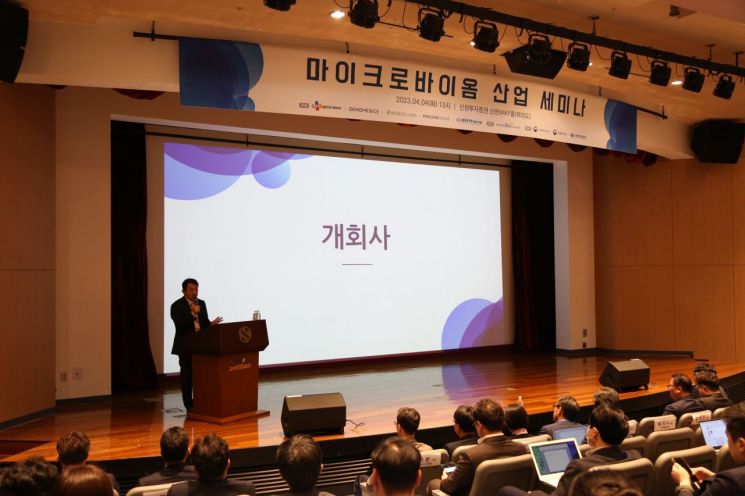 Bae Jisoo, CEO of Gnome & Company, is delivering the opening remarks at the 'Microbiome Industry Seminar' held on the afternoon of the 4th at Shinhan Investment Corp. in Yeouido, Yeongdeungpo-gu, Seoul. Photo by Korea Bio Association
Kwang-Jun Lee, Head of the Zoonotic Infectious Disease Research Division at the Korea Disease Control and Prevention Agency's Infectious Disease Research Center, stated, "Genes cannot be changed, but lifestyle and microbiome can be," emphasizing, "Changing these to overcome disease limitations is an important part of microbiome research." Regarding target diseases, he noted from R&D investment trends, "Research on endocrine, nutritional, and metabolic diseases has been steadily ongoing," and "There are also increasing cases of infectious parasitic diseases after COVID-19." However, he added, "Investment in the medical field is still insufficient," and said, "We plan to prepare support measures such as establishing standard protocols and building multidisciplinary networks so that clinical institutions can secure data and promote and support research."
© The Asia Business Daily(www.asiae.co.kr). All rights reserved.
![Clutching a Stolen Dior Bag, Saying "I Hate Being Poor but Real"... The Grotesque Con of a "Human Knockoff" [Slate]](https://cwcontent.asiae.co.kr/asiaresize/183/2026021902243444107_1771435474.jpg)

















