From Historic City to Advanced Science City Leap
Mayor Ju Nak-yeong: "A New Growth Engine"
Gyeongju, which succeeded in attracting the SMR (Small Modular Reactor) national industrial complex, is transforming from a historical and cultural city into an advanced science city.
On March 15, Gyeongju City was confirmed as the final candidate site for the SMR national industrial complex. With a project cost of 396.6 billion KRW, a 1.5 million square meter national industrial complex targeting the global nuclear power market will be established by 2030 in the Munmu Daewang-myeon area of Gyeongju.
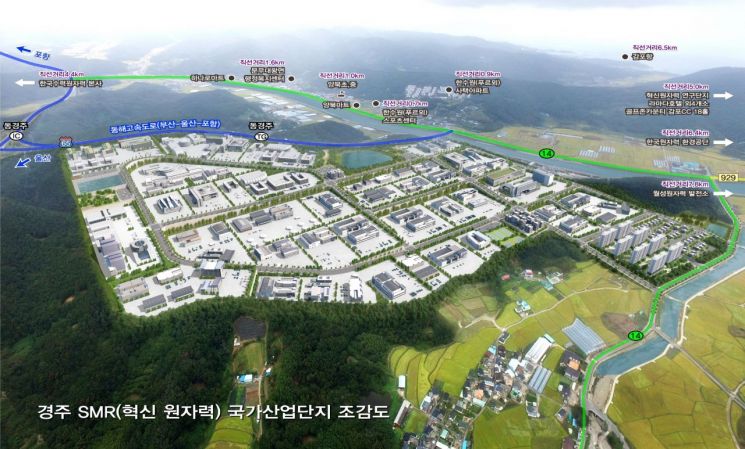
The SMR national industrial complex development project is a specialized project linked with the Munmu Daewang Science Research Institute, which will be the cradle of domestic SMR research and development, and is a key strategic project of Gyeongju City’s 8th mayoral term to create new growth engines for the region.
Gyeongju City, previously known only as a historical and cultural city, has taken an important step forward as an advanced science and industrial city by acquiring a national industrial complex centered on manufacturing.
The Small Modular Reactor (SMR) is a small reactor with a power generation capacity of less than 300 MW that enhances safety compared to existing large nuclear power plants while improving economic efficiency through modular configuration. It can be used in various fields such as hydrogen production, marine applications, and urban air mobility (UAM), and is gaining attention as an optimal power source for achieving carbon neutrality.
Additionally, it requires low initial investment and has a short construction period, enabling quick capital recovery. With technological advancements, it is also possible to reduce weight and increase power generation capacity.
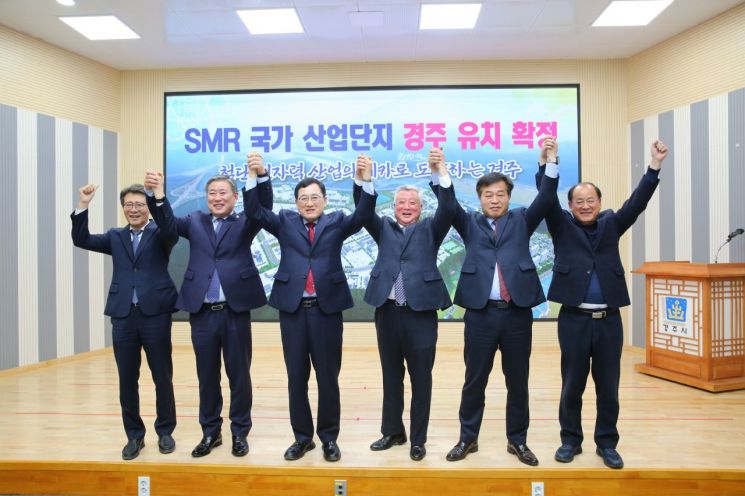 As news of the confirmed attraction of the SMR National Industrial Complex to Gyeongju was announced, Mayor Ju Nak-young, City Council Chairman Lee Cheol-woo, and Chamber of Commerce Chairman Lee Sang-geol are holding a congratulatory ceremony.
The Munmu Daewang Science Research Institute, which began construction in July 2021, was established with the goal of building an SMR innovative manufacturing cluster, and Gyeongju City strategically promoted the creation of the ‘SMR national industrial complex’ to realize this.
Gyeongju chose to attract the specialized SMR industrial complex, judging that the SMR national industrial complex would have substantial economic effects through significant job creation as a production facility for major parts and equipment modules of next-generation nuclear power plants.
In August last year, the Ministry of Land, Infrastructure and Transport announced plans to select new national industrial complex candidate sites to promote balanced national development and foster differentiated small and strong cities with the launch of the new government.
Accordingly, Gyeongju submitted a proposal in October last year and underwent a rigorous evaluation process including on-site inspections, comprehensive expert evaluations, and review by the Industrial Location Policy Committee.
In particular, to secure tenant demand, which is known as the biggest challenge in the evaluation process for new national industrial complexes, Gyeongju promoted the project to related companies nationwide, achieving an encouraging result by securing tenant demand area of 2.75 million square meters from 225 companies including large corporations.
Starting with a feasibility study for attracting the SMR national industrial complex in September last year, Gyeongju signed business cooperation agreements with four institutions including the Korea Atomic Energy Research Institute for the next-generation power system ‘Supercritical CO2 power generation technology,’ and in October, signed cooperation agreements with six institutions including Pohang University of Science and Technology and Korea Hydro & Nuclear Power for ‘Gyeongju SMR National Industrial Complex Attraction Cooperation.’
In February this year, Gyeongju established cooperative governance with various related organizations, including nine institutions such as major shipping companies HMM and Janggeum Shipping, signing a business cooperation agreement for ‘Nuclear-powered ships and marine system technology development,’ laying the groundwork for entering the SMR market.
The SMR national industrial complex will be developed by 2030 near the Donggyeongju IC area in Munmu Daewang-myeon.
Gyeongju City plans to create an industrial ecosystem by differentiating integrated manufacturing and future innovative nuclear industry platforms based on the SMR research and development and production national innovation cluster.
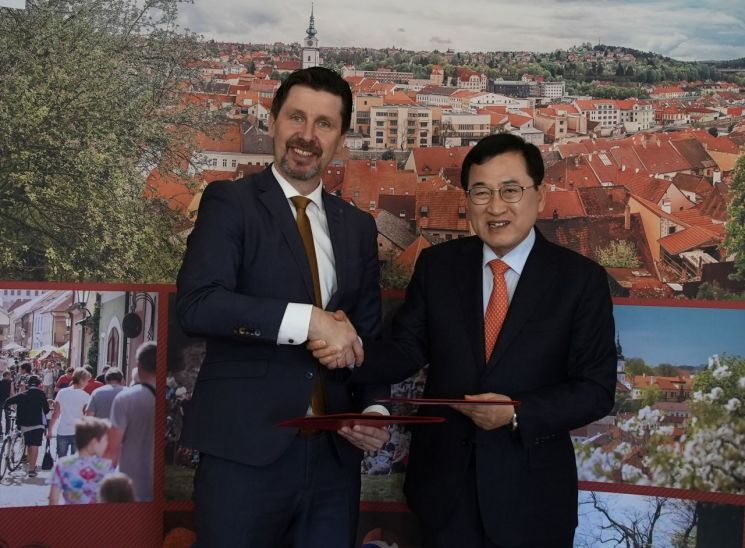 Mayor Joo Nak-young (right in the photo), who visited the Czech Republic on the 17th of last month to promote nuclear power sales, signed a letter of intent for friendly cooperation with Pavel Pakal, Mayor of Trebic, Czech Republic, at the city hall.
In addition, linked with the SMR research and development at the Munmu Daewang Science Research Institute, scheduled for completion in 2025, the city plans to foster SMR manufacturing and the materials, parts, and equipment (SoBuJang) industry, and through the agglomeration of related companies, it is expected to become a core hub of the nation’s next-generation nuclear industry.
The industrial complex will house 23 core industries including nuclear power, electric power industry, nuclear power plant dismantling, and research and development services, as well as 29 related industries such as green energy, materials and parts, and electrical equipment.
The economic ripple effect is also significant. According to recent research conducted by Gyeongju City, the economic ripple effects induced by the SMR national industrial complex are 730 billion KRW in production inducement effect, 341 billion KRW in value-added inducement effect, and 5,399 jobs created. After the industrial complex is established and operational, the production inducement effect is expected to reach 6.7357 trillion KRW, and employment inducement effect 22,779 jobs.
Now, with six nuclear power plants, Korea Hydro & Nuclear Power, Korea Radioactive Waste Agency, the Munmu Daewang Science Research Institute currently under construction, the Heavy Water Reactor Dismantling Technology Institute, and the SMR national industrial complex, Gyeongju will emerge as a genuine mecca of the nuclear industry.
Designation and operation of a national industrial complex take a long time. To quickly realize the ripple effects as regional economic revitalization, the designation and operation of the national industrial complex must be expedited.
Administrative procedures such as preliminary feasibility studies, environmental impact assessments, and consultations with related ministries are required for the future development of the industrial complex.
On the 31st of last month, stakeholders related to the national industrial complex candidate sites gathered at the Government Sejong Convention Center to hold a pan-government task force Kick-off meeting.
First, Gyeongju City plans to promptly proceed with negotiations for selecting the project implementer targeting public institutions such as LH in the first half of this year, and concurrently attract tenant companies including applying for preliminary feasibility studies by the first half of next year.
After applying for and obtaining approval for the industrial complex, the city plans to focus administrative efforts to ensure that all administrative procedures proceed quickly with the goal of starting construction in 2026.
The total project period, including completion of tenant companies’ move-in, is until 2030, but the city is determined to complete administrative procedures in the shortest possible time to accelerate the project and create synergy for early development.
In particular, efforts will be made to create residential conditions such as attracting autonomous high schools and comfortable residential complexes so that workers can have a comfortable and happy working life in the region.
Mayor Joo Nak-young visited Trebic City in the Czech Republic starting on the 16th, the day after Gyeongju was designated as a national industrial complex candidate site, to promote nuclear power sales. As the mayor of a city with six nuclear power plants, he personally promoted the safety of Korean nuclear power to support Korea Hydro & Nuclear Power in securing nuclear power orders.
Mayor Joo Nak-young said, “SMR is a savior and new growth engine that will boost our country’s economy, which is facing a crisis due to the stagnation of key industries such as semiconductors, automobiles, and steel,” and added, “We will do our best to speed up follow-up measures and create an industrial ecosystem that leads regional innovative growth.”
© The Asia Business Daily(www.asiae.co.kr). All rights reserved.
![Clutching a Stolen Dior Bag, Saying "I Hate Being Poor but Real"... The Grotesque Con of a "Human Knockoff" [Slate]](https://cwcontent.asiae.co.kr/asiaresize/183/2026021902243444107_1771435474.jpg)

















