Each Company "Let's Not Steal Local Customers" Collusion
Criticism Intensifies Amid Power Rate Hike
The Japan Fair Trade Commission uncovered collusion among major electric power companies in Japan and imposed a record-high fine of 100 billion yen (approximately 980 billion won). The Ministry of Economy, Trade and Industry also joined in by taking measures such as suspending subsidy payments. Amid worsening public opinion due to recent demands by Japanese electric power companies for electricity rate hikes, the government appears to have taken a firm stance after uncovering unfair practices.
According to NHK on the 3rd, the Ministry of Economy, Trade and Industry announced that it would suspend subsidy payments and bidding for six companies, including Chubu, Kansai, Kyushu, Chugoku Electric Power, and subsidiaries of Kyushu Electric Power. This is a follow-up government action following the Fair Trade Commission's order. Earlier, the Japan Fair Trade Commission ordered these companies to be excluded from related business activities and to pay a fine of 100 billion yen for violating the Antimonopoly Act. This is the highest amount ever ordered by the Fair Trade Commission in fines.
It was revealed that they formed a cartel restricting each other from acquiring new customers for business-use electricity sales to office buildings and factories. They divided the regions where electricity is supplied to prevent each other from operating in overlapping areas and conspired to limit participation from other companies to avoid bidding competition. The Fair Trade Commission stated, "This is a malicious cartel that goes against the purpose of liberalization."
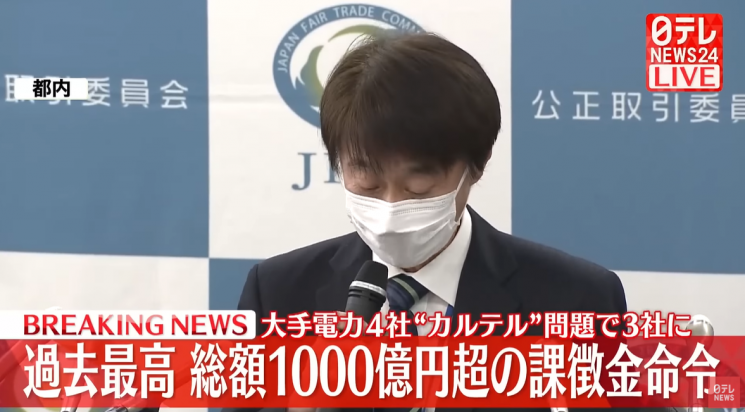 The Japan Fair Trade Commission announced on the 30th that it imposed a fine of 100 billion yen on a cartel of major electric power companies. (Photo by Nittere)
This collusion appears to have occurred due to competition with new retail-only electric power companies that supply electricity at low prices. In 2016, Japan liberalized "electricity retail" to prevent large electric power companies from monopolistically supplying electricity in regions. As a result, retail-only electric power companies emerged that purchase electricity from power generation companies at wholesale prices and supply it to households and businesses at lower prices.
In addition to monopoly allegations, it was also revealed that major electric power companies improperly accessed customer information of new retail-only electric power companies and other competitors. The Ministry of Economy, Trade and Industry imposed suspension of subsidy payments and bidding disqualification on five companies, including Kansai Electric Power and Kyushu Electric Power, in response.
In Japan, where privatization has already made electricity rate hikes a problem, voices demanding structural reforms are growing louder. On the 30th, conscious of public opinion, the president and chairman of Chugoku Electric Power resigned together, taking responsibility. The Chugoku Shimbun editorial criticized, "The cartel among electric power companies is practically equivalent to an electricity rate increase," and added, "Regional companies that should receive electricity at low prices in line with the purpose of privatization have also been harmed."
© The Asia Business Daily(www.asiae.co.kr). All rights reserved.
![Clutching a Stolen Dior Bag, Saying "I Hate Being Poor but Real"... The Grotesque Con of a "Human Knockoff" [Slate]](https://cwcontent.asiae.co.kr/asiaresize/183/2026021902243444107_1771435474.jpg)
















