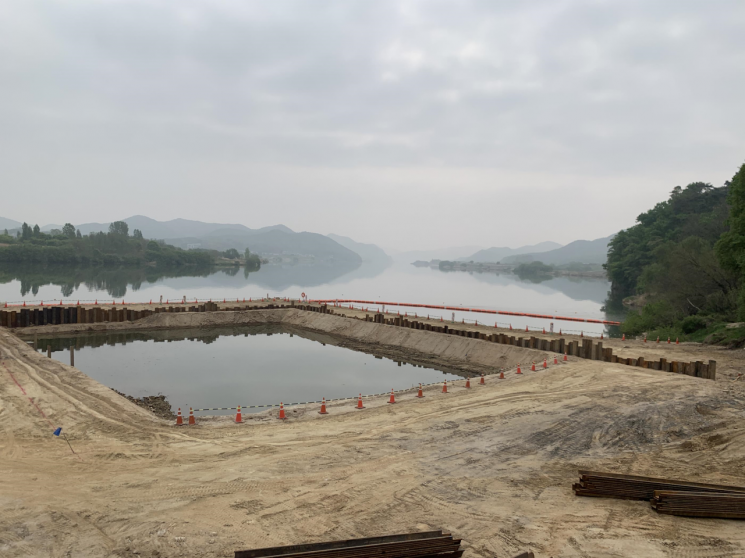
Gyeonggi Province has designated the period from April to October as the comprehensive drought countermeasure period to prepare for droughts such as shortages of agricultural and domestic water.
The province will first operate a continuous monitoring system in cooperation with 31 cities and counties during the countermeasure period according to the drought crisis alert response standards.
The response standards are divided into four stages: ▲Interest stage when the cumulative rainfall over the past six months is about 65% or less of the average ▲Caution stage when water shortages are expected during periods of high water demand such as the farming season with 55% or less ▲Warning stage at 45% or less ▲Severe stage when 45% or less continues for more than 20 days causing drought or concerns about large-scale damage.
As an agricultural water countermeasure, the province will continuously manage rainfall and reservoir levels to ensure stable water supply during the farming season and establish a cooperative system with Gyeonggi Province, cities and counties, and the Korea Rural Community Corporation in case of drought occurrence.
Additionally, to address agricultural water shortages, the province will actively promote special measures for the farming year and surface water reinforcement development to newly install or reinforce pumping stations and intake weirs (weirs installed across rivers to raise water levels when river levels are low to facilitate water pumping) before the farming season in affected areas.
For domestic water countermeasures, the province will cooperate with the Han River Basin Environmental Office, Korea Water Resources Corporation, and cities and counties to respond to water supply accidents. In vulnerable water supply areas such as Yongin City and seven other cities and counties relying on groundwater, islands, and mountainous regions, the province will support 3.2 billion KRW to promote local water supply system expansion projects. In six cities and counties including Gwangju City, the province will provide 16.5 billion KRW to install 127.7 km of pipelines.
Han Young-jo, Director of the Natural Disaster Division of the province, emphasized, "Currently, indicators such as reservoir and dam water levels are favorable, but due to severe monthly rainfall fluctuations caused by climate change, meticulous drought preparedness is necessary. We will proactively implement drought prevention measures that can operate on-site to ensure that residents do not experience inconvenience in their farming preparations and daily lives."
Meanwhile, the province's own analysis shows that rainfall in the province from January to March this year was 46.3 mm, which is 20.8 mm less than the average rainfall (67.1 mm). The province expects rainfall in April and May to be similar to or less than the average.
© The Asia Business Daily(www.asiae.co.kr). All rights reserved.
![Clutching a Stolen Dior Bag, Saying "I Hate Being Poor but Real"... The Grotesque Con of a "Human Knockoff" [Slate]](https://cwcontent.asiae.co.kr/asiaresize/183/2026021902243444107_1771435474.jpg)
















