Gallup Poll Released Today
People Power Party and Democratic Party Tied at 33% Support Rate
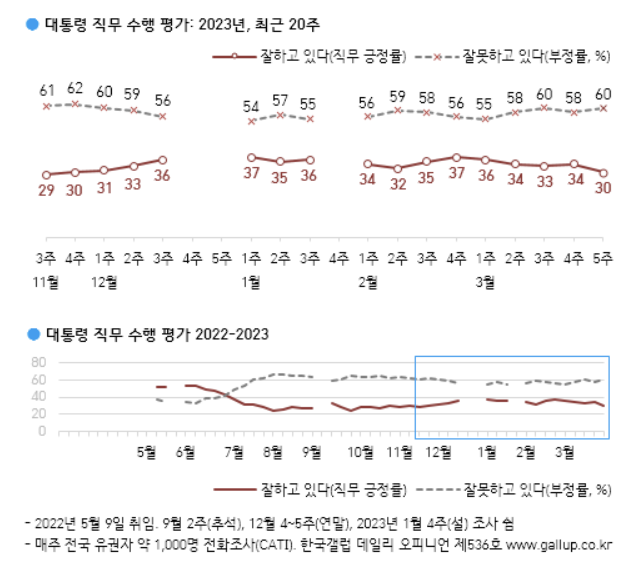
President Yoon Suk-yeol's approval rating for his administration has declined, barely maintaining the 30% mark. The drop in approval is analyzed to be due to worsening public opinion regarding Japan-South Korea relations, including the Japan-South Korea summit.
According to Gallup's regular public opinion survey conducted from the 28th to the 30th (a telephone interview survey of 1,000 adults aged 18 and over nationwide), the positive evaluation of President Yoon's job performance, defined as "doing well in presidential duties," recorded 30%, down 4 percentage points from the previous week. This is the lowest level since the third week of November last year (29%).
The negative evaluation of job performance rose 2 percentage points from the previous survey to 60%.
Issues such as the trilateral compensation method for forced labor by Japan and the Japan-South Korea summit have acted as negative factors for President Yoon's approval rating. Since the second week of March, after proposing a solution for forced labor compensation, mentions of Japan and diplomatic relations have ranked highest among both positive and negative reasons for evaluating the president's job performance.
When asked the reasons for their positive evaluation of the president's job performance (304 respondents), 12% mentioned "diplomacy," 9% mentioned "labor union response," and 9% mentioned "improvement in Japan relations." Conversely, among those with a negative evaluation (595 respondents), 21% cited "diplomacy," 20% cited "Japan relations and forced labor compensation issues," and 8% cited "economy, livelihood, and prices" as problems. Among the responses to this open-ended question, a new answer appeared: "damage to national dignity and embarrassment to the country" (1%).
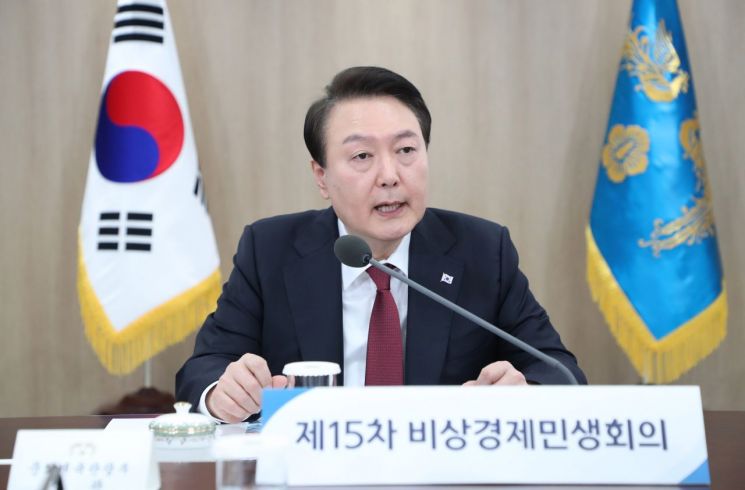
Since the government announced the trilateral compensation plan for victims of forced labor under Japanese rule on the 6th, followed by President Yoon's visit to Japan and the Japan-South Korea summit on the 16th and 17th, controversies over Japanese textbook historical distortion and Fukushima contaminated water and seafood have continued this week. In particular, regarding the Japan-South Korea summit, related follow-up reports by Japanese media on Dokdo and Fukushima seafood have continued, while the South Korean government repeatedly denied the content of those reports. Additionally, controversies surrounding the sudden replacement of former National Security Office chief Kim Sung-han have newly emerged, making diplomatic issues a factor hindering President Yoon's approval rating.
Notably, in this survey, only 13% of respondents in their 20s (aged 18-29) gave a positive evaluation of President Yoon's job performance. Considering that public opinion among people in their 20s fluctuated between the high teens and low 20s throughout March, the response has turned cold. Among the centrist group, which holds the casting vote in public opinion, 25% responded that the administration is performing well, while 61% said it is performing poorly.
According to Gallup's weekly public opinion survey-based compilation of the 13th president's first-year fourth-quarter job evaluation, President Yoon's average approval rating was 34%, ranking lower than former President Roh Moo-hyun (22%, recorded on December 30, 2003) and former President Lee Myung-bak (32%, recorded in December 2008). The previous president, Moon Jae-in, recorded 68% on average from January to March 2018.
In party support, the Democratic Party of Korea fell 2 percentage points from the previous survey, and the People Power Party dropped 1 percentage point, both recording 33%. The proportion of respondents with no party affiliation was 29%.
For detailed survey methodology and results related to this public opinion poll, please refer to the website of the Central Election Survey Deliberation Commission.
© The Asia Business Daily(www.asiae.co.kr). All rights reserved.
![Clutching a Stolen Dior Bag, Saying "I Hate Being Poor but Real"... The Grotesque Con of a "Human Knockoff" [Slate]](https://cwcontent.asiae.co.kr/asiaresize/183/2026021902243444107_1771435474.jpg)
















