Although the easing of inflationary pressures in Europe, including Germany?the largest economy in the Eurozone (20 countries using the euro)?has been reconfirmed, the European Central Bank (ECB) is expected not to loosen its tightening stance. This is due to the fact that the real policy interest rate remains the lowest among major countries and core inflation pressures are still considered worrisome. Since last year, the ECB has sharply raised interest rates but now faces the difficulty of battling another risk: the possibility of a financial crisis triggered by fears of bank insolvency.
On the 30th (local time), Germany’s Federal Statistical Office announced that the preliminary consumer price index (CPI) inflation rate for March was 7.8%, significantly down from 9.3% in the previous month. This figure is higher than the Wall Street consensus forecast of 7.5% compiled by Bloomberg News, influenced by a sharp drop in energy inflation from 19.1% in February to 3.5% in March. According to Bloomberg Economics, the core CPI, which excludes energy and food prices, rose to 5.7% from 5.4% the previous month. The outlook for core inflation is not positive either. Martin Edemmer, a Bloomberg economist, stated, "Core inflation pressures in Europe’s largest economy remain at a worrying level," and predicted that "core CPI could rise until this summer."
Experts expect that the ECB will maintain its tightening stance at the next meeting, given that Germany’s core inflation has yet to subside. Silvia Ardagna, an economist at Barclays UK, said, "Core inflation remains persistently high," and forecasted that a rate hike would be inevitable at the monetary policy meeting in May. The ECB, which had kept rates at 0% for a long time, raised its benchmark rate by 0.5 percentage points in July last year and has since increased rates six consecutive times. At the previous meeting, the ECB raised the benchmark rate by 0.5 percentage points to 3.5% annually. On the day before the meeting, fears of bank insolvency originating in the US spread to Europe, fueling bankruptcy rumors about Swiss investment bank Credit Suisse (CS). Nevertheless, the ECB prioritized taming inflation and implemented a big rate hike.
The Eurozone’s real policy interest rate remains the lowest among major countries except Japan, and unlike the US, Canada, and the UK, the Eurozone is not yet considered to have entered the late phase of the tightening cycle. This is partly because the Eurozone’s rate hikes have lagged behind those of neighboring countries. Based on the US Federal Reserve’s (Fed) experience, the market expects the first directional shift when core inflation peaks, leaving open the possibility of further rate hikes until the third quarter. Bloomberg noted, "Since the peak of core inflation has not been confirmed, it is difficult to predict when the tightening cycle will end."
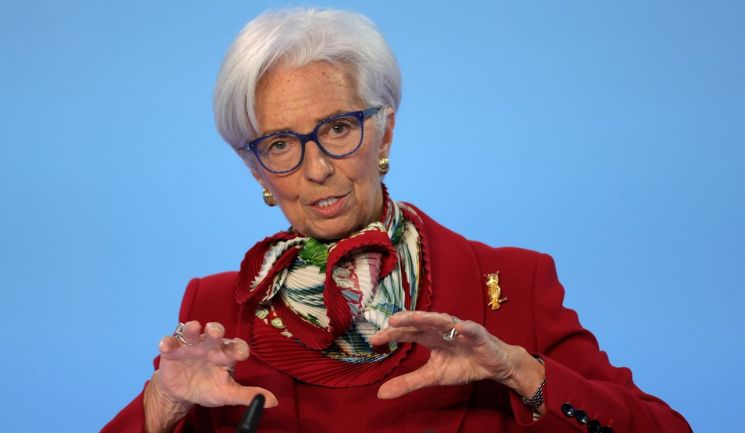
However, the bankruptcy of the mid-sized US bank Silicon Valley Bank (SVB) has rapidly spread fears of a "bankdemic" (bank + pandemic) to large European banks and US securities firms, complicating the ECB’s calculations regarding monetary tightening. The global financial turmoil is leading to credit tightening, increasing the risk of an economic recession. The crisis theory that the current situation could escalate to the level of the 2008 financial crisis has sharply increased uncertainty around the ECB’s monetary policy. Peter Kazimir, European Union (EU) Commissioner, recently said, "There is a real risk that banks will reduce lending due to financial turmoil amid high interest rates," and added, "The ECB may need to slow the pace of rate hikes."
Nonetheless, within the ECB, there is a strong sentiment not to assume that the current crisis will spread to a systemic risk in the Eurozone but to focus on inflation. The ECB has decided to prioritize price stability amid the dual challenges of financial stability and inflation. Isabel Schnabel, the most hawkish member of the ECB Executive Board, emphasized, "Core inflation has proven to be higher and more persistent than expected," and stated that easing inflationary pressures will be the top priority. Even Philip Lane, the ECB’s chief economist who is considered neutral, said, "If financial tensions cause the economy to contract, inflationary pressures will naturally decrease," but added, "More rate hikes may be necessary going forward."
© The Asia Business Daily(www.asiae.co.kr). All rights reserved.
![Clutching a Stolen Dior Bag, Saying "I Hate Being Poor but Real"... The Grotesque Con of a "Human Knockoff" [Slate]](https://cwcontent.asiae.co.kr/asiaresize/183/2026021902243444107_1771435474.jpg)
















