Martial Arts 'Comparison and Implications of Domestic and International Companies' Digital Transformation Capabilities' Presentation
The level of digital transformation among domestic companies was found to be 1 to 1.5 stages behind that of overseas companies. In particular, the adoption rate among domestic mid-sized and small-to-medium enterprises (SMEs) was low, prompting advice for government policy support.
The Korea International Trade Association (KITA) announced a report titled "Comparison of Digital Transformation Capabilities of Domestic and Overseas Companies and Implications" on the 30th. This report was based on the results of a digital transformation survey conducted on domestic and overseas companies. A total of 515 domestic companies and 123 overseas companies responded.
According to the survey results, domestic companies were found to be 1 to 1.5 stages behind overseas companies in terms of digital transformation level. Among the five stages of digital transformation (Preparing → Starting Adoption → Applying → Settling → Actively Progressing), overseas companies mostly responded with ▲Settling (36.6%) ▲Applying (27.6%) ▲Actively Progressing (23.6%). In contrast, only 3.5% of domestic companies answered 'Actively Progressing.' The majority belonged to ▲Applying (39.8%) ▲Starting Adoption (26.0%) ▲Preparing (22.9%).
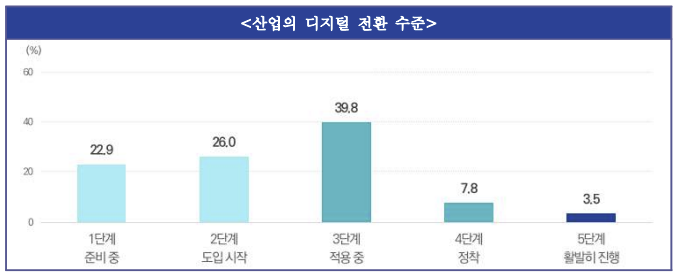 Graph of responses on the level of digital transformation of domestic companies / [Image source=Korea International Trade Association]
When dividing the digital transformation progress into five stages (Not progressing at all → Started but progressing slowly → Average → Somewhat progressing → Progressing very well), the gap between SMEs and large companies was found to be 1.5 to 2 stages. The largest proportion of large companies answered that digital transformation was 'Somewhat progressing (43.1%).' The smaller the company size, the more responses indicated 'Not progressing at all,' due to the lack of dedicated digital transformation organizations and personnel.
KITA pointed out that since digital transformation requires massive capital and time investment, government policy support is necessary for domestic SMEs and mid-sized companies that lack sufficient resources. Jung Manki, Vice Chairman of KITA, said, "We will actively discover successful innovation cases related to digital transformation and spread them to mid-sized and small-to-medium enterprises," adding, "We will continue to monitor the digital transformation status of our companies and provide consulting services."
© The Asia Business Daily(www.asiae.co.kr). All rights reserved.
![Clutching a Stolen Dior Bag, Saying "I Hate Being Poor but Real"... The Grotesque Con of a "Human Knockoff" [Slate]](https://cwcontent.asiae.co.kr/asiaresize/183/2026021902243444107_1771435474.jpg)















