Prime Minister Han Deok-su's Public Persuasion on the "Grain Management Act"... "Recommended Presidential Veto"
Prime Minister Han Duck-soo issued an unprecedented public statement on the 29th, sharply criticizing the 'Grain Management Act' that the opposition party pushed through the plenary session with a majority of seats. He referred to the Grain Management Act as the 'Forced Purchase of Surplus Rice Act,' stating that it was already opposed during the previous administration and is a failed policy overseas, officially recommending that the president exercise the veto power.
The amended Grain Management Act, which passed the National Assembly on the 23rd, stipulates that when the surplus rice production exceeds 3-5% of demand or rice prices fall by 5-8% compared to the previous year, the government will purchase the entire surplus production. On the 23rd, the National Assembly passed the amendment to the Grain Management Act led by the Democratic Party of Korea in the plenary session, with 169 votes in favor, 90 against, and 7 abstentions.
The ruling party and government have consistently opposed the amendment due to concerns over rice oversupply and fiscal burden. Prime Minister Han's statement on this day is interpreted as a step to highlight the problems of the Grain Management Act amendment based on discussions immediately after the ruling party-government meeting, emphasizing and persuading the public on the necessity of exercising the veto power.
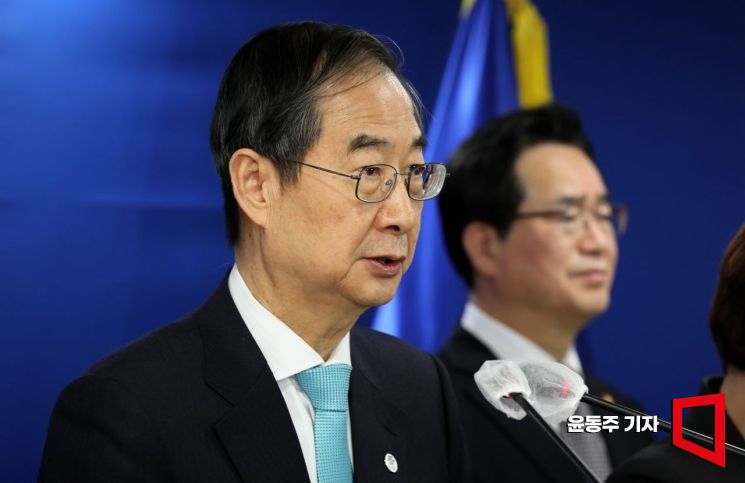 Prime Minister Han Duck-soo is delivering a public address regarding the 'Amendment to the Grain Management Act' at the Government Seoul Office in Jongno-gu, Seoul, on the 29th. Photo by Yoon Dong-joo doso7@
In the statement delivered at the joint briefing room of the Government Seoul Office Complex in the afternoon, Prime Minister Han said, “The government intends to recommend to the president the request for reconsideration (veto) of the Grain Management Act amendment to protect the development of our rice industry and the future of agriculture.” He added, “Issues related to the people's livelihood, agriculture, rural areas, and farmers' lives should not be pursued for political gain,” and said, “The amendment does not benefit anyone. The government cannot take a path destined to fail.”
In the eight-page statement, Prime Minister Han pointed out the harms the Grain Management Act would bring in detail. Using phrases such as “populist policy that goes against market principles,” “pursuing it again as if what was wrong then is right now,” and “forced purchase of surplus rice,” he expressed strong opposition.
He said, “The amendment paralyzes the market's supply and demand adjustment function, and the damage will fall entirely on farmers.” He added, “Currently, the government implements 'rice market isolation' by purchasing surplus rice when prices plummet due to repeated overproduction, but this measure should be carried out only at a minimal level in urgent situations where the market cannot function properly.”
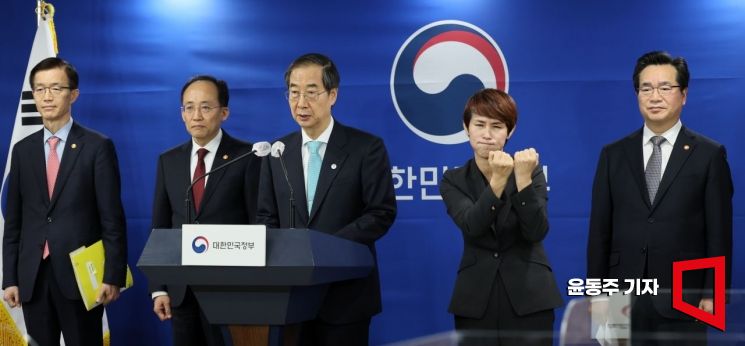 Prime Minister Han Duck-soo is delivering a public address regarding the 'Amendment to the Grain Management Act' at the Government Seoul Office in Jongno-gu, Seoul, on the 29th. Photo by Yoon Dong-joo doso7@
Prime Minister Han particularly stated, “Purchasing rice unconditionally and permanently despite surplus further undermines the market's supply and demand adjustment function. Oversupply will worsen, and prices will fall further.” He cited a Rural Economy Institute study predicting that if the amendment is implemented, the current surplus of 230,000 tons will exceed 630,000 tons by 2030, and rice prices will fall to the low 170,000 won range.
He continued, “The damage will be borne entirely by farmers, especially small-scale farmers who will suffer the most,” and said, “Contrary to the stated purpose of stabilizing rice prices and protecting farmers, the amendment will drive our agriculture toward ruin.”
Prime Minister Han also criticized that the amendment will eliminate resources that should be invested in future agriculture. He said, “The fiscal burden from the amendment exceeds 1 trillion won annually, which could instead create 300 advanced smart farms, nurture 3,000 young venture farmers, and cultivate 50,000 talents to lead the future of rural areas,” adding, “Storing surplus rice in government warehouses for years and then disposing of it for alcohol or feed at prices one-fifth or one-tenth of the market value is a waste of taxpayers' money.”
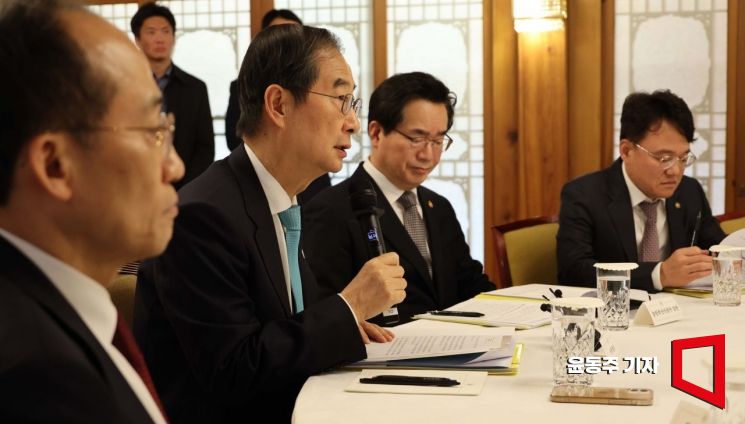 Prime Minister Han Duck-soo is speaking at the party-government meeting on the Grain Management Act held at the Prime Minister's official residence in Jongno-gu, Seoul on the 29th. Photo by Dong-joo Yoon doso7@
He also directly criticized the opposition party, saying, “This amendment was already opposed during the previous administration for the same reasons,” and added, “Pursuing it again as if ‘what was wrong then is right now’ is unfair to the taxpayers.”
He mentioned overseas failures as well. “In the 1960s, Europe implemented price guarantees but eventually stopped due to side effects such as increased production and decreased farm income from price drops. Thailand also implemented price intervention policies in 2011 but abolished them after three years due to supply-demand control failures and excessive fiscal burdens,” he said, emphasizing, “Populist policies that go against market principles can never succeed.” He noted, “Farmer organizations such as the Korea Federation of Agricultural Cooperatives and the Rice Farmers Association have voiced opposition to the bill,” and stressed, “Given these circumstances, it is very regrettable that the 'Grain Management Act amendment' was unilaterally processed in the National Assembly.”
In conclusion, Prime Minister Han said, “I earnestly ask the National Assembly, the agricultural sector, and the public to understand that the decision to request a veto is a determination made for the national interest, farmers, and to take the right path.”
© The Asia Business Daily(www.asiae.co.kr). All rights reserved.
![Clutching a Stolen Dior Bag, Saying "I Hate Being Poor but Real"... The Grotesque Con of a "Human Knockoff" [Slate]](https://cwcontent.asiae.co.kr/asiaresize/183/2026021902243444107_1771435474.jpg)

















