Prime Minister Han Deok-su: "The Grain Management Act Was Already Opposed by Previous Government"
"It's Not the People's Duty to Re-push It as 'Wrong Then, Right Now'"
Prime Minister Han Duck-soo on the 29th officially announced the exercise of the presidential veto power, stating, "I will recommend to the President to request a reconsideration of the 'Rice Management Act Amendment' to protect the development of our rice industry and the future of agriculture."
Prime Minister Han said, "As a result of today's ruling party and government consultation, we agreed that it is appropriate to inform the public about the adverse effects of this bill and to request reconsideration from the National Assembly."
In an eight-page public statement released at the joint briefing room of the Government Seoul Office Building in the afternoon, Prime Minister Han strongly opposed the Rice Management Act pushed by the opposition party, describing it as a "populist policy that goes against market principles," "re-pursuing it with the attitude of 'it was wrong then but right now'," and "a forced purchase law for surplus rice."
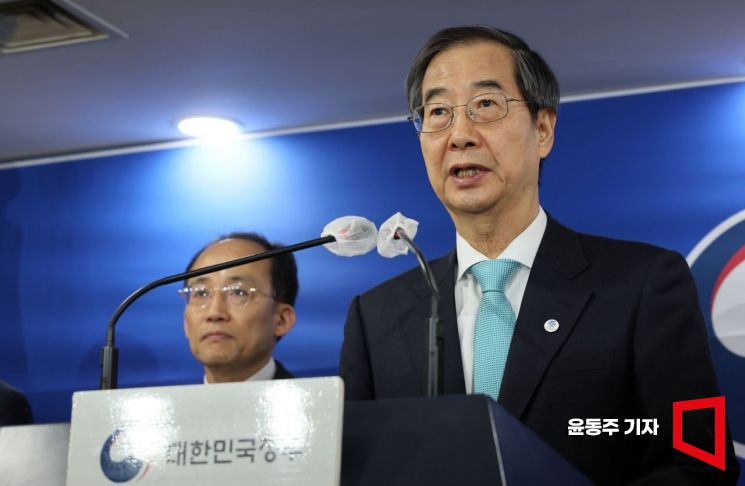 Prime Minister Han Duck-soo is delivering a public address regarding the 'Amendment to the Grain Management Act' at the Government Seoul Office in Jongno-gu, Seoul, on the 29th. Photo by Yoon Dong-joo doso7@
Prime Minister Han criticized the Rice Management Act, saying, "The government has continuously explained the problems and side effects, and agricultural and farmers' organizations also opposed it, but it was unilaterally processed in the National Assembly, which is regrettable."
He emphasized, "If rice is purchased unconditionally despite surplus, the market's supply and demand adjustment function will be further weakened, leading to oversupply and a decline in rice prices." Citing research from the Korea Rural Economic Institute, he predicted that if the amendment is implemented, the current surplus of 230,000 tons will exceed 630,000 tons by 2030, and rice prices will fall to the low 170,000 won range.
Prime Minister Han pointed out, "The financial burden due to the amendment will exceed 1 trillion won annually, and if resources that should be used to strengthen agricultural competitiveness and nurture young farmers are poured into purchasing surplus rice, rural innovation will become even harder to achieve."
He also said, "The era of considering food security based solely on rice is over," adding, "Expanding domestic production of crops like wheat and soybeans, which are absolutely dependent on overseas imports, is a decision for the entire nation and farmers." Prime Minister Han emphasized, "Issues related to people's livelihoods and the lives of agriculture and rural areas should not be pursued for political gain."
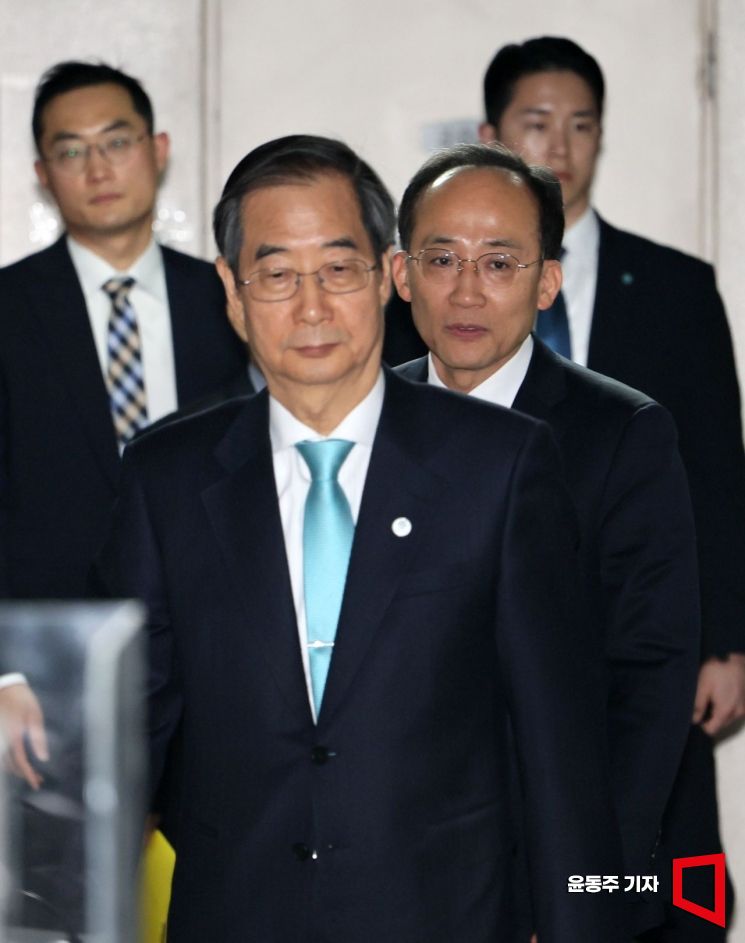 Prime Minister Han Duck-soo is entering the press conference room at the Government Seoul Office in Jongno-gu, Seoul, on the 29th to deliver a public address regarding the "Amendment to the Grain Management Act." Photo by Yoon Dong-joo doso7@
Prime Minister Han particularly stressed regarding the Rice Management Act, "Populist policies that go against market principles can never succeed." He criticized, "This amendment was already opposed by the previous government for the same reasons," and said, "Re-pursuing it with the attitude of 'it was wrong then, but right now' is unfair to the taxpayers."
The Rice Management Act amendment, which passed the National Assembly on the 23rd, stipulates that when the surplus production of rice exceeds 3-5% of demand or rice prices fall by 5-8% compared to the previous year, the government will purchase all surplus production.
The ruling party and government have consistently opposed the amendment, expressing concerns about rice oversupply and fiscal burden. President Yoon Suk-yeol requested on the 27th during a regular meeting with Prime Minister Han to "gather opinions between the ruling party and government."
Before Prime Minister Han's statement, the ruling party and government held a consultation on the Rice Management Act at 3 p.m. at the Prime Minister's official residence in Samcheong-dong, Seoul. Prime Minister Han's statement is interpreted as a step emphasizing the necessity of exercising the veto power by pointing out the problems of the Rice Management Act amendment based on the discussions immediately after the ruling party and government meeting.
© The Asia Business Daily(www.asiae.co.kr). All rights reserved.
![Clutching a Stolen Dior Bag, Saying "I Hate Being Poor but Real"... The Grotesque Con of a "Human Knockoff" [Slate]](https://cwcontent.asiae.co.kr/asiaresize/183/2026021902243444107_1771435474.jpg)
















