Complete remission in 1 patient and partial remission in 1 patient confirmed
"Encouraging results at an early stage"
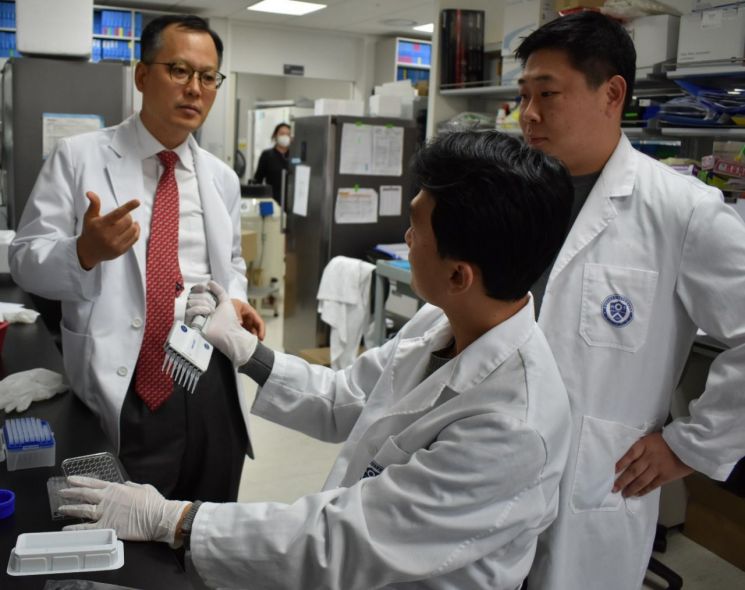 GI Innovation's immuno-oncology drug 'GI-101' clinical chief investigator Byungchul Cho, head of the Lung Cancer Center at Yonsei Cancer Hospital, discussing with the research team.
 [Photo by GI Innovation]
GI Innovation announced on the 29th that it has achieved one confirmed complete response (CR) and one partial response (PR) in the Phase 1/2 monotherapy clinical trials of its immuno-oncology drug 'GI-101 (GII-101-P101, KEYNOTE-B59)'.
These results come from an early clinical setting involving patients with terminal solid tumors who had failed all existing standard treatments and were receiving the drug as a fourth or fifth line therapy or beyond. The company explained, "This demonstrates not only strong anticancer activity as a single agent but also potential as a combination therapy with existing anticancer drugs." Currently, the GI-101 clinical trials have enrolled a total of 81 patients with advanced and metastatic solid tumors?56 in monotherapy and 25 in combination therapy with Keytruda?and the Phase 2 trial is ongoing.
In the Phase 1/2 monotherapy trials of GI-101, among the 56 patients enrolled so far, tumor evaluation was completed in 39 patients, showing CR in cervical cancer, PR in urothelial carcinoma, and a -38.3% reduction in target tumor size in MSS colorectal cancer patients, whose response rate to immuno-oncology drugs is known to be around 1%.
A GI Innovation representative stated, "It is rare to observe CR and PR cases in monotherapy trials, especially at an early stage," and added, "It is encouraging that CR and PR cases were observed in patients who had failed existing treatments and were receiving fourth or fifth line therapies or beyond." They further noted, "The MSS colorectal cancer patient with confirmed tumor reduction is also expected to achieve a PR case, and there remains the possibility of remission cases emerging in other patients."
The CR case involved a pMMR and HER2-negative cervical cancer patient who had failed standard treatments. After two doses of GI-101 administered at three-week intervals, all lesions disappeared and no new lesions were observed for more than four weeks, confirming CR. The patient is currently undergoing treatment.
The PR case was observed in a urothelial carcinoma patient who was unresponsive to immuno-oncology drugs. After two doses administered at three-week intervals, the target tumor shrank by -33.3%, and subsequently continued to decrease to -46.6%. The patient continued treatment for about five months. GI Innovation also highlighted the MSS colorectal cancer patient case. MSS colorectal cancer, classified as a representative "cold tumor" and known to be unresponsive to immuno-oncology monotherapy with a response rate of about 1%, showed a target tumor reduction of -38.3%. Although new lesions appeared, the patient has been receiving GI-101 monotherapy for nearly a year.
Regarding adverse reactions, GI-101 did not induce dose-limiting toxicities or severe adverse events such as vascular leak syndrome up to a dose of 0.3 mg/kg in the Phase 1/2 monotherapy trials.
Dr. Byung-Chul Cho, the principal investigator of the clinical study and head of the Lung Cancer Center at Yonsei Cancer Hospital, said, "Early clinical trials recruit patients who have failed all existing treatments, so it is very difficult to observe objective responses (OR) with monotherapy alone. Especially, cases achieving CR with monotherapy are very rare, so these CR and PR cases are very encouraging." He added, "Not only the OR cases but also the confirmed tumor reduction in MSS colorectal cancer patients, whose response rate to immuno-oncology drugs is around 1%, demonstrates clear anticancer activity of the monotherapy. This is a meaningful result that aligns with the trend of global pharmaceutical companies focusing on the efficacy of monotherapy for combination therapies."
Jang Myung-ho, head of new drug development and clinical strategy at GI Innovation, said, "GI-101's Phase 2 monotherapy trial, planned for 40 terminal cancer patients, has rapidly enrolled 30 patients in about two months, indicating fast progress in the clinical trial," and added, "We believe this reflects the expectations of the participating clinical investigators regarding the anticancer activity of GI-101."
© The Asia Business Daily(www.asiae.co.kr). All rights reserved.
![Clutching a Stolen Dior Bag, Saying "I Hate Being Poor but Real"... The Grotesque Con of a "Human Knockoff" [Slate]](https://cwcontent.asiae.co.kr/asiaresize/183/2026021902243444107_1771435474.jpg)
















