Daejeon City is taking steps to improve habitual congestion sections within the city and eradicate the unauthorized abandonment of Personal Mobility (PM) devices.
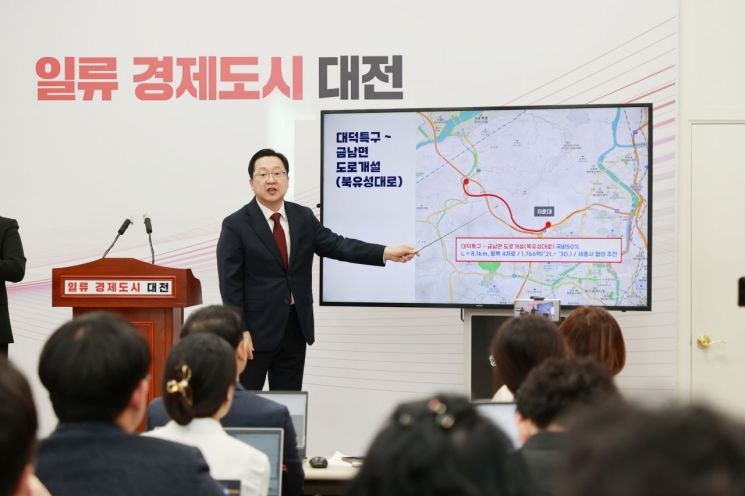 Lee Jang-woo, Mayor of Daejeon, is explaining plans to improve traffic flow in habitual congestion areas and to eradicate unauthorized parking of personal mobility devices at Daejeon City Hall on the 29th. Photo by Daejeon City
On the 29th, Mayor Lee Jang-woo held a briefing and stated, “We will improve habitual congestion sections to alleviate citizen inconvenience and proactively establish a safety net for both PM users and pedestrians.”
Previously, the city analyzed data from traffic volume and speed collection devices installed on roads within the city, and through on-site inspections, selected 33 habitual congestion sections that require improvement.
The selection criteria were cases where the average travel speed was below 15 km/h for more than 21 hours per week.
This reflects the enforcement decree of the Urban Traffic Maintenance Promotion Act.
Among these, 16 sections including Gyeryong-ro, which are part of the old downtown area, are expected by the city to be improved through road operation enhancements such as illegal parking enforcement, signal system improvements, and adjustment of left-turn pocket lengths.
The city believes that road operation improvements in these old downtown areas are confirmed as short-term improvement tasks, allowing for prompt action.
There are 17 sections requiring road structure improvements such as bottleneck elimination. The city plans to analyze the causes of traffic congestion and prepare 22 customized improvement measures as medium- to long-term tasks, including intersection grade separation, new road construction, and road widening, investing approximately 1.93 trillion KRW to resolve the issues.
In particular, since most habitual congestion occurs in the old downtown area, the city’s policy is to seek ways to disperse and bypass downtown traffic demand in advance by expanding roads and constructing outer ring roads such as Gyebaek-ro and Taepyeong-ro.
Traffic congestion near Wonshinheung-dong and Bongmyeong-dong around the Gyeryong Bridge intersection will be alleviated by completing the (tentatively named) Doan Bridge and the connecting road to the Mannyeon Underpass by next month, dispersing traffic by linking the previously disconnected Cheonbyeon Urban Expressway.
Additionally, the Jeongnim Middle School to Sajunggyo road will begin construction in July and is planned to be completed by the end of 2026. Eight projects will be implemented step-by-step to establish a connected loop road network.
The city is also establishing the role of PM and proactively building a safety net as the number of users has recently increased, raising accident risks.
So far, the city has sought to resolve safety issues through PM user insurance enrollment, creation of dedicated parking zones, and business agreements with rental operators.
However, considering ongoing illegal activities such as unauthorized PM abandonment, two-person riding, and unlicensed driving, the city plans to implement drastic measures including system improvements and strengthening operator responsibilities.
First, by May, the city will revise the “Daejeon City Personal Mobility Safety and Convenience Promotion Ordinance” to establish grounds for no-parking zones and PM towing and fee collection.
The city also plans to eradicate illegal parking through PM towing. The ordinance revision will include provisions to charge a towing fee of 30,000 KRW per PM and separate storage fees.
The city has set a promotion and guidance period until the end of June before towing begins. Starting in July, it will encourage operators to handle violations themselves through on-foot enforcement and prior warnings by autonomous districts, towing PMs if no action is taken within one hour.
Furthermore, the city plans to designate sections with high accident risks as special management zones and strengthen enforcement in cooperation with the Daejeon Police Agency.
Mayor Lee said, “We will focus on resolving habitual traffic congestion in the region through customized, phased improvements and effective measures, and early establishment of a proper PM usage culture. We ask for active citizen participation for successful implementation.”
© The Asia Business Daily(www.asiae.co.kr). All rights reserved.
![Clutching a Stolen Dior Bag, Saying "I Hate Being Poor but Real"... The Grotesque Con of a "Human Knockoff" [Slate]](https://cwcontent.asiae.co.kr/asiaresize/183/2026021902243444107_1771435474.jpg)















