29th National Assembly Confirmation Hearing for Constitutional Court Judge Nominee Jeong Jeong-mi
Ruling Party: "Constitutional Court Judge Composition is a Tilted Playing Field"
Opposition: "Does a 5-4 Decision Diminish Its Significance?"
On the 29th, the ruling and opposition parties clashed over the Constitutional Court's decision regarding the 'Complete Removal of Prosecutorial Investigation Authority Act (Geomsu Wanbak)' during the confirmation hearing of Jeong Jeong-mi, a nominee for Constitutional Court Justice, held at the National Assembly. They also confronted each other while questioning Jeong's stance on the government's solution for compensation related to Japan's forced labor during its colonial rule.
Members of the People Power Party (PPP) on the National Assembly's Legislation and Judiciary Committee asked Jeong about her opinions on the Constitutional Court's rulings, continuing with the implication that the composition of the Constitutional Court justices is biased.
Jeon Ju-hye, a PPP lawmaker who filed a constitutional dispute over this law, said, "There are currently five justices from a specific research association, and these justices reach the same conclusions not only on highly political cases but also on socially sensitive issues," adding, "They also reached the same conclusion on the recent Geomsu Wanbak bill. The concern is that the Constitutional Court is becoming a tilted playing field due to its composition. What do you think about this?" she asked Jeong.
Jeong responded, "I do not believe that the justices made their rulings based on political orientations or biased opinions related to the research associations they belonged to," and added, "I think it is inappropriate to criticize the Constitutional Court's decisions as being politically motivated."
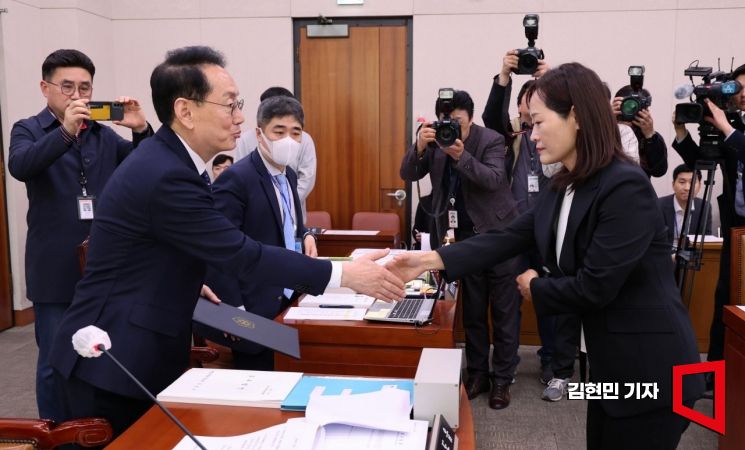 Constitutional Court nominee Jeong Jeong-mi is submitting the oath statement to Kim Do-eup, Chairman of the Legislation and Judiciary Committee, at the confirmation hearing held at the National Assembly in Yeouido, Seoul on the 29th. Photo by Kim Hyun-min kimhyun81@
Kim Do-eup, the chairman of the Legislation and Judiciary Committee, questioned Jeong, "Do you think the current composition of the Constitutional Court justices is diverse? There are five justices from the International Human Rights Law Research Association and the Uri Law Research Association, and former President Moon Jae-in appointed them. Can this be considered diverse?" He continued, "During the Moon administration, the Constitutional Court and the Supreme Court were completely ruined. Two people who were direct subordinates of former President Moon during former President Roh Moo-hyun's era were appointed?one to the Constitutional Court and one to the Supreme Court," and fiercely criticized, "This is not only a disgrace but will be remembered in history. This is why the Constitutional Court is in its current state."
Democratic Party lawmakers countered by emphasizing the 'rule of law.' Kwon In-sook, a Democratic Party lawmaker, said, "In this decision, five justices were in favor and four opposed. Although the numbers may seem close, there was a 5-4 decision. Does that mean the significance of the Constitutional Court's decision is diminished or less meaningful?" She added, "Those responsible for national governance are indiscriminately criticizing and attacking the five justices who ruled to dismiss, thereby escalating social conflict."
In response, Jeong said, "When the courts or the Constitutional Court make a final ruling, expressing refusal to accept it can cause the general public to misunderstand that 'it is acceptable not to accept it.' While legal criticism of the judgment is possible, outright denial of the judgment is inappropriate," she said. However, when Kwon asked, "Do you consider the actions regarding this 5-4 decision as a disruption of constitutional order?" Jeong replied, "I do not think those criticizing intend it that way."
Forced Labor Compensation: "Violation of Supreme Court Ruling" vs. "A Different Dimension of Issue"
The ruling and opposition parties also clashed over the government's compensation for victims of Japan's forced labor during its colonial rule. Park Beom-gye, a Democratic Party lawmaker, mentioned the constitutional principle of separation of powers, asking, "Despite the Supreme Court's final ruling, President Yoon Seok-yeol said that the relationship between us and Japan worsened due to the Supreme Court's ruling, which differs from the government's position. Is it acceptable to blatantly violate the Supreme Court's ruling?" Jeong responded, "I do not think the president violated the rulings of the judiciary of the Republic of Korea," and when asked if she actively agreed, she replied, "Not exactly, that is not what I mean."
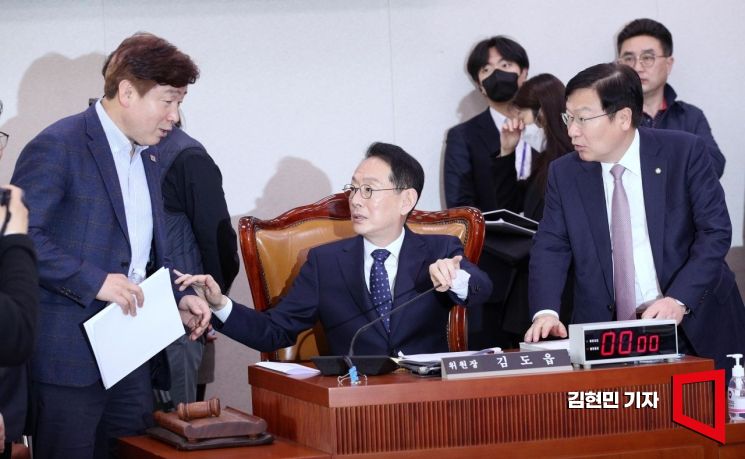 Kim Do-eup, Chairman of the National Assembly Judiciary Committee, and party secretaries are conversing during the confirmation hearing for nominee Jeong Jeong-mi, a Constitutional Court Justice candidate, held on the 29th at the National Assembly in Yeouido, Seoul. From the left, Gi Dong-min, opposition party secretary; Chairman Kim; Jeong Jeom-sik, ruling party secretary. Photo by Kim Hyun-min kimhyun81@
Jang Dong-hyuk, a PPP lawmaker, questioned whether the third-party compensation method contradicts the Supreme Court ruling. "If third-party compensation is recognized, do you think it overturns the Supreme Court's intent and the reasons behind the ruling that forced labor was illegal? Do you consider this a legal issue or a matter of a different dimension?" he asked.
Nominee Jeong Apologizes for Violation of Farmland Act, Calling it a "Serious Mistake"
Jeong said, "The Supreme Court ruling declared the debtor's responsibility, but the actual process of receiving the money and realizing the compensation could be a separate matter," adding, "The liability for damages due to forced labor has been confirmed, and the third-party compensation part is related to enforcement."
Meanwhile, during the hearing, Jeong apologized for allegations of violating the Farmland Act. It was revealed that she acquired farmland located in Cheongdo-gun, Gyeongbuk Province, and wrote in the agricultural management plan that she would personally engage in farming, which violated the Farmland Act. In reality, it was Jeong's father who farmed the land.
Jeong explained, "I did not know the exact circumstances of the farmland acquisition. I only heard from my father that it was purchased under my name," adding, "If the contract was concluded, it could have been canceled, and if it was transferred under my name, the ownership should have been returned to my father. Leaving it as it was is my serious mistake. I sincerely accept the pointed criticism and will immediately transfer the ownership back to my father."
© The Asia Business Daily(www.asiae.co.kr). All rights reserved.
![Clutching a Stolen Dior Bag, Saying "I Hate Being Poor but Real"... The Grotesque Con of a "Human Knockoff" [Slate]](https://cwcontent.asiae.co.kr/asiaresize/183/2026021902243444107_1771435474.jpg)
















