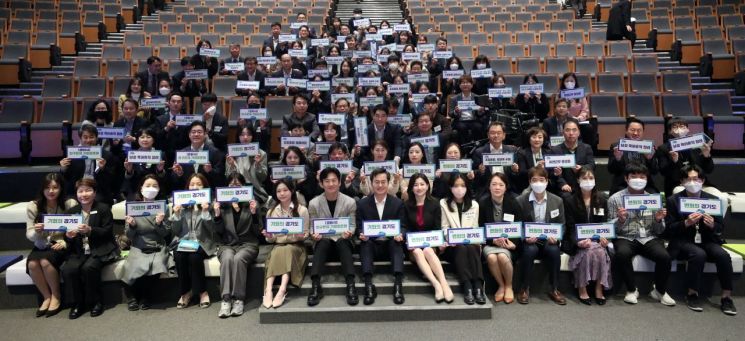
 Gyeonggi Province Governor Kim Dong-yeon is taking a commemorative photo with participants of the Population Issue Opportunity Forum held at the Gyeonggi Provincial Government Office on the 29th.
Gyeonggi Province is attracting attention by discussing practical solutions to the low birthrate issue with around 400 employees gathered in one place. On the 29th, the province held a 'Population Issue Opportunity Forum' at the Gyeonggi Provincial Government Auditorium.
The forum was expanded into the 'Gyeongbasi' (Time to Change Gyeonggi Province) program just one week after Governor Kim Dong-yeon held a discussion on low birthrate responses with employees in their 20s to 40s at the provincial office on the 22nd.
To hear the stories left untold in the first forum, the province replaced the monthly open government meetings with another session involving senior provincial officials, heads of public institutions, and public institution employees.
Governor Kim Dong-yeon said, "I recently had a discussion with 110 employees on this issue, and it was the first time I heard such vivid voices about childcare, childbirth, workplace difficulties, and the experiences of those who are not getting married. If we do not deeply empathize with the problems faced by residents, we cannot create living policies, policies that solve problems, or bring about change."
He continued, "The government announced its low birthrate measures yesterday. In my view, they are not much different from previous measures and only slightly improved. Looking at the members of the Low Birthrate and Aging Committee, they are all distinguished people, but I feel they are not those who directly experience these issues," adding, "I want to listen to the real stories from employees and residents to create truly practical and realistic measures that lead the central government and other local governments. If there is any framework we have, let's try to break it."
During the open discussion held that day, participants freely expressed their opinions on marriage, pregnancy, childbirth, parenting, caregiving, and education. Some shared notes they had prepared in advance.
One public institution employee stated, "The workload is heavy, making it difficult to take parental leave. The system for substitute personnel during parental leave should be improved to create a workable environment."
Another employee pointed out, "While policies and welfare aspects are improving, the perceptions of older generations in organizations and society do not seem to keep up."
Other voices from diverse experiences included suggestions such as ▲ recognizing and supporting the careers of those whose careers were interrupted due to childcare by creating hiring and support systems ▲ improving treatment for current employees so they can take childcare time without worry ▲ using part of the education tax or local tax under the name 'Joint Parenting Tax' to implement birth, parenting, and childcare policies ▲ establishing a system where schools take responsibility for the care gap of first and second graders in elementary school.
Governor Kim concluded the discussion by saying, "I hope you see that gathering like this and speaking honestly is an important first step to solving this issue. Unless the overall social culture is resolved, and unless consciousness, atmosphere, and incentive systems themselves change, I don't think this problem will be solved," urging, "Let's use this occasion as a good starting point for Gyeonggi Province to lead change and work together so that Korea can change as well."
© The Asia Business Daily(www.asiae.co.kr). All rights reserved.
![Clutching a Stolen Dior Bag, Saying "I Hate Being Poor but Real"... The Grotesque Con of a "Human Knockoff" [Slate]](https://cwcontent.asiae.co.kr/asiaresize/183/2026021902243444107_1771435474.jpg)















