29th Youth Policy Coordination Committee 9th Meeting
'Cheonwon Breakfast' 685,000 → 1.5 Million People
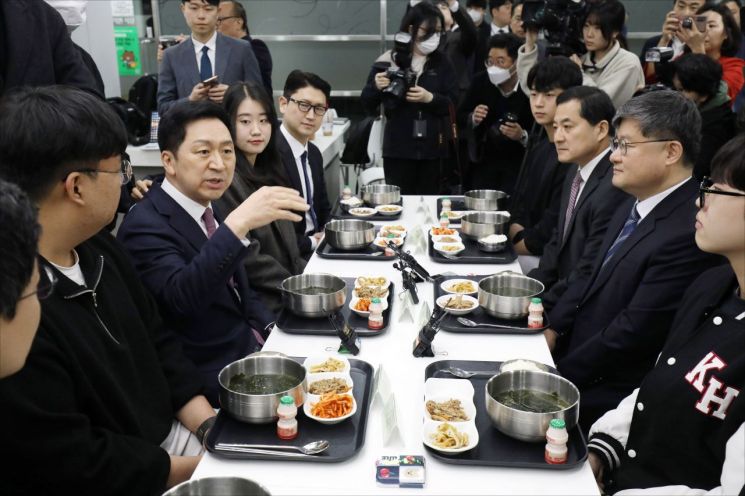 On the 28th, Kim Gi-hyeon, the leader of the People Power Party, talks with young people while having a 1,000 won breakfast at Kyung Hee University in Dongdaemun-gu, Seoul.
 [Image source=Yonhap News]
The government will invest over 25 trillion won to support youth policies. The support plan includes expanding the ‘1000-won breakfast’ program for university students. Additionally, to properly reflect the opinions of young people in policies, advisory roles and the 2030 advisory group will be expanded to all ministerial-level central administrative agencies.
On the 29th, the Youth Policy Coordination Committee held its 9th meeting at the Small and Medium Business DMC Tower to discuss related agenda items, including the ‘2023 Youth Policy Implementation Plan.’ The plan includes a total of 390 tasks under the jurisdiction of 33 central administrative agencies and a budget plan of approximately 25.4 trillion won. Compared to last year (376 tasks, 24.6 trillion won), the number of tasks increased by 24 and the budget by 800 billion won.
The sector with the largest budget share is housing, which will receive 10.4 trillion won, an increase of 1.5 trillion won from the previous year. Welfare and culture will receive 1.9 trillion won, and education will be allocated 7.1 trillion won. The job sector is expected to require a total budget of 5.8 trillion won.
Specifically, considering the recent high demand for the 1000-won breakfast program, the government decided to significantly expand the support scale from 685,000 to 1.5 million beneficiaries. Accordingly, the related budget was nearly doubled from 778 million won to 1.588 billion won. Additional recruitment for new supported universities will be conducted immediately, and the number of supported students at the 41 universities currently implementing the program will also be increased.
The 1000-won breakfast program has been implemented by the Ministry of Agriculture, Food and Rural Affairs since 2017 to provide quality breakfasts to university students and support the formation of healthy eating habits among youth. Since the government supports 1000 won and the school supports 2000 won of the 4000 won meal cost, university students only need to pay 1000 won. The program has recently gained attention due to the sharp rise in dining-out prices amid high inflation.
Furthermore, the committee will expand channels to reflect youth perspectives across the entire government in response to criticism that young people’s actual political participation opportunities remain limited. Currently, out of 857 government committees, only 190 include youth participation. Therefore, the target for youth participation in government committees will be changed from ‘committees mainly dealing with youth policies’ to ‘all government committees,’ and when dealing with youth policies, the youth ratio will be mandated to increase from 10% to 30%. The number of youth advisory roles and the 2030 advisory group responsible for communication channels within ministries will be increased from 9 to 24.
In the employment sector, which has high interest, it was judged that support for creating quality jobs and strengthening job competencies for youth was insufficient. To address this, a new employment service for enrolled students will be established to expand youth jobs and strengthen job competencies. Youth-specific employment services will also be enhanced, including increasing the scale, support period, and support amount of the ‘Youth Challenge Support Program’ for NEET youth (Not in Education, Employment, or Training).
Additionally, to strengthen youth job competencies, the government will support work experience for more than 80,000 people annually and enhance advanced industry vocational training utilizing private companies’ training infrastructure. The private-led youth startup academy, which was only one last year, will be expanded to six by 2025, supporting up to 120 first-time youth entrepreneurs annually. Other measures include establishing an integrated reporting center for recruitment irregularities and promoting a full revision of the Recruitment Procedures Act into a Fair Recruitment Act.
© The Asia Business Daily(www.asiae.co.kr). All rights reserved.
![Clutching a Stolen Dior Bag, Saying "I Hate Being Poor but Real"... The Grotesque Con of a "Human Knockoff" [Slate]](https://cwcontent.asiae.co.kr/asiaresize/183/2026021902243444107_1771435474.jpg)















