Excessive Political Interference and Staff Shortages Criticized
"Changes Must Be Sought at the Initial Stage"
On the 28th (local time), Bloomberg, a global economic media outlet based in the United States, criticized the semiconductor policy of the Joe Biden administration through an editorial, stating that it is being implemented incorrectly. The policy itself, based on the current Semiconductor Act, is facing issues due to excessive political intervention in its approach. Since it is still in the early stages, Bloomberg emphasized the need to seek changes quickly.
On the same day, Bloomberg published an editorial titled "America's $52 billion semiconductor manufacturing plan is heading toward failure." This editorial came one month after the U.S. Department of Commerce first announced the criteria for semiconductor subsidy applications last month, and just one day after releasing detailed procedures for semiconductor company subsidy applications.
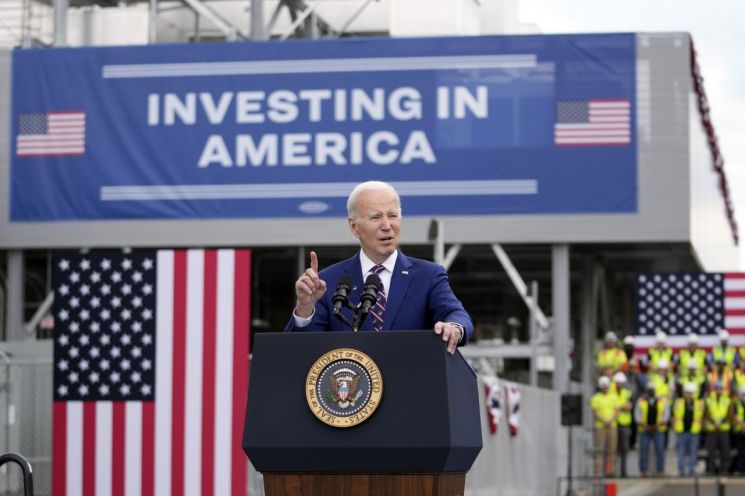 On the 28th (local time), U.S. President Joe Biden visited the Wolfspeed semiconductor plant in Durham, North Carolina, and gave a speech.
 [Image source=AP Yonhap News]
At the end of last month, the U.S. Department of Commerce announced the subsidy application criteria under the CHIPS and Science Act (CSA). These criteria included various profitability indicators such as companies’ projected cash flows, as well as trade secrets like specific factory production capacities and utilization rates. Moreover, it mandated hiring local construction workers paid fair wages and the installation of childcare facilities.
Following this announcement by the U.S. government, concerns arose domestically as well. While it was interpreted as an effort to avoid criticism of funneling American taxpayers’ money into specific industries, the inclusion of confidential information put companies in a difficult position, and the incorporation of various social policies has also drawn criticism.
In fact, last month, the Wall Street Journal (WSJ) also introduced Goldman Sachs’ forecast that America’s global semiconductor production share would not increase by even 1%, and sharply criticized the CSA as a socialist industrial policy in its editorial.
Bloomberg stated, "By now, it is clear that the CSA is not working as intended," pointing out problems with the Biden administration’s approach to fostering semiconductor manufacturing. Bloomberg evaluated, "Simply providing subsidies is not enough. Producing semiconductors in the U.S. still takes 25% longer and costs 50% more compared to Asia," adding, "Significant policy changes are necessary for U.S.-based manufacturers to have even a slight competitive edge."
Bloomberg identified three reasons why the Biden administration’s semiconductor policy approach is flawed: unnecessary bureaucratic formalities by authorities, labor shortages caused by a broken immigration system, and political interference.

First, Bloomberg reported that the time required to build semiconductor fabs (factories) in the U.S. increased by 38% in 2020 compared to 1990. Due to the Clean Air Act, obtaining related permits alone takes 18 months, and reviews under the National Environmental Policy Act average about 4 years and 6 months. During this process, companies face difficulties as they must consult with many agencies and coordinate interests.
Another issue is labor. Citing a report from global consulting firm McKinsey, Bloomberg stated that finishing the semiconductor fab projects currently underway in the U.S. requires about 300,000 skilled workers. However, there is a severe shortage of related personnel domestically, causing companies like Intel in the U.S. and TSMC in Taiwan to struggle to secure workers.
Lastly, Bloomberg criticized the inclusion of social goals unrelated to the semiconductor industry in this policy, which further increases costs when producing in the U.S., already an expensive option, by requiring more funding.
Bloomberg said, "The good news is that most of these problems are solvable. This is just the beginning." It proposed introducing a 'fast track' system to expedite administrative procedures and expanding visas for skilled workers. Additionally, it suggested removing costly and counterproductive provisions related to the CSA and leaving progressive agendas to be handled by Congress.
© The Asia Business Daily(www.asiae.co.kr). All rights reserved.
![Clutching a Stolen Dior Bag, Saying "I Hate Being Poor but Real"... The Grotesque Con of a "Human Knockoff" [Slate]](https://cwcontent.asiae.co.kr/asiaresize/183/2026021902243444107_1771435474.jpg)
















