Ministry of Labor Publishes List of Institutions Failing Mandatory Employment
4 of 17 Public Institutions Located in Gwangju and Jeonnam
Experts Say "Law Should Be Amended to Strengthen Obligations"
The government has set a mandatory employment rate for persons with disabilities to increase their employment opportunities and imposes penalties such as employment levies if this is not met. However, it has been revealed that even public institutions do not comply. Critics point out that the social atmosphere ignoring persons with disabilities persists as even public institutions, not just private ones, fail to adhere to these regulations.
On the 29th, reviewing the list of companies and institutions with a mandatory employment rate below 2.72% and no employment efforts, disclosed by the Ministry of Employment and Labor, shows that 4 out of 17 public institutions are located in the Gwangju and Jeonnam regions.
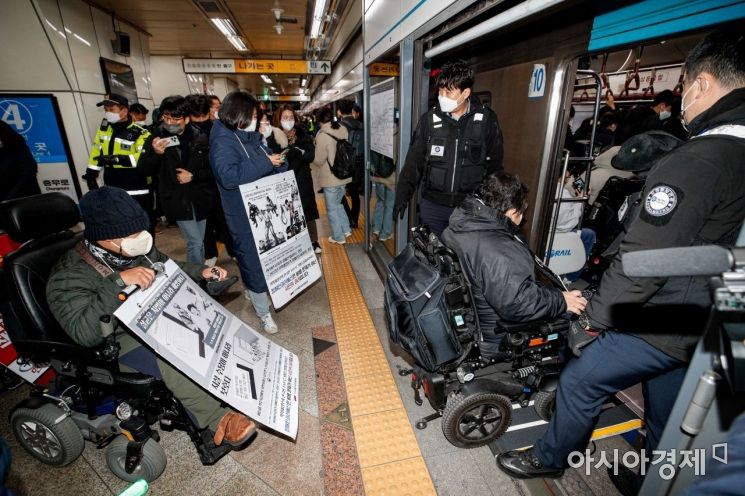 Members of the National Solidarity for the Elimination of Discrimination against Persons with Disabilities are seen protesting on the subway at Samgakji Station on Line 4 in Yongsan-gu, Seoul, urging the expansion of the budget for disability rights during subway boarding./Photo by Kang Jin-hyung aymsdream@
No employment effort means that as of December 2021, the employment rate of persons with disabilities was significantly low, and despite prior notice of being listed publicly, no efforts such as new hiring or recruitment were made for a year.
The mandatory employment rate for public institutions such as public enterprises, quasi-governmental agencies, other public institutions, and local public enterprises with 50 or more regular employees is 3.4%, while for private companies with 300 or more regular employees, it is 3.1%.
The public institutions located in Gwangju and Jeonnam among the non-compliant institutions announced by the Ministry of Employment and Labor this time are the Gwangju-Jeonnam Research Institute, Shinan-gun Welfare Foundation, Mokpo City Medical Center, and Jeonnam Bio Industry Promotion Agency.
The Gwangju-Jeonnam Research Institute has 74 regular employees, with a mandatory employment number of at least 2 persons with disabilities, but currently has none. The Shinan-gun Welfare Foundation has 56 regular employees and a mandatory employment number of 1, but also none employed. Mokpo City Medical Center, with 254 regular employees, has a mandatory employment number of 8 but has only employed 2 persons with disabilities. The Jeonnam Bio Industry Promotion Agency, with 196 regular employees, has a mandatory employment number of 6 but has employed only 1.
According to the Act on the Promotion of Employment and Vocational Rehabilitation of Persons with Disabilities, institutions such as national, local governments, public institutions with an employment rate of persons with disabilities below 2.72% (80% of the mandatory employment rate of 3.4%), and private companies with 300 or more employees with an employment rate below 1.55% (50% of the mandatory employment rate of 3.1%) are subject to prior notice of public listing. They are then encouraged to employ persons with disabilities through six months of disability awareness education, briefings, meetings, and integrated employment support services. However, public institutions themselves are failing to comply.
Given this situation, persons with disabilities residing in Gwangju and Jeonnam expressed their frustration.
Lee Jae-min (37), who is training at the Digital Training Center of the Korea Employment Agency for Persons with Disabilities Gwangju Headquarters, dreaming of employment in public institutions, said, "Even though I have a disability, I was confident that there are jobs I can do and was studying for certification, but now I feel that my job might not exist due to environmental factors regardless of my efforts."
Bae Young-jun, a standing activist of the Gwangju Disability Discrimination Abolition Solidarity, criticized, "It is absurd that the government demands companies to comply with mandatory employment of persons with disabilities while public institutions themselves are not properly adhering to it."
Experts unanimously agree that the Act on the Promotion of Employment of Persons with Disabilities should be amended, especially since public institutions, which should lead by example, are not fulfilling their mandatory employment obligations.
Professor Lee Jeong-seo of the Department of Social Welfare at Chosun University of Science and Technology said, "Despite the government's mandatory employment system for persons with disabilities being in place, there is little expected effect in expanding jobs for persons with disabilities, and they are being neglected. The 'Act on the Promotion of Employment of Persons with Disabilities' should be amended to strengthen the obligations of public institutions."
A representative of the Shinan-gun Welfare Foundation explained, "There are actually fewer than five full-time employees at the foundation, and it consists of entrusted facilities, welfare facilities, nursing homes, and small local children's centers, totaling over 100 people, so we were unaware that we were subject to mandatory employment for persons with disabilities. We are recommending and educating to employ as many persons with disabilities as possible. Currently, we have employed one person with a disability and plan to continue increasing employment this year."
© The Asia Business Daily(www.asiae.co.kr). All rights reserved.
![Clutching a Stolen Dior Bag, Saying "I Hate Being Poor but Real"... The Grotesque Con of a "Human Knockoff" [Slate]](https://cwcontent.asiae.co.kr/asiaresize/183/2026021902243444107_1771435474.jpg)











