Tariff Rates Scheduled to Decrease Starting in May
On the 29th, the government decided at the Emergency Economic and Livelihood Countermeasure Meeting to reduce tariff rates starting in May on seven items whose prices have recently risen, as part of measures to support the low-income economy by easing the burden of food prices and lowering production costs for farmers and fishermen.
Through this tariff reduction, the government expects that prices of popular agricultural products (green onions, radishes), livestock products (chicken), and seafood (pollock) will stabilize somewhat, thereby reducing the food burden on low-income households.
Chicken, which has a basic tariff rate of 20-30%, has seen supply decrease due to rising production costs, causing prices to continue rising, with February prices up 16.4% compared to the same month last year. A 0% quota tariff will be applied to up to 30,000 tons of imported chicken until the end of June.
Green onions have a basic tariff rate of 27%, and due to decreased production caused by the winter cold wave, prices in February rose 29.7% compared to the same month last year. Under this measure, a 0% quota tariff will be applied to up to 5,000 tons until the end of June.
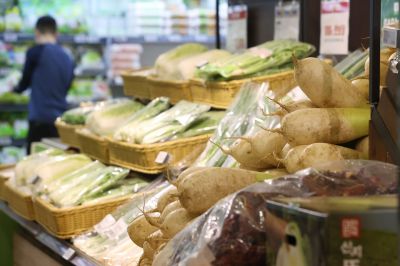
In the case of radishes, the cold wave in Jeju in January is expected to reduce shipments from March to June this year by about 28% compared to the average year, and recently, imported radish prices have been about 40% higher than usual, making price stabilization urgent. Therefore, a 0% quota tariff will be applied to imported radishes until the end of June instead of the basic 30% tariff.
Pollock, currently subject to a 22% adjusted tariff rate, has maintained high retail prices as stocks decreased during the high-consumption winter period. With the prolonged Russia-Ukraine conflict, concerns about supply instability continue, so until the end of June, the 22% adjusted tariff will be temporarily replaced by a 10% basic tariff.
Additionally, for potatoes used in potato chip manufacturing, a 0% quota tariff will be applied to up to 13,000 tons until the end of November instead of the 30% basic tariff. For frozen saury, currently subject to a 24% adjusted tariff, a 10% basic tariff will be applied only for bait used in hairtail fishing until the end of the year. Furthermore, for 10 tons of imported duck hatching eggs (fertilized duck eggs for incubation) imported until the end of June, a quota tariff will be applied to reduce the tariff rate from 12% to 0%.
The government plans to revise the quota and adjusted tariff regulations (Presidential Decree) to ensure that the planned policy effects can be realized starting in May.
© The Asia Business Daily(www.asiae.co.kr). All rights reserved.
![Clutching a Stolen Dior Bag, Saying "I Hate Being Poor but Real"... The Grotesque Con of a "Human Knockoff" [Slate]](https://cwcontent.asiae.co.kr/asiaresize/183/2026021902243444107_1771435474.jpg)
















