Impact of Eased Quarantine and Increased Outdoor Activities
Surpassing the Growth Rate of Contactless Payments
As COVID-19 quarantine measures eased and outdoor activities increased, the growth rate of face-to-face payment amounts last year surpassed that of non-face-to-face payments compared to the previous year. The proportion of face-to-face payments among total payments also approached 60%, rising from 59.2% the previous year, marking a shift back to an expansion of face-to-face payments.
According to the '2022 Domestic Payment Trends' released by the Bank of Korea on the 29th, the year-on-year growth rate of face-to-face payment amounts last year (daily average of 1.6 trillion KRW, provisional) was 12%, exceeding that of non-face-to-face payments (8.8%). Due to the impact of COVID-19, the share of face-to-face payments among total payments had continuously declined from 66.0% in 2019, 61.2% in 2020, and 59.2% in 2021, but with the easing of quarantine measures last year, it recorded 59.9%, marking a reversal to expansion.
Lee Dong-gyu, head of the Payment Stability Team at the Financial Payment Bureau of the Bank of Korea, explained, "The shift to an expansion in the share of face-to-face payments last year is the first since statistics collection began in 2019," adding, "This is due to the easing of COVID-19 quarantine measures, which significantly increased outdoor activities."
Non-face-to-face payments include not only online transactions using PCs but also payments made at the transaction site without contact with a terminal through mobile devices such as smartphones (e.g., automatic payments via taxi-hailing apps).
Contactless Payments Using Mobile Devices Surge 46.9%
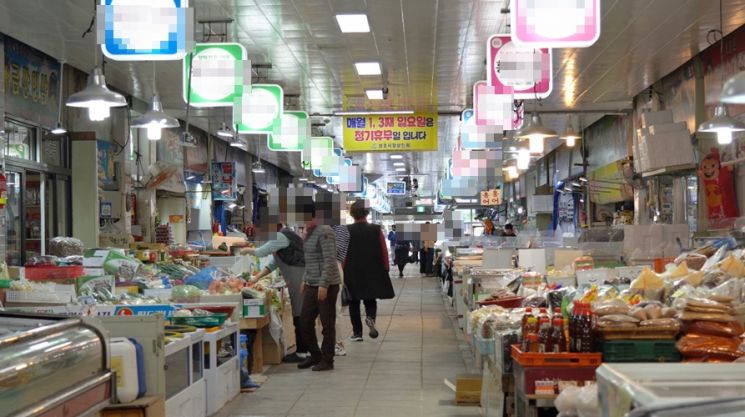
In particular, payments using mobile devices increased by 13.9%, showing a larger growth rate than payments using physical cards (7.8%). Among face-to-face payments, the method of touching mobile devices to payment terminals (card terminals, QR codes, etc.) instead of physical cards showed a significant increase of 46.9%.
The total card usage amount (daily average of 3.1 trillion KRW) increased by 12.7% compared to the previous year due to the recovery of private consumption and the easing of quarantine measures. Both credit cards (13.5%) and check cards (9.6%) saw an increase in usage.
By authentication method, among payments using mobile devices (daily average of 1.3 trillion KRW), the share of card-based simple payment services expanded due to preferences for convenience, accounting for 46.3%.
Card-based simple payment services store card information in advance on mobile devices and allow payments using simple authentication methods (password input, fingerprint recognition) during transactions. This share has steadily increased from 35.1% in 2019 to 39.1% in 2020, 43.3% in 2021, and 46.3% last year.
Furthermore, the proportion of card-based simple payment services provided by fintech companies also grew to 66.6%, up from 64.1% the previous year.
Looking at individual credit card usage, most sectors saw increases centered on travel (+67.1%) and restaurants (+25.2%), but usage in household goods and home appliances (-7.7%) showed a sluggish trend.
By region, credit card usage increased in all areas. Jeju had the highest growth rate at 16.4%, followed by Daegu-Gyeongbuk (14%) and Daejeon-Chungnam (13.8%).
The amount of account transfers through small-amount payment networks (daily average of 91.8 trillion KRW) increased by 5.3% compared to last year, as preferences for non-face-to-face financial transactions continued.
The amount of bill and check payments averaged 16.7 trillion KRW daily, decreasing by 11.8% from the previous year due to factors such as the reduction in electronic bill issuance.
© The Asia Business Daily(www.asiae.co.kr). All rights reserved.

















