North Korea Aims for 'Internal Unity' Amid Threats to South
COVID-19 Border Closure Orders... Gradual Lifting
"Must Strengthen Preparedness Over Inter-Korean Dialogue"
North Korea, which has been escalating nuclear threats day after day this year, has begun to open its borders that were locked down after the COVID-19 outbreak. Given that North Korea has previously suddenly engaged in dialogue after declaring the completion of its nuclear force following nuclear tests, there is speculation that North Korea, suffering from food shortages, may use the border opening as an opportunity to shift the situation.
The Workers' Party organ, Rodong Sinmun, on the 29th referred to the South Korea-U.S. joint exercises and stated, "The eyes of the people looking at the southern land where the enemies who dare to play with fire targeting us are entrenched are fiercely piercing," threatening, "We will never forgive the enemies and will mercilessly punish them." The day before, after unveiling the tactical nuclear warhead 'Hwasan-31' to be mounted on short-range ballistic missiles for the first time, North Korea has further raised the level of its threats. It is unusual for North Korea, which has been slandering South Korea through external propaganda media, to issue such blatant criticism in state-run media accessible to the entire population. This is analyzed as evidence that the North Korean leadership feels a heavy burden regarding the South Korea-U.S. joint exercises and that internal conditions, including economic difficulties, are severe. The recent series of provocations and threats against the South are aimed at internal consolidation.
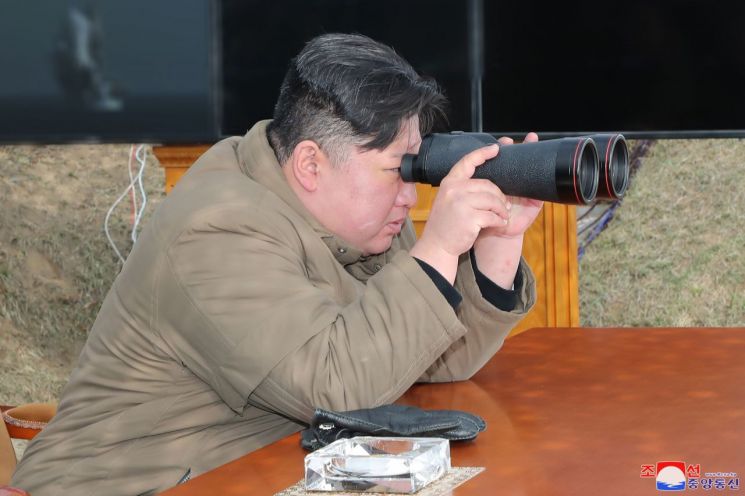 North Korean leader Kim Jong-un observing the underwater explosion test of a nuclear-powered unmanned underwater attack vehicle [Image source=Yonhap News]
A notable change is that North Korea is opening the borders it locked down immediately after the COVID-19 outbreak in January 2020. On the 27th, it was confirmed that Wang Yajun, the newly appointed Chinese ambassador to North Korea, arrived in Pyongyang. The entry of the Chinese ambassador to North Korea is seen as a signal of the lifting of the 'border closure order,' and it is the first time in two years since late 2021 that a Chinese ambassador has entered Pyongyang.
North Korea also held a general meeting of the Olympic Committee on the 25th to discuss ways to increase medal acquisition in international competitions. With the Asian Games in Hangzhou, China, this September and the Paris Olympics next July approaching, the fact that Kim Deok-hoon, the Prime Minister of the Cabinet, and close aides of Kim Jong-un are being consecutively appointed to sports positions is also seen as a sign that North Korea is seeking to return to the international sports stage.
North Korea has previously shown a rapid posture change immediately after raising tensions on the Korean Peninsula through nuclear tests. During the sixth nuclear test on September 2017, it launched the intercontinental ballistic missile (ICBM) 'Hwasong-15' and declared the completion of its national nuclear force, but suddenly engaged in dialogue the following year. Subsequently, in April 2018, it made a groundbreaking declaration to blow up the tunnels of the Punggye-ri nuclear test site.
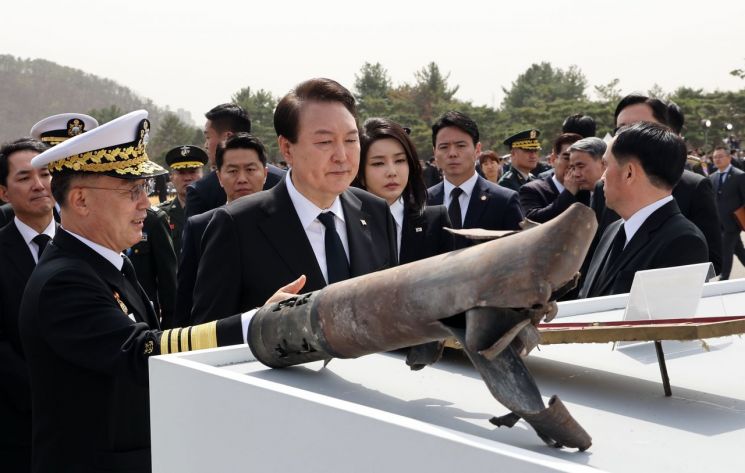 President Yoon Seok-yeol inspecting North Korean rocket artillery shells during the Yeonpyeong Island shelling [Image source=Yonhap News]
The Yoon Seok-yeol administration is keeping the door to dialogue open but maintains a firm stance that North Korea must first show willingness to denuclearize. Kim Gun, head of the Ministry of Foreign Affairs' Peace Negotiation Headquarters on the Korean Peninsula, urged at the overseas diplomatic mission chiefs' meeting the day before to 'create a strategic environment where North Korea has no choice but to return to denuclearization negotiations,' which is in the same context. Therefore, even if North Korea returns to the international community, it is expected to be difficult to resume 'inter-Korean dialogue.'
Moon Sung-mook, head of the Unification Strategy Center at the Korea Institute for National Strategy, diagnosed, "North Korea is aiming for a 'numbing effect' that resolves internal difficulties through external tension." He added, "At present, demands such as dismantling the South Korea-U.S. alliance and easing sanctions against North Korea are unacceptable," and analyzed, "It is time to maintain thorough preparedness to make Kim Jong-un realize that nuclear threats mean 'the end.'"
© The Asia Business Daily(www.asiae.co.kr). All rights reserved.
![Clutching a Stolen Dior Bag, Saying "I Hate Being Poor but Real"... The Grotesque Con of a "Human Knockoff" [Slate]](https://cwcontent.asiae.co.kr/asiaresize/183/2026021902243444107_1771435474.jpg)
















