Among a total of 12 cases, 9 are joint projects between the Korea Chamber of Commerce and Industry and the Ministry of Science and ICT
A service that rents out backup vehicles when delivery trucks have accidents or breakdowns will be launched through the Sandbox. A platform operating specialized school buses will also enter a pilot phase to improve the "3 discomforts of commuting" (inconvenience, anxiety, dissatisfaction).
The Korea Chamber of Commerce and Industry (KCCI) Sandbox Support Center and the Ministry of Science and ICT held the ‘ICT Sandbox Deliberation Committee’ on the 28th. On this day, the committee approved nine cases including the ‘Vehicle Rental Service for Delivery Truck Accidents and Breakdowns (A Motors)’ and the ‘Safe School Bus Platform Service (Schoolbus Co., Ltd.)’ submitted through the KCCI Sandbox Support Center.
Meanwhile, in addition to the nine KCCI projects, the committee also approved three other cases including a ‘Mobile Vehicle Scrap Quote Comparison Platform’ and ‘Mobile Electronic Notifications for Administrative, Public, and Private Institutions,’ approving a total of 12 cases.
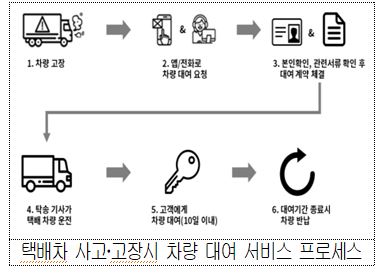
Vehicle Rental for Delivery Truck Accidents and Breakdowns → Reducing Burden on Delivery Drivers and Supporting Smooth Logistics Delivery
On this day, the ‘Vehicle Rental Service for Delivery Truck Accidents and Breakdowns’ applied for by A Motors was granted a regulatory sandbox exemption for pilot testing.
This service rents out a private cargo vehicle of the same class for a short period when a delivery truck becomes inoperable due to an accident or breakdown. Until now, delivery drivers have faced difficulties in providing smooth delivery services to customers when their trucks were involved in accidents or breakdowns because they could not find replacement vehicles. They had to either forcefully share their loads with other fellow drivers or rent cargo vehicles with drivers at high costs, resulting in significant financial losses. Although the ‘Vehicle Rental Service for Delivery Truck Accidents and Breakdowns’ was designed to improve the working conditions of delivery drivers, it was not possible under current laws. According to Article 56 of the current Cargo Vehicle Act, paid transportation using private cargo vehicles is prohibited. Even if a business license is obtained under the Living Logistics Service Act to provide the service, the facility and equipment requirements stipulated in Article 2 of the Enforcement Decree of the Living Logistics Service Act (such as having 30 or more business offices in 5 metropolitan cities and provinces, securing 100 or more vehicles, and having cargo sorting facilities) are difficult to apply to this service, making it impossible to operate.
The committee stated, “This service is useful for small-scale self-employed delivery drivers who face difficulties due to the lack of proper alternatives when delivery trucks have accidents or breakdowns, and it is expected to support smooth logistics delivery.” The regulatory sandbox exemption was granted under conditions that the vehicle rental is limited to cases where the delivery-only cargo vehicle (with a ‘Bae’ license plate) has an accident or breakdown, and the person renting the vehicle must drive it themselves.
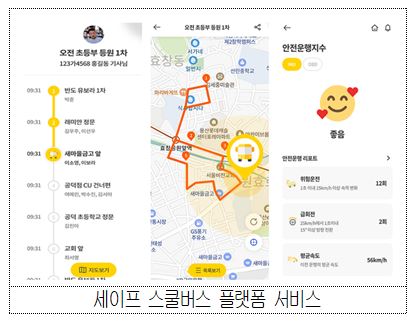
Specialized School Bus Platform Service → Resolving the ‘3 Discomforts (Inconvenience, Anxiety, Dissatisfaction)’ of Commuting
The ‘Safe School Bus Platform Service’ applied for by Schoolbus Co., Ltd. was also granted a regulatory sandbox exemption for pilot testing. The applicant company provides the service by signing transportation contracts with kindergartens and academies using children’s school buses (small vans with 15 seats or fewer) owned by the company and drivers directly employed by the company. Through a real-time information platform, it provides information such as real-time vehicle location, boarding and alighting details, and the driver’s safe driving index, enhancing convenience for students and parents.
Under Article 81 of the current Passenger Vehicle Act, paid transportation using private vehicles is generally prohibited, but transportation for educational purposes is exceptionally allowed. However, only vehicles directly owned (or co-owned) by academies or kindergartens are permitted, and services using children’s school buses (small vans) through transportation contracts with educational institutions were not possible.
The committee said, “It is expected that convenience for students and parents will increase through real-time information provision via the online platform,” and approved the regulatory sandbox exemption under conditions that do not reduce the responsibility of educational institutions and their heads, strictly comply with the obligation to have a companion on board, and adhere to current safety and supervision regulations.
Kang Myung-soo, Head of the Public Projects Division at KCCI, said, “New types of platforms in various fields such as logistics, commuting, and daily life have received exemptions. The Sandbox will actively support these platform services so that they are not hindered by regulations and can increase public safety and convenience.”
The KCCI Sandbox Support Center is the first private sandbox organization in Korea. It supports all industrial sectors including ICT convergence and industrial convergence sandboxes. Companies that cannot commercialize their businesses due to the absence of laws or outdated regulations can receive consulting through the KCCI Sandbox. The service is free of charge.
© The Asia Business Daily(www.asiae.co.kr). All rights reserved.
![Clutching a Stolen Dior Bag, Saying "I Hate Being Poor but Real"... The Grotesque Con of a "Human Knockoff" [Slate]](https://cwcontent.asiae.co.kr/asiaresize/183/2026021902243444107_1771435474.jpg)
















