Seoul City will officially launch the ‘Yangjae GTX Transfer Hub Integrated Development Master Plan Establishment’ project for an area of approximately 250,000㎡ around Yangjae Station, one of the core areas in the Gangnam downtown. This is to prepare a three-dimensional complex development plan for major hub facilities around Yangjae Station in connection with the metropolitan transportation transfer system.
The area around Yangjae Station has been designated as the Yangjae Station Core District through the 2030 Seoul Living Area Plan. Accordingly, there is a need for spatial strategies for key facilities appropriate to the hierarchy, aiming to foster a center for research and development (R&D), business, and commerce.
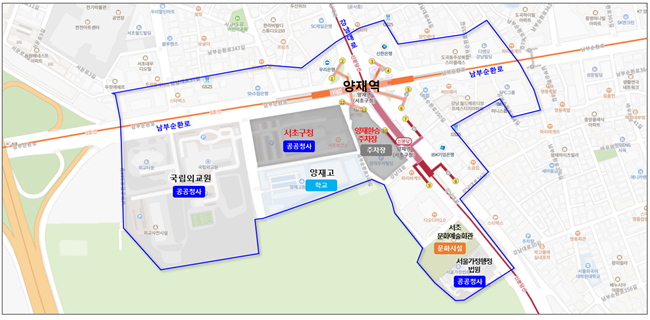
Additionally, Yangjae Station, where the construction of the Metropolitan Area Express Railway (GTX) Line C is planned, is adjacent to Seocho IC on the Gyeongbu Main Road, providing optimal location conditions for metropolitan bus transfers entering Seoul. A GTX transfer center is planned to be established in connection with the development of the Seocho-gu Complex Building.
Accordingly, Seoul City plans to proactively prepare a linked development plan for key hub facilities such as public offices, cultural facilities, and transfer parking lots around Yangjae Station through this project. Furthermore, considering the locational characteristics at the center of Yangjae, guidelines for three-dimensional complex development through smooth connections between major transportation facilities such as the transfer center will also be established.
The main contents include presenting a future vision for the Yangjae Station Core District area that aligns with higher-level plans and strategic goals, and establishing a master plan. It will also include integrated development plans among major core facilities and phased implementation strategies to execute the plan.
The city stated that the area around Yangjae Station, a metropolitan transportation transfer hub, has limitations in inducing vertical use of space, three-dimensional utilization, and integrated linked development through simple planar management plans such as land use and density. Therefore, this project is being implemented. After the bidding announcement, proposals will be received next month and the project will commence. The results are expected to be released in the first half of 2024.
Since identifying key issues for each ongoing project is a major concern, the city stated that it will focus on preparing an effective plan through expert consultations in fields such as urban planning, architecture, and transportation, as well as collaboration with related organizations and communication with residents. In particular, the development direction of the Seocho-gu Complex Building, which has somewhat stalled after being pursued since 2015, is expected to regain momentum according to this spatial concept.
The city plans to make the Seocho-gu Complex Building development a hub for regional revitalization and a leading development model of a compact city public office. Specifically, it will introduce regional necessary functions such as public business services, childcare, lifelong education, and culture, as well as strategic uses desired by the public, including job creation functions like new industry R&D campuses, startup complex support centers, shared offices, and safe urban housing supply.
Jo Nam-jun, Director of the Seoul City Urban Planning Bureau, said, “Through this project, we will induce three-dimensional complex development centered on public transportation to strengthen downtown capabilities and promote regional revitalization around Yangjae Station. We also plan to proactively establish integrated urban space concepts to advance urban planning facilities so that they can accommodate diverse future social demands.”
© The Asia Business Daily(www.asiae.co.kr). All rights reserved.
![Clutching a Stolen Dior Bag, Saying "I Hate Being Poor but Real"... The Grotesque Con of a "Human Knockoff" [Slate]](https://cwcontent.asiae.co.kr/asiaresize/183/2026021902243444107_1771435474.jpg)















