Soil Analysis Results Show "Water-Filled Glass Beads" Across the Region
"A Crucial Milestone for Humanity's Lunar Base Construction"
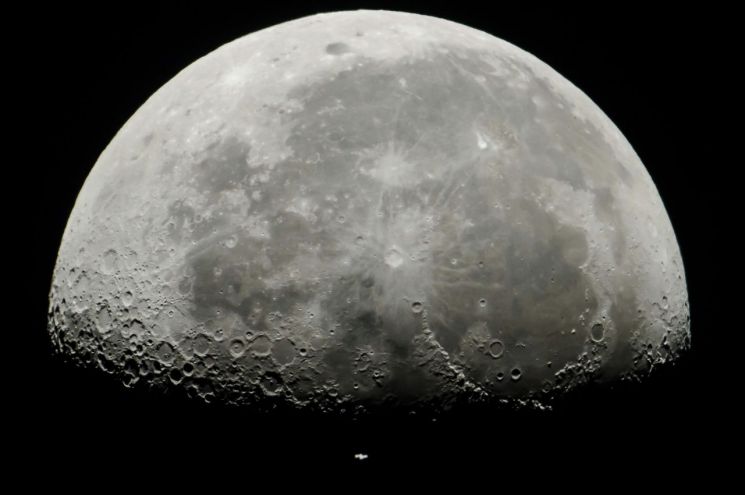
The possibility of obtaining hundreds of billions of tons of water from the lunar surface has been confirmed, signaling a green light for humanity's plans to establish temporary bases or settlements on the Moon.
According to AP News, The Telegraph, and others, an international research team including the University of Chinese Academy of Sciences (UCAS) announced on the 27th (local time) in the scientific journal Nature Geoscience that they analyzed lunar soil samples brought back to Earth by China's unmanned lunar probe Chang'e 5 in December 2020 and obtained these results.
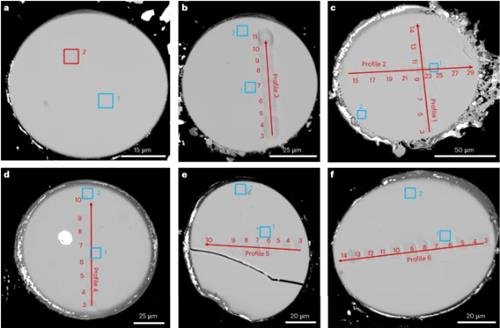
The researchers discovered 117 small glass beads less than 1 mm in diameter in the soil samples.
These beads were formed at the moment when meteorites collided with the Moon in the past and subsequently absorbed water while being exposed to the solar wind.
Glass beads are created when the temperature momentarily rises during the impact of comets or meteorites, causing silicon underground to melt and then solidify.
The solar wind consists mostly of positively charged hydrogen ions, which, when they meet oxygen atoms on the lunar surface, form hydroxyl groups. Hydroxyl groups are a major component of water (H₂O) molecules.
The astronomy community explains that these glass beads can absorb water like a sponge. The researchers estimated that billions of such glass beads are distributed across the entire lunar surface, and the amount of water they contain could range from a minimum of 300 million tons to a maximum of 270 billion tons.
Although each glass bead contains only a small amount of water, it is estimated that if gathered together, it could be utilized as a water resource.
Mahesh Anand, a professor of planetary science and exploration at the Open University in the UK who participated in the study, said that heating these glass beads to about 100 degrees Celsius can extract the water inside.
Previously, NASA and others had observed evidence of water in the lunar polar regions and subsurface layers through exploration satellites, but finding a method to extract water from these areas was challenging.
Professor Anand evaluated that it is now possible to supply water reliably to future lunar explorers, stating, "The potential to explore the Moon sustainably has never been higher."
Professor He Jiuhui of Nanjing University in China, who also participated in the research, said, "It has been revealed that recharging water on the lunar surface is possible."
The British daily newspaper The Guardian predicted that this discovery will be an important turning point for humanity's plans to build bases on the Moon.
© The Asia Business Daily(www.asiae.co.kr). All rights reserved.
![Clutching a Stolen Dior Bag, Saying "I Hate Being Poor but Real"... The Grotesque Con of a "Human Knockoff" [Slate]](https://cwcontent.asiae.co.kr/asiaresize/183/2026021902243444107_1771435474.jpg)
















