Low Fertility and Aging Society Committee Meeting on the 28th
Record Low Birth Rate... Yoon Directly Chairs Meeting
Considering 'Wage Increase for Parental Co-Care'
Question Mark Over Whether Measures Will Boost Birth Rate
The government has unveiled four major promotion strategies and five key areas to address the low birthrate and aging population issues. The core of the measures is to ‘select and concentrate’ on highly effective policies while expanding the scope and level of welfare targets. Considering criticism that astronomical amounts of money were poured in but failed to prevent low birthrates, the policy evaluation method will also be changed.
On the 28th, President Yoon Seok-yeol held a meeting of the Low Birthrate and Aging Society Committee at the Blue House State Guest House and received a report on the ‘Policy Directions and Tasks for Low Birthrate and Aging Society’ from Vice Chairman Kim Young-mi. It is the first time in about seven years that President Yoon personally presided over the meeting. Since the total fertility rate dropped to 0.78, the lowest ever and the lowest in the world, it is interpreted as the president’s determination to personally oversee support measures.
Expansion of incentives for shared caregiving, nationwide expansion of Neulbom Schools
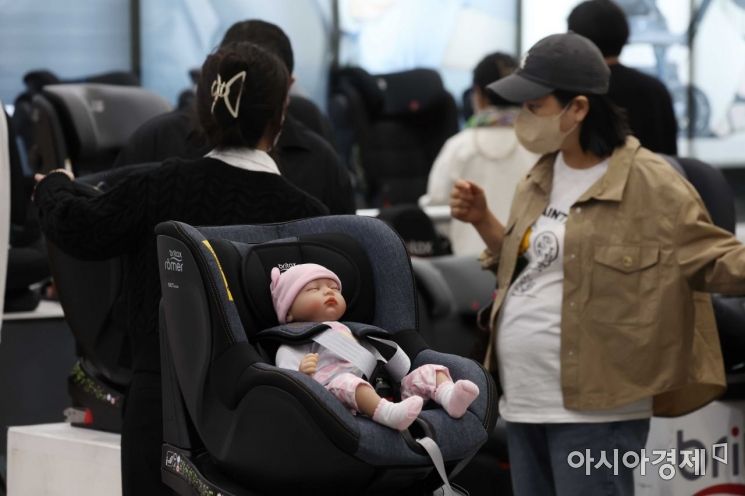 Citizens browsing booths at the KOBE Baby Fair held last year at COEX in Gangnam-gu, Seoul. The photo is unrelated to the article content. Photo by Mun Ho-nam munonam@
According to the announced promotion directions, the committee changed the existing goal of ‘improving individual quality of life’ to ‘creating a social environment where marriage, childbirth, and parenting can be happy choices.’ The intention is to redefine the scope of low birthrate response policies with more specific and accurate goals. The basic plan, which covers policies by each ministry in a broad area, will be completely reviewed, focusing on core policies with high effectiveness and relevance. If each ministry pursues fragmented policies, the effectiveness of low birthrate measures will inevitably decline.
They also announced plans to change the formal policy evaluation practices and introduce a new evaluation method. This is due to criticism that despite investing about 280 trillion won over the past 15 years, the low birthrate problem has not been overcome. South Korea’s total fertility rate is already the lowest among the 38 member countries of the Organisation for Economic Co-operation and Development (OECD). South Korea is the only country with a total fertility rate below 1. Moreover, as perceptions of marriage and childbirth change, the trend of low birthrate is expected to continue for the time being.
Accordingly, the committee plans to improve childbirth and childcare environments through five key areas. First, they will create dense and high-quality care and education services. They will strengthen babysitter services and part-time childcare systems. Regarding care services, government support was previously provided only based on the income level of dual-income households, but a plan to consider the number of children to reduce the burden on multi-child families is being discussed.
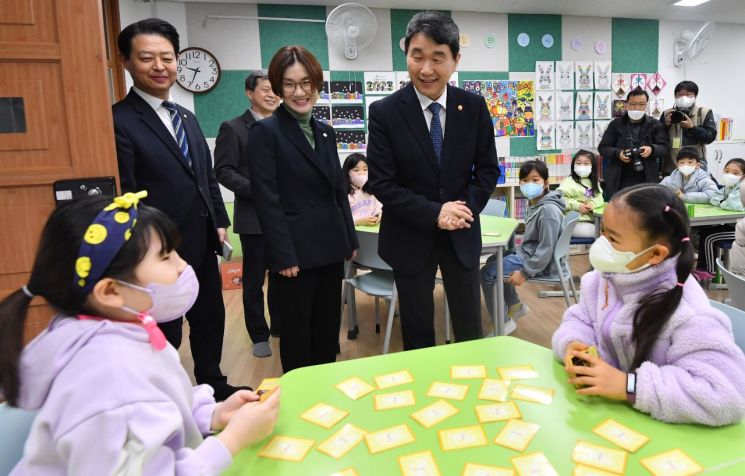 Lee Ju-ho, Deputy Prime Minister for Social Affairs and Minister of Education, and Kim Young-mi, Vice Chairperson of the Low Birthrate and Aging Society Committee, among others, are seen observing a class at Neulbom School in Gajaeul Elementary School, Seodaemun-gu, Seoul, on the morning of the 9th of last month.
For the currently implemented ‘3+3 Parental Leave System,’ an extension of six months is likely. This system increases the usual wage compensation from 80% to 100% (with the cap raised from 1.5 million won to 3 million won) when fathers and mothers take at least three months of parental leave alternately. This means more incentives will be given to parents practicing shared caregiving in the future.
In addition, the implementation of integrated childcare and nationwide expansion of Neulbom Schools, as well as the enactment of the Basic Child Act, will be pursued. To allow working parents to spend time with their children, conditions for using work-childcare support systems will be created, and the working environment during childcare periods will be improved to enable direct parental care.
Simultaneous review of increases in child allowance, housing funds, and infertility treatment support
The burden of housing and childcare costs will also be alleviated. Housing supply and financial support for newlyweds will be expanded, and customized housing supply considering the number of household members will be increased. In particular, a proposal to unify the different standards that count multi-child families as three children for public sale housing and two children for public rental housing is under review.
The child allowance system, which provides 800,000 won to households with a combined income of less than 40 million won, will also be revised. The target will be expanded and the support amount increased to assist low-income households. A family-friendly tax law amendment that reduces tax burdens on companies providing childbirth and childcare support to employees is also being considered and is planned to be submitted to the regular National Assembly session this year.
Infertility support, which provides differential support based on income, will expand its target. Currently, the support project for treatment has been delegated to local governments with an income criterion set at 180%. However, many local governments have abolished this income criterion and provide treatment costs support to all income groups. Accordingly, the government plans to relax the income criteria through consultations with local governments.
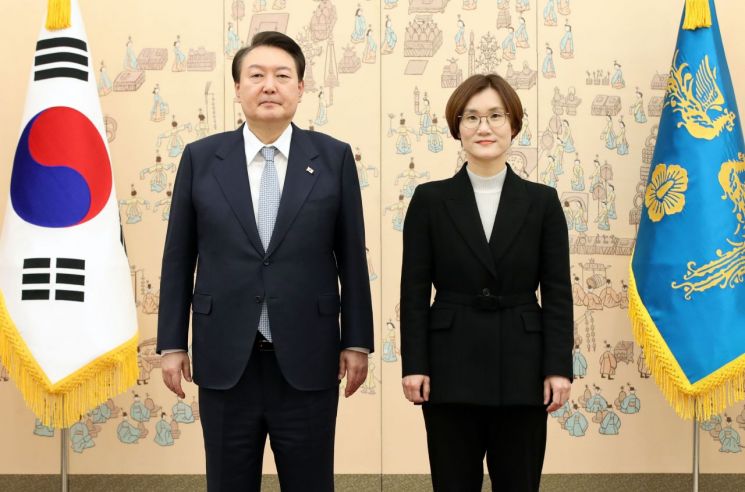 President Yoon Suk-yeol and Kim Young-mi, Vice Chairperson of the Low Birthrate and Aging Society Committee
 [Image source=Yonhap News]
However, it is questionable whether the birthrate will rebound with this plan. Although the president personally instructed, “The committee should lead and all related ministries should work together to prepare measures” (February 22) and “Prepare bold and definite low birthrate measures that the public can feel” (March 8), the content is not significantly different from existing measures.
Hong Seok-cheol, Standing Member of the Low Birthrate and Aging Society Committee, explained, “This meeting was not to announce a comprehensive plan but to discuss policy directions,” adding, “While various topic-specific measures have been prepared, some require more detailed plans.” He added, “We will announce measures by grouping several topics throughout the first and second halves of this year.”
© The Asia Business Daily(www.asiae.co.kr). All rights reserved.
![Clutching a Stolen Dior Bag, Saying "I Hate Being Poor but Real"... The Grotesque Con of a "Human Knockoff" [Slate]](https://cwcontent.asiae.co.kr/asiaresize/183/2026021902243444107_1771435474.jpg)


















