Daejeon City will build a future-type transfer center at Daejeon Station. The future-type transfer center is a concept that links future mobility such as urban air mobility, autonomous vehicles, electric and hydrogen vehicles, and personal mobility devices with the existing transfer center functions connecting railroads and buses.
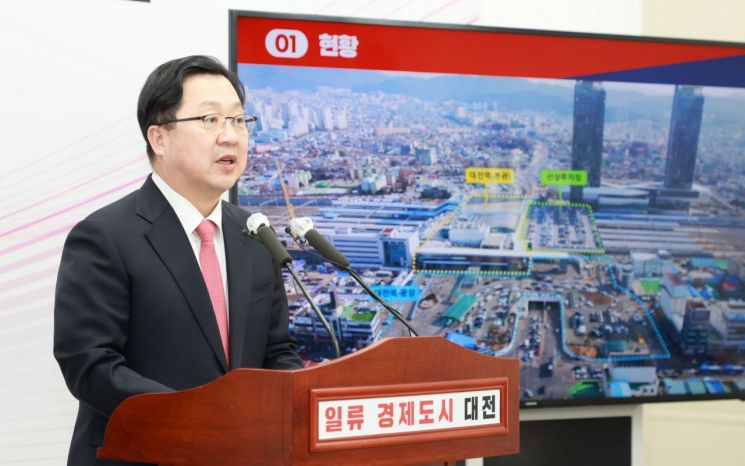 Lee Jang-woo, Mayor of Daejeon, is announcing the 'Daejeon Station Future-type Transfer Center Construction Plan' at Daejeon City Hall on the 28th. Photo by Daejeon City
On the 28th, the city announced that the ‘Daejeon Station Future-type Transfer Center Construction Plan’ was finally selected as a pilot project by the Ministry of Land, Infrastructure and Transport’s Metropolitan Area Wide-area Transportation Committee (hereinafter referred to as the MAWTC).
The contest was held for local governments nationwide. Twelve local governments across the country applied. Among them, four local governments where Daejeon Station, Pyeongtaek-Jije Station, Gangneung Station, and Masan Station are located were finally selected to participate in the pilot project.
According to the contest results, Daejeon will build a future-type transfer center on a 78,620㎡ site including the railway site and the west square area, including the elevated parking lot at Daejeon Station. The total project cost is 150 billion KRW, and completion is targeted for 2029.
The average daily number of users at Daejeon Station is about 37,000, ranking third nationwide after Seoul Station and Dongdaegu Station. However, voices calling for facility improvements have been continuously raised due to the relatively inconvenient transfer system between transportation modes.
Reflecting this, the city plans to build a future-type transportation system that enhances transfer convenience between existing transportation modes such as railroads, buses, and BRT through the construction of the future-type transfer center.
This year, the city will receive half of the 500 million KRW cost for establishing the basic plan for the future-type transfer center as national funding. In addition, more than 30% of the main project cost will be covered by national funds.
The basic concept plan includes establishing a vertical take-off and landing pad (vertiport) and charging facilities in the elevated railway space on the north side of Daejeon Station toward Seoul, considering the urban air mobility route, as well as creating passenger convenience facilities, meeting lounges, and an elevated cultural park (about 15,000㎡).
Also, the existing elevated parking lot on the south side, at the same height as the Daejeon Station concourse, will be expanded and rebuilt to provide a ‘Kiss and Ride’ facility where car drivers do not get off and only travelers board and alight, and a space for transferring to public transportation such as city buses, BRT, and taxis will be prepared.
The urban railway Line 2 Daejeon Station tram stop, which was scheduled to be built near Sinandong History Park adjacent to Daejeon Station, will be relocated to the underground road space under the east square of Daejeon Station to directly connect with the east square for easier transfer with railroads and other public transportation.
The west square of Daejeon Station will be transformed into a space for rest, meeting, and exchange for citizens and visitors, as well as a pedestrian-centered transportation transfer space. The vertical take-off and landing pad for urban air mobility to be installed at Daejeon Station will first introduce a triangular pilot route linked with Daedeok Innopolis and Gyochon Advanced National Industrial Complex by utilizing Daejeon’s three major national rivers, according to the city’s plan.
Upon completion of the future-type transfer center project, the city expects that the transfer service between various transportation modes around Daejeon Station will improve from the current level D (transfer time 3?4 minutes) to level C (transfer time 2?3 minutes).
In addition, the city will organically link major projects such as the Daejeon Station area urban convergence special zone plan, designation of the innovation city, and station area development projects to maximize synergy effects.
Lee Jang-woo, Mayor of Daejeon, said, “Once the project is completed, Daejeon Station will serve as a hub for balanced development between the east and west regions and become a center leading domestic future transportation.” He added, “The city will strive to build a ‘transportation network’ that unites the Chungcheong region with new transportation modes by linking this project with Daedeok Innopolis and Gyochon Advanced National Industrial Complex.”
© The Asia Business Daily(www.asiae.co.kr). All rights reserved.
![Clutching a Stolen Dior Bag, Saying "I Hate Being Poor but Real"... The Grotesque Con of a "Human Knockoff" [Slate]](https://cwcontent.asiae.co.kr/asiaresize/183/2026021902243444107_1771435474.jpg)















