Discovery of a Corona Hole 20 Times the Size of Earth
Further Analysis Needed on Solar Wind Strength
A 'black hole' the size of 20 Earths appeared on the sun, generating a 'solar wind' that is expected to affect Earth, potentially causing satellite malfunctions this weekend.
On the 28th (local time), U.S. science media Science Alert reported that NASA's solar observation satellite 'SDO' discovered a 'coronal hole' on the sun.
The coronal hole identified this time appeared consecutively following last week. This coronal hole is large enough to fit 20 Earths, whereas the coronal hole discovered last week was about the size of 30 Earths.
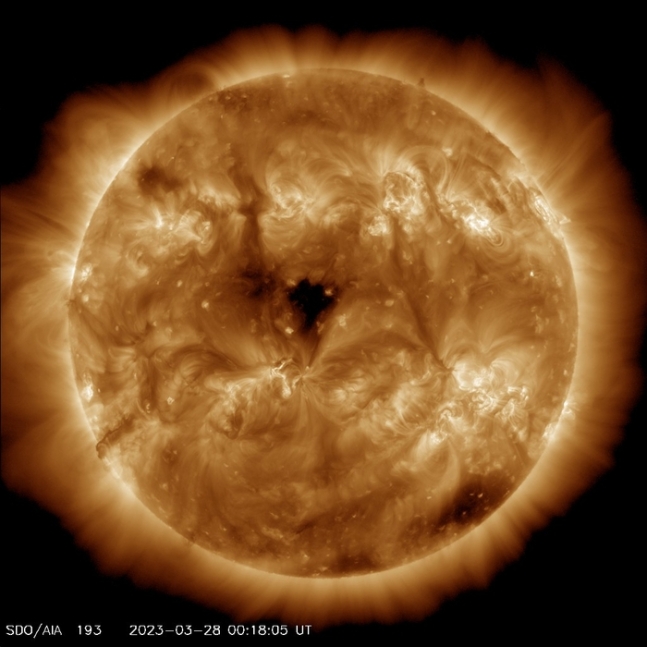 The coronal hole captured by the Solar Dynamics Observatory (SDO) of the National Aeronautics and Space Administration (NASA). [Photo by NASA]
A coronal hole is not a physical hole. It appears dark because its temperature is lower than the average temperature of the sun's outermost atmosphere (corona), which ranges from 1 million ℃ to 3 million ℃. The scientific community has not yet determined the exact origin of coronal holes but considers them part of the sun's normal activity.
As these coronal holes have been observed consecutively, concerns about 'solar wind' are increasing. Coronal holes are known as the starting points where solar wind begins to blow.
Solar wind is a stream of electrically charged particles such as electrons and protons. When solar wind reaches Earth, it disturbs Earth's surrounding magnetic field. It also damages the ionosphere, which reflects or absorbs radio waves in Earth's atmosphere.
This can cause damage to artificial satellites orbiting Earth or increase measurement errors in satellite navigation systems. Shortwave communications may be cut off, and power grids could experience failures. The interference with satellite operations is particularly problematic.
Scientists expect the solar wind originating from this coronal hole to travel at a speed of 800 km per second. It is predicted to reach Earth this Friday or Saturday.
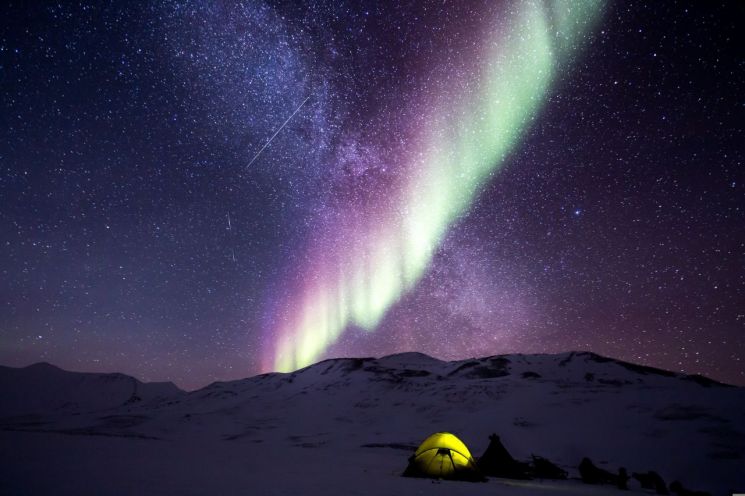 The appearance of the aurora. The photo is not directly related to the content of the article. [Photo source=Pixabay]
The actual strength of the solar wind requires further analysis. However, scientists anticipate that auroras will appear stronger than usual.
Meanwhile, the coronal hole discovered last week did not cause significant damage to Earth.
© The Asia Business Daily(www.asiae.co.kr). All rights reserved.
![Clutching a Stolen Dior Bag, Saying "I Hate Being Poor but Real"... The Grotesque Con of a "Human Knockoff" [Slate]](https://cwcontent.asiae.co.kr/asiaresize/183/2026021902243444107_1771435474.jpg)
















