The Ministry of Environment aims to supply 40,000 electric two-wheelers this year and will provide subsidies totaling 32 billion KRW. To expand the supply of electric two-wheelers, a battery swapping system will be introduced.
On the 28th, the Ministry of Environment announced the "2023 Electric Two-Wheeler Purchase Subsidy Reform Plan," which outlines these measures. First, a subsidy budget of 32 billion KRW was allocated to supply 40,000 electric two-wheelers this year. This is a 78% increase compared to last year's budget of 18 billion KRW for a target of 20,000 units. The total number of electric two-wheelers supplied so far is 62,917 units.
The Ministry of Environment identified the short driving range and long charging time (about 3 hours) compared to internal combustion engine two-wheelers as factors suppressing demand for electric two-wheelers. While internal combustion engine two-wheelers can travel about 300 km, electric two-wheelers only achieve a driving range of 70 km to 80 km per charge. To address these challenges, the Ministry restructured the subsidy system focusing on the expansion of battery-swappable electric two-wheelers, which allow users to immediately replace depleted batteries with fully charged ones at battery swapping stations.
Previously, subsidies were only provided when purchasing the entire electric two-wheeler including the battery. Going forward, subsidies will also be provided when purchasing only the vehicle body and using a battery sharing service. This subsidy will be about 60% of the full subsidy amount. The Ministry expects that this will not only promote the supply of battery-swappable electric two-wheelers but also significantly improve user convenience by expanding battery swapping stations and enhancing battery performance and safety management systems.
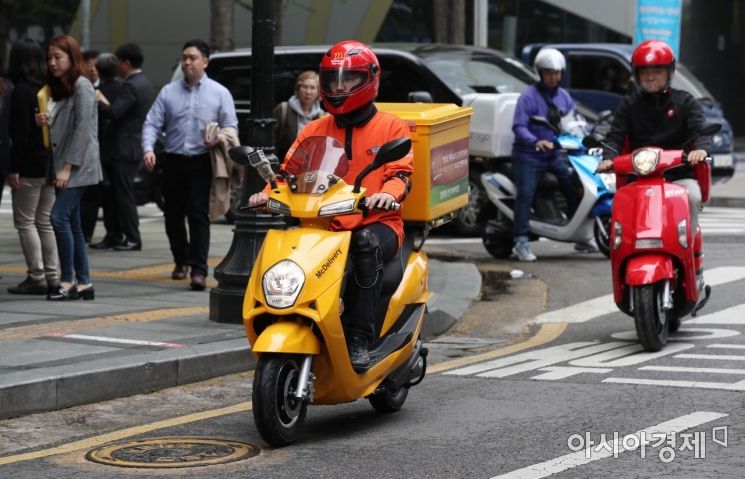 After the Seoul Metropolitan Government, franchise, and delivery specialized companies' electric two-wheeler transition win-win agreement ceremony held on the 24th at the Seoul City Hall video conference room, delivery drivers from McDonald's, Pizza Hut, and Barogo are conducting a pilot operation of electric two-wheelers. Photo by Moon Honam munonam@
The subsidy differentiation criteria based on the performance and size of electric two-wheelers will also be rationalized. Previously, other types of electric two-wheelers such as three-wheel vehicles were subject to the general (large) electric two-wheeler subsidy cap of 3 million KRW regardless of performance or size. Starting this year, separate subsidy standards will be established for other types of electric two-wheelers. The subsidy cap for this year is set at 2.7 million KRW, and plans are underway to apply differentiated subsidy caps based on the size and type of other vehicles in the future. The weight of battery capacity in subsidy calculation will be increased from 40% to 45% to promote the supply of electric two-wheelers with longer driving ranges per charge. An additional 10% subsidy will be provided to small business owners and vulnerable groups who use two-wheelers for livelihood purposes such as delivery.
The Ministry of Environment will post the "2023 Electric Two-Wheeler Supply Project Subsidy Processing Guidelines," which include the subsidy reform plan, on the Zero Emission Vehicle integrated website. After collecting supporting documents and gathering opinions by the 3rd of next month, the electric two-wheeler subsidies will be finalized. Park Yeon-jae, Director of Air Quality Policy at the Ministry of Environment, stated, "We expect not only improvements in air quality and reductions in greenhouse gas emissions from the expanded supply of electric two-wheelers but also industrial and economic benefits from the activation of innovative projects such as the battery subscription economy model."
© The Asia Business Daily(www.asiae.co.kr). All rights reserved.
![Clutching a Stolen Dior Bag, Saying "I Hate Being Poor but Real"... The Grotesque Con of a "Human Knockoff" [Slate]](https://cwcontent.asiae.co.kr/asiaresize/183/2026021902243444107_1771435474.jpg)
















