2024 Budget Guidelines Approved at Cabinet Meeting
Top Priority for Sectoral Budget Allocation is 'Export Enhancement and Support'
10% Reduction in Discretionary Spending, Welfare Focused on the 'Vulnerable'
The government is preparing next year's budget with the top priority of expanding and supporting exports. To maintain a sound fiscal policy, bold investments will be directed only to essential areas, while unnecessary expenditures such as cash welfare will be blocked. For welfare budgets, which account for a large share of spending, execution will focus on socially vulnerable groups.
The top priority for budget allocation by sector is 'export support'
The '2024 Budget Draft Preparation and Fund Operation Plan Guidelines,' approved and finalized at the Cabinet meeting on the 28th, reflect the government's strong determination to allocate the budget fully to exports. The first catchphrase among the four major investment focuses is to "boost private economic vitality through export drives and the promotion of Startup Korea." Last year, the top priority was "supporting a firm rebound and leap of our economy."
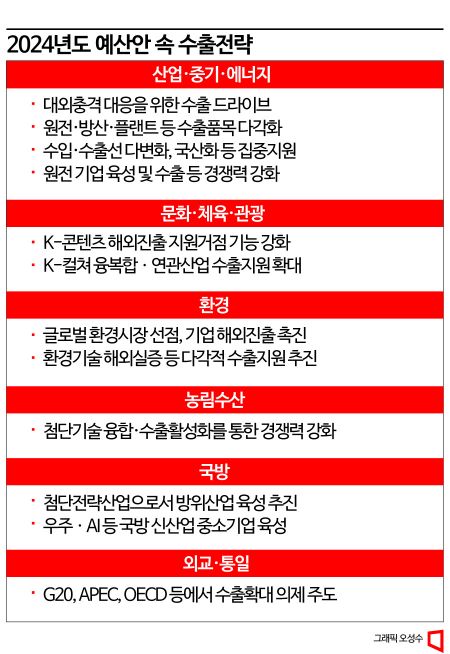
In the industrial, small and medium-sized enterprises (SMEs), and energy sectors, which account for the largest share of exports, the government announced plans to promote an "export drive." In the 2023 budget guidelines, the top priorities were "transition to a low-carbon economy" and "accelerating the spread and expansion of renewable energy," but with the new government’s inauguration and rapidly changing economic conditions, the priority has shifted to exports.
According to the changed strategy, the government plans to diversify export items focusing on promising sectors such as defense and plants, and support exports through online and digital methods. To proactively respond to the global supply chain restructuring, it will diversify import and export routes and also promote domestic research and development (R&D), as well as attract U-turn and foreign companies. In preparation for increasingly stringent global environmental regulations like the Carbon Border Adjustment Mechanism, support for domestic companies' carbon reduction efforts will also be increased.
Notably, a nuclear power industry promotion policy, which was absent last year, has appeared. The budget will be invested not only in nurturing nuclear power companies but also in nuclear power exports, related R&D, and infrastructure development. It aims to strengthen the international competitiveness of the nuclear power industry and support technology development and dissemination in new energy industries such as hydrogen and wind power. The fund operation plan announced on the same day includes measures to use the electricity fund for developing innovative small modular reactors, strengthening the nuclear power ecosystem, and supporting overseas expansion.
This policy direction aligns with President Yoon Seok-yeol’s emphasis on exports throughout his administration. Since the beginning of his term, President Yoon has stressed that "all ministries are the Ministry of Industry." At the Cabinet meeting held after his visits to the United Arab Emirates (UAE) and Switzerland in January, he mentioned, "I will run tirelessly as Korea’s number one salesperson." Furthermore, at the fourth export strategy meeting last month, he set a goal of "export plus (0.2% increase)" and established a new position of export and investment officer (level 1) to monitor export targets by ministry.
As a result, export expansion policies have been significantly addressed even in sectors that previously lacked export strategies. In the culture, sports, and tourism sectors, given the growing global status of "K-content," comprehensive support will be provided for exports of content and related industries to strengthen competitiveness. In the environmental sector, the government has set a strategy to focus on nurturing three major green industries with high growth potential?carbon neutrality, water, and circular economy?and aims to transform Korea into a green industry export nation. Support will be provided through various means such as large-scale project orders and overseas demonstration of environmental technologies.
10% reduction in discretionary spending, welfare reorganized around the 'vulnerable'
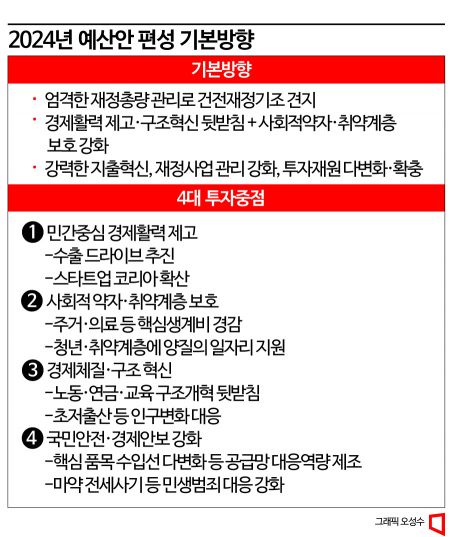
Along with focused investment, a strong sound fiscal policy will also be maintained. The government plans to reduce discretionary spending by more than 10% excluding rigid expenditures and national agenda items, continuing from last year. Discretionary spending is estimated to be around 100 to 120 trillion won in total, meaning a cut of 10 to 12 trillion won. The saved budget will be used as reinvestment funds. The government will also eradicate moral hazard caused by excessive or repeated receipt of social security benefits and will suppress public sector wage increases as much as possible.
Regarding government subsidies, which recently became controversial due to unions’ failure to submit accounting books, penalties will be imposed for fraudulent receipt and improper use. A task force will monitor projects and devise measures to prevent recurrence of fraudulent cases. Additionally, similar-purpose and function projects across ministries will be comprehensively reviewed, focusing on project consolidation and blocking duplicate payments. Choi Sang-dae, Vice Minister of Strategy and Finance, explained, "We will actively identify leak factors to prevent unjust waste of taxes," adding, "Cash-based service projects without verification of economic effects will be blocked."
The welfare budget will also focus on the "vulnerable." Budget will be allocated to the three major areas of welfare for the vulnerable: proactive response to welfare blind spots, strengthening coverage with substantial support, and expanding self-reliance foundations. Newly emerging welfare recipients such as isolated and reclusive youth or single-parent families will be supported, and medical safety net blind spots existing among low-income vulnerable groups will be actively identified and supplemented. Blind spots in the basic living security system and care support will also be addressed.
The government’s stance is that to provide thicker support to vulnerable groups within a limited budget, priority must be given to the vulnerable. The proportion of mandatory spending has increased every year, approaching 53.3% this year, and fiscal conditions are challenging due to rising national debt interest payments. However, there is speculation that pressure from the National Assembly to increase welfare budgets may intensify ahead of next year’s general election. Vice Minister Choi said, "It is not that political schedules are not considered," adding, "When the economy is difficult, focused budget support for socially vulnerable groups who are more struggling is necessary."
© The Asia Business Daily(www.asiae.co.kr). All rights reserved.
![Clutching a Stolen Dior Bag, Saying "I Hate Being Poor but Real"... The Grotesque Con of a "Human Knockoff" [Slate]](https://cwcontent.asiae.co.kr/asiaresize/183/2026021902243444107_1771435474.jpg)
















