Mayor Kang Gijeong and Minister Won Heeryong Hold 'Urban Development Cooperation Meeting'
Proposals Include Congested Road Improvements and Moonlight Expressway Urban Section Undergrounding
Minister Won: "Ministry of Land Leads Resolution of
On the 27th, Kang Ki-jung, Mayor of Gwangju Metropolitan City, requested national support from Won Hee-ryong, Minister of Land, Infrastructure and Transport, who visited Gwangju, for the early groundbreaking of the Gwangju Future Car National Industrial Complex, the undergrounding of the urban section of the Dalbit High-Speed Railway, and improvements to traffic congestion roads.
In response, Minister Won promised, "We will activate a one-team system to ensure maximum national support."
In the afternoon of the same day, Mayor Kang and Minister Won held the "Cooperation Meeting for Early Establishment of the Gwangju Future Car National Industrial Complex and Urban Development Infrastructure Support" at the former Jeonbang and Ilsin Textile sites, which are habitual traffic congestion and crowded areas expected to see a sharp increase in traffic volume due to landmark development.
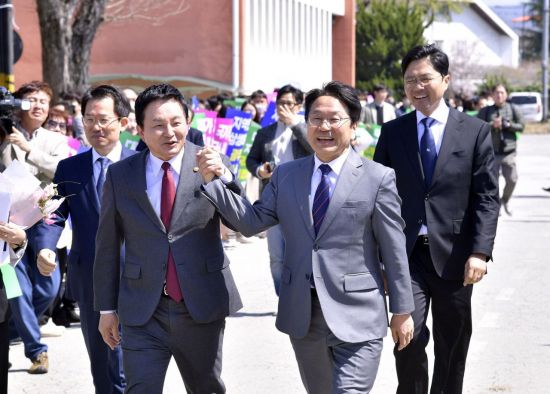
This meeting was arranged to discuss the Ministry of Land, Infrastructure and Transport's national industrial complex promotion plan and Gwangju City's pending issues following the selection of the "Gwangju Future Car National Industrial Complex" as the final candidate site for the new national advanced industrial complex by the Ministry on the 15th.
First, Gwangju City requested the Ministry to expedite procedures necessary for the establishment of the industrial complex, such as selecting the project implementer, conducting preliminary feasibility studies, and lifting the Greenbelt, to ensure the swift creation of the Gwangju Future Car National Industrial Complex.
Since the Bittgreen National Industrial Complex is saturated with a 91% sales rate, early groundbreaking of the Future Car National Industrial Complex is urgent. Therefore, support for a "one-stop permit service" was requested to promptly carry out various impact assessments, including environmental impact assessments, and the conversion of farmland and forest land.
Mayor Kang said, "The 1 million-pyeong Future Car National Industrial Complex is a new national industrial complex being created for the first time in 14 years. Along with semiconductors, it will be the future food source site for Korea and Gwangju." He added, "We will quickly establish the complex to cluster complete car manufacturers, materials and parts companies, research institutes, and enterprises, making it a genuine national industrial complex."
In response, Minister Won stated, "We will launch an inter-ministerial promotion team involving not only the Ministry of Land, Infrastructure and Transport but also other ministries to ensure the Future Car National Industrial Complex project proceeds as quickly as possible." He added, "Specifically, we will complete the selection of the project implementer by April and practically begin the establishment of the industrial complex."
He also promised to enact a special law for the urban convergence special zone to transform the Gwangju Sangmu district into an innovative space where jobs, housing, and leisure life coexist, and to create growth hubs such as the Gwangju Songjeong Station Investment Leading Zone and Chonnam National University Campus Innovation Park.
Gwangju City proposed seven projects to establish transportation infrastructure and create a breakthrough for regional development, which are local issues.
They suggested improvements to habitual traffic congestion roads such as Gwangcheon Intersection near the comprehensive bus terminal, Pungam Intersection, and Munhwa Intersection.
In particular, Gwangcheon Intersection is expected to see a sharp increase in traffic volume due to the president's pledge to open a complex shopping mall and the redevelopment projects in Imdong and Gwangcheon-dong. Accordingly, the plan is to include the "Bitgoeul-daero to Gwangcheon 2-gyo Congestion Road Improvement Project" in the 5th National Plan for Traffic Congestion Improvement in Metropolitan Areas, inducing traffic demand dispersion through the opening of bypass road networks.
They requested the undergrounding of the urban section of the Gwangju-Daegu Dalbit High-Speed Railway. Although the Dalbit High-Speed Railway is a key regional pledge of the president connecting six cities and provinces in Yeongnam and Honam regions, 10 local governments, and 18 million people, the section with the highest passenger and traffic volume between Gwangju Songjeong Station and Gwangju Station is planned as an aboveground line crossing the city center. This causes traffic disconnection between the north and south of Gwangju, hinders regional development, and increases accident risks, so the 14 km section should be undergrounded.
They also requested Korail to directly operate the shuttle train between Gwangju Station and Gwangju Songjeong Station, increase the number of KTX trains, and increase the frequency of dispatches. On weekends, the number of KTX operations in Gwangju is 48, which is less than half of Daegu's 121 and Busan's 119.
The passenger capacity per train is about 600 in Gwangju, whereas it is in the 900s in Ulsan, Daegu, and Busan, causing serious inconvenience to local residents and users. Considering fairness with other regions and the increasing trend of KTX usage, Gwangju City requested to increase the current 10-car trains to 20 cars and to increase the number of weekend dispatches.
Additionally, they requested improvements such as ▲ easing Greenbelt regulations including excluding the total volume of Greenbelt in the metropolitan area for the military airport relocation project and government pledge projects ▲ enacting the legal basis for the urban convergence special zone ▲ supplying medium-sized units of public rental housing within the KTX investment leading zone to create a breakthrough for regional development and support the success of the Gwangju-type job model.
Mayor Kang said, "The place where we stand now is a site with a history of exploitation during the Japanese colonial period and the hardships of industrial workers, and in the near future, it will be the site of a Gwangju landmark." He added, "One axis is the future car food source, and the other is building a city based on a fun city through a complex shopping mall. We will join forces with the Ministry of Land, Infrastructure and Transport. Since this is President Yoon Seok-yeol's election pledge, we request the government's active support."
Minister Won promised, "The complex shopping mall is the wish of Gwangju citizens, and we will support it as much as possible so that it can be built along with smooth traffic."
Regarding the undergrounding of the Dalbit High-Speed Railway, he said, "The Ministry of Land, Infrastructure and Transport is preparing a special law. According to the plan, it can be submitted to the National Assembly in the first half of the year." He added, "Once the special law is enacted, it will be possible to secure sufficient funding by attracting private investment. We will cooperate with Gwangju City to make it a reality."
© The Asia Business Daily(www.asiae.co.kr). All rights reserved.
![Clutching a Stolen Dior Bag, Saying "I Hate Being Poor but Real"... The Grotesque Con of a "Human Knockoff" [Slate]](https://cwcontent.asiae.co.kr/asiaresize/183/2026021902243444107_1771435474.jpg)
















