Suwon Hwaseong Haenggung, Suwon Hwaryeongjeon, Osan Doksanseong, etc.
"Filial piety, love for the people, and other temporal and regional values have not been sufficiently reviewed"
The relics of the new city built by King Jeongjo of the Joseon Dynasty failed to pass the first hurdle for UNESCO World Heritage registration. According to the Cultural Heritage Administration on the 27th, the World Heritage Subcommittee under the Cultural Heritage Committee reviewed the provisional list selection of the '18th-century King Jeongjo's New City Construction Relics' earlier this month and rejected it. They judged that temporality and urbanity were not sufficiently guaranteed. The committee evaluated that "as a serial heritage, the components do not sufficiently contribute to the Outstanding Universal Value (OUV), and some lack authenticity."
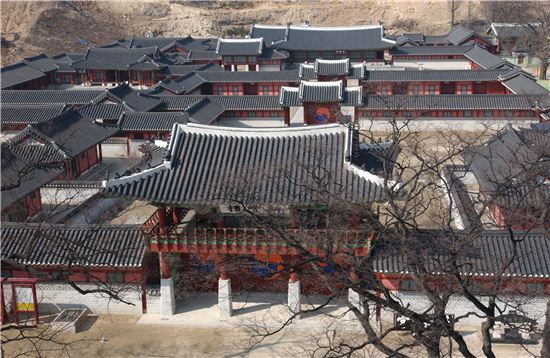 Panoramic View of Hwaseong Haenggung Palace in Suwon
The 18th-century King Jeongjo's New City Construction Relics refer to the relics of the new city established by Jeongjo to practice universal values of East Asian Confucian culture such as filial piety (孝) and love for the people (愛民). It collectively refers to ten sites including Hwaseong Yungneung and Geonneung, already registered as World Heritage, Suwon Hwaseong, Suwon Hwaseong Haenggung, Suwon Hwaryeongjeon, Jijidaebi, Osan Doksanseong and Sema site, Manseokgeo, Suwon Chukmanje, Suwon Hyanggyo, and Osan Gwolrisa.
The Gyeonggi Province explained in the registration application that "the universal values of filial piety, love for the people, and education were fused with the development of commerce and industry and Silhak thought during King Jeongjo's reign, serving as tangible evidence of a planned city realized with strong purpose in a short period." They added, "It encompasses functions such as royal tombs (陵寢) for kings or queens, irrigation (灌漑) necessary for farming, and governance (統治) of the country."
The committee conducted document reviews and on-site investigations and judged that provisional list registration was inappropriate. While acknowledging that "the attempt to discover new values of some components by linking Confucian values of the Jeongjo era with city construction is positive," they pointed out that "all the heritage applied for is focused solely on Jeongjo." They concluded that "it has not been sufficiently examined what temporal and regional values Jeongjo's filial piety, love for the people, and education held in the history of human civilization," and that "explaining it as a special case realizing universal values is an arbitrary interpretation."
The World Heritage provisional list is a kind of preliminary list that gathers heritage worthy of World Heritage registration. To apply for World Heritage registration, one must pass four stages of domestic review: provisional list, priority registration list, registration application candidate, and registration application target.
© The Asia Business Daily(www.asiae.co.kr). All rights reserved.
![Clutching a Stolen Dior Bag, Saying "I Hate Being Poor but Real"... The Grotesque Con of a "Human Knockoff" [Slate]](https://cwcontent.asiae.co.kr/asiaresize/183/2026021902243444107_1771435474.jpg)
















