[Report] Frontline of Vehicle Defect Investigation at Korea Automobile Safety Research Institute
Electric Vehicle Rear-End Collision Demonstration... Battery Safety Verification
World's Only Battery Drop Test Also First Public External Reveal
Self-Certification Compliance and Manufacturing Defect Investigation... 3.24 Million Vehicle Recalls
"Strengthening Investigation Standards for Future Cars like Autonomous Driving and Electric Vehicles"
A vehicle of similar size collided into the rear of a stationary Audi electric car at a speed of 48 km/h. The trunk area was dented, and the bumper and glass were shattered. They checked whether the high-voltage battery installed in the electric car was damaged by the collision or if there was any risk of electric shock due to leakage.
After confirming that there was no particular danger, the press, who had been standing at a distance, were allowed to approach the vehicle. This was a scene from an actual crash test held on the 23rd at the Crash Test Facility of the Korea Automobile Testing & Research Institute.
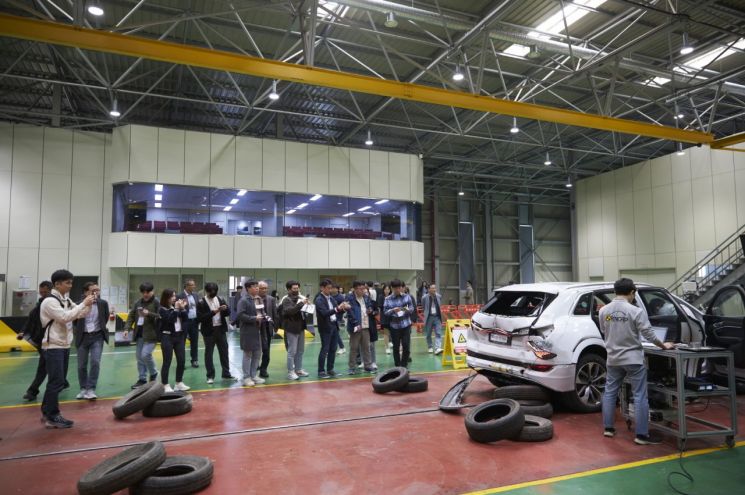 At the Vehicle Safety Research Institute's crash test facility, the results of the rear collision test of the Audi electric SUV e-tron are being reviewed.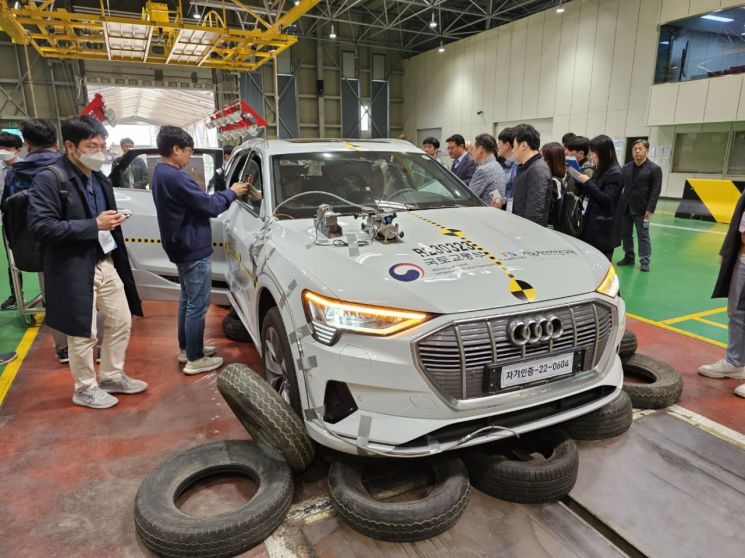
This test is part of the vehicle self-certification conformity investigation, where accidents likely to occur in daily life are simulated and the safety of the battery system is evaluated. Various data before and after the collision are analyzed using measuring instruments installed inside the vehicle to assess its safety. They even simulate scenarios where the vehicle flips over. Manufacturer representatives were also present at the site to observe.
Jang Hyeong-jin, a research fellow at the Korea Automobile Testing & Research Institute, said, "We examine manufacturing defects through various tests such as fixed wall impact, moving wall side impact, 75-degree pole side impact, and rollover tests. Since manufacturers may raise issues, we keep the test data for one year before disposal."
The drive battery (vehicle battery) drop test was also publicly revealed for the first time. A 400 kg battery pack used in a small commercial electric vehicle was dropped from a height of 4.9 meters. The battery hit the ground with a loud noise. A large dust collector was operated to prevent dust or harmful gases from escaping. They monitored for one hour to see if any fire would ignite.
Moon Bo-hyun, a senior researcher, said, "While a person might get injured from a 4.9-meter fall, the battery must not fail. We verify whether the safety standards are properly met through rigorous testing."
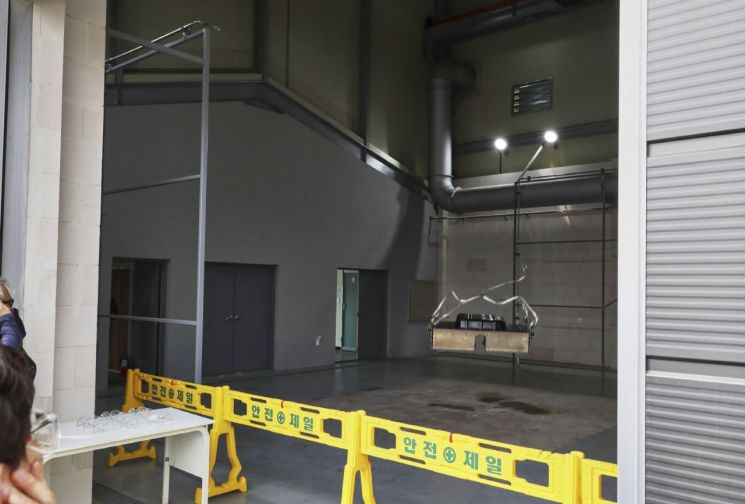 A drop test is being conducted in the Battery Safety Testing Laboratory. A 400kg battery pack used in the electric 1-ton truck Porter was dropped freely from a height of 4.9 meters.
 South Korea is recognized as a powerhouse in battery technology and manufacturing, and its safety standards are also world-class. Since 2009, this institute has developed various safety standards and testing methods. International standards related to battery safety emerged in 2013. There are about ten international safety standards for automotive batteries, but this institute tests twelve, exceeding that number.
The battery drop test demonstrated that day is conducted only in South Korea. It assumes all possible scenarios that could arise while driving an electric vehicle. Even China, where electric vehicle adoption is rapid and the battery industry is large, refers extensively to this institute’s safety standards and testing methods.
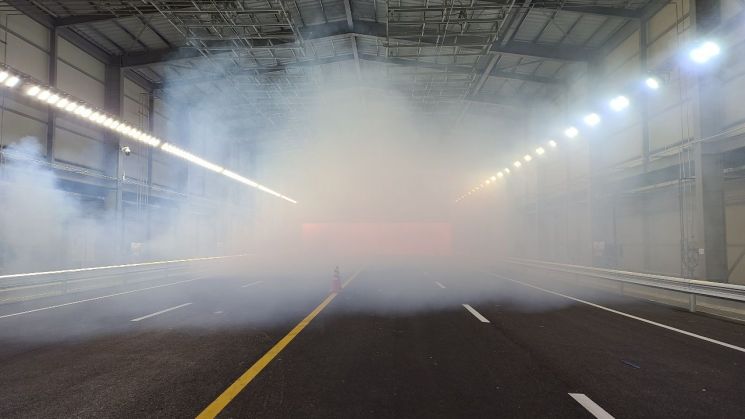 Weather Environment Simulation Facility. It can also create dark conditions by blocking light in a four-lane tunnel shape.
 A facility to verify the performance of various driving assistance systems and autonomous driving technologies under rain or fog conditions has recently started operation. It can simulate heavy rain at 80 mm per hour and fog conditions where visibility is reduced to 1?2 meters. A space to test whether electromagnetic waves emitted by vehicles harm the human body or cause malfunctions in the vehicle due to electromagnetic interference, as well as demonstrations of the Automatic Emergency Braking System (AEBS) mandated for buses and vans, were also shown to the press that day.
South Korea used to operate a type approval system for automobiles and parts but switched to a self-certification system in 2003. Type approval is a method where the government pre-approves safety standards and other requirements, which is common in Europe, Japan, and most other countries. Self-certification allows manufacturers to produce vehicles autonomously but holds them fully accountable for defects. This system is used in the United States and Canada and was adopted by South Korea following the Korea-US automotive negotiations in the 1990s.
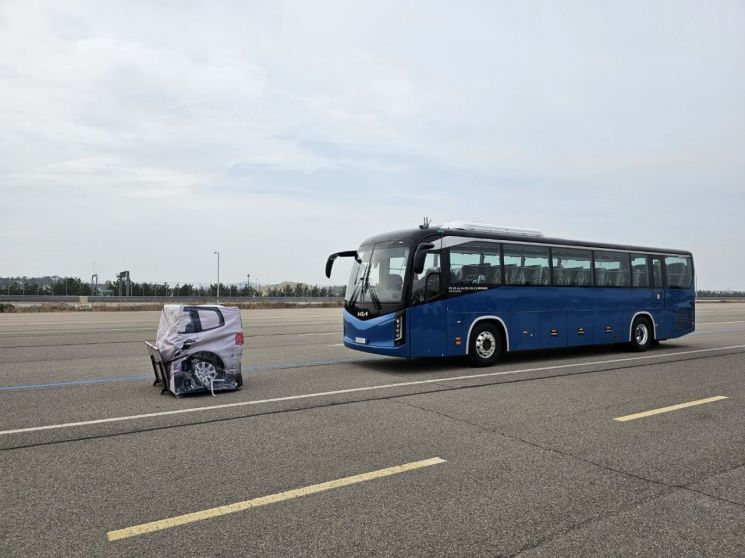 An emergency automatic braking system (AEBS) test conducted with a 45-seat bus. This device, mandatory for buses and vans, detected objects ahead and stopped the vehicle 3 to 4 meters in front without driver intervention.
 While self-certification increases autonomy and industrial competitiveness, it requires thorough scrutiny to ensure safety standards are properly met. This is why the Korea Automobile Testing & Research Institute puts great effort into the self-certification conformity investigation project. To ensure impartiality, the institute does not receive vehicles from manufacturers but allocates its own budget to purchase new cars. Vehicle types and models are selected based on sales volume and complaint reports over the past two years.
Alongside this, safety defect investigations have led to the recall of 3,247,296 vehicles last year alone, a more than 15-fold increase compared to ten years ago. This is the result of meticulously reviewing about 7,800 reports received by the recall center operated by the institute and approximately 5,200 documents submitted by manufacturers. In the process of prompting free repairs for the engine oil increase issue in Hyundai hybrid vehicles, close cooperation with the Korea Transportation Safety Authority’s vehicle inspection office played a key role. The institute also filtered out Chinese electric buses that failed to meet performance standards during document reviews.
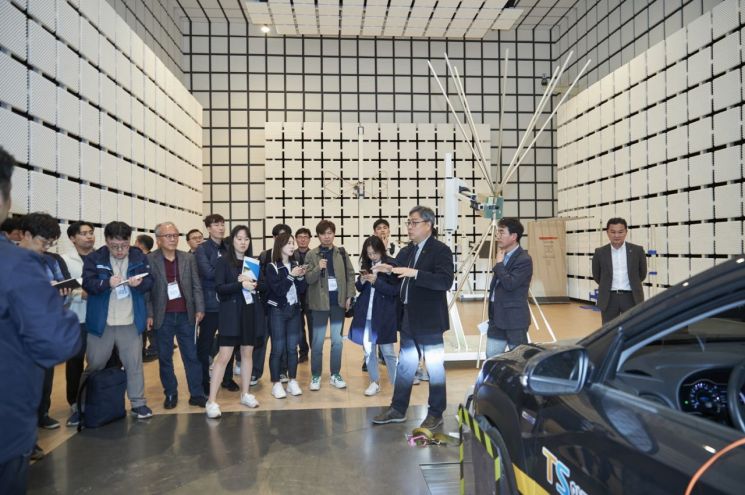 Eom Seong-bok, President of the Korea Automobile Safety Research Institute, is explaining the test principles to the press inside the Electromagnetic Compatibility Testing Room at the institute.
 Safety is considered the foremost factor not only in vehicle development and manufacturing but also during operation. The reason we do not have to worry about safety every time we drive or use a vehicle is because of the social consensus to establish and adhere to related standards.
Um Seong-bok, president of the Korea Automobile Testing & Research Institute, said, "We will strengthen the accident investigation and response system for automobile defects such as self-certification conformity investigations, autonomous driving devices, and battery fires, and conduct prompt defect investigations so that the public can use future vehicles with confidence."
© The Asia Business Daily(www.asiae.co.kr). All rights reserved.
![Clutching a Stolen Dior Bag, Saying "I Hate Being Poor but Real"... The Grotesque Con of a "Human Knockoff" [Slate]](https://cwcontent.asiae.co.kr/asiaresize/183/2026021902243444107_1771435474.jpg)

















