A single wooden house (based on 63㎡·19 pyeong) offsets the annual carbon dioxide emissions of 18 passenger cars, according to a research result.
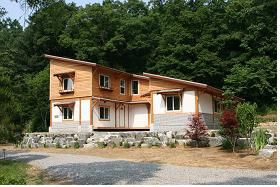 Exterior view of the 'Hangreen' wooden house. 'Hangreen' is a trademark developed and registered by the National Institute of Forest Science, constructed using the Pre-Cut method, which assembles major wooden building materials on-site. It features a hybrid structure that harmonizes the advantages of traditional wooden houses and Hanok houses. Source=Asia Economy DB
The Korea Forest Service's National Institute of Forest Science recently conducted an evaluation of the carbon dioxide storage and emissions of wooden buildings, revealing this result on the 26th.
The evaluation was carried out using a self-developed life cycle assessment program to quantitatively assess the environmental impact of wooden construction.
This method calculates the carbon dioxide emissions and carbon storage capacity from wood usage for six types of standard wooden house designs provided by the Korea Forest Service.
As a result, six types of wooden houses ranging from 63㎡ to 136㎡ (19 pyeong to 41 pyeong) emitted 153.1tCO2 to 230.2tCO2 of carbon dioxide throughout the entire construction process, from raw material manufacturing to disposal, showing 17.6tCO2 to 52.7tCO2 less emissions compared to general houses.
On the other hand, the carbon storage due to wood usage was found to be 17tCO2 for the 63㎡ (19 pyeong) type and 34tCO2 for the 136㎡ (41 pyeong) type.
Considering that the annual carbon dioxide emission per passenger car is 1.92tCO2 (based on an annual driving distance of 15,000 km), a single 63㎡ (19 pyeong) wooden house offsets the annual carbon emissions of 18 passenger cars, and the 136㎡ (41 pyeong) type offsets that of 45 cars.
In particular, the National Institute of Forest Science explained that as wooden buildings increase in size, the carbon dioxide emissions per unit area decrease, and the carbon storage due to increased wood usage rises. Following global trends, if wooden construction in Korea becomes larger and taller, the contribution to carbon neutrality through wooden buildings will be greater.
Dr. Minji Kim of the Wood Industry Research Division at the National Institute of Forest Science said, “Wooden construction is both a way to reduce carbon emissions and to store carbon, making it a building suitable for the carbon-neutral era.” She added, “The National Institute of Forest Science plans to continuously work with related ministries to reflect relevant indicators in the green building certification system to recognize the eco-friendliness of wooden construction.”
© The Asia Business Daily(www.asiae.co.kr). All rights reserved.
![Clutching a Stolen Dior Bag, Saying "I Hate Being Poor but Real"... The Grotesque Con of a "Human Knockoff" [Slate]](https://cwcontent.asiae.co.kr/asiaresize/183/2026021902243444107_1771435474.jpg)















