Fair Trade Commission Standard Terms "Damaged Gift Certificates Must Be Reissued"
Company Refuses Exchange Claiming "Part of Serial Number Erased"
A consumer filed a lawsuit after a gift certificate issuing company refused to exchange a gift certificate damaged by being accidentally put in the washing machine.
According to a Yonhap News report on the 25th, Mr. A, who runs a law firm in Daegu, filed a complaint with the Seoul Eastern District Court on the 21st requesting Emart to exchange a Shinsegae gift certificate worth 100,000 won with a damaged serial number and barcode. In the complaint, Mr. A claimed that if Emart does not exchange the gift certificate in time, it must also pay interest of 6-12% per year.
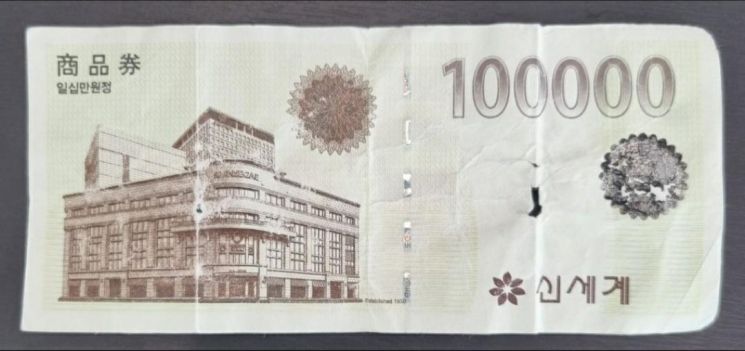
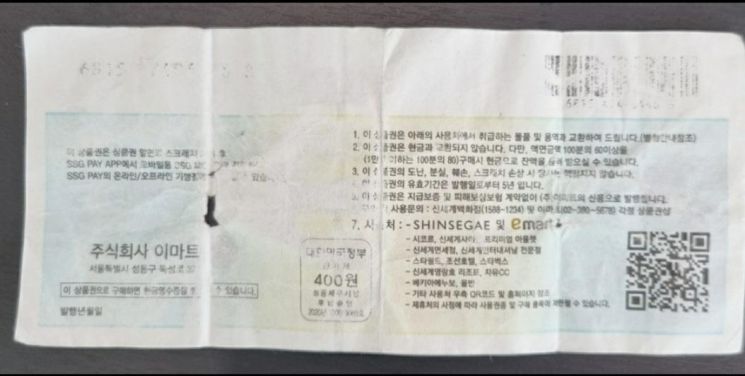
Mr. A accidentally put the gift certificate in the washing machine while doing laundry around September last year, resulting in some of the serial number and barcode on the gift certificate being erased. He visited the Banwaryeol branch of Emart in Daegu in November of the same year to request an exchange of the gift certificate.
Although part of the serial number on the gift certificate was erased, Mr. A argued that since Emart is the issuer of the gift certificate and the type and amount of the gift certificate can be confirmed, Emart has the obligation to reissue the gift certificate according to the Fair Trade Commission’s standard terms and conditions.
Article 6 of the Fair Trade Commission’s standard terms states, "If requested by the customer, the issuer or franchisee must reissue a damaged gift certificate. If the gift certificate is damaged to the extent that it is impossible to confirm that it is issued by the issuer, reissuance and use of the gift certificate may be refused. However, if it is possible to know that it is the issuer’s gift certificate but the type, amount, or quantity of the gift certificate is unclear, the customer may receive a reissued gift certificate at the lowest price within the scope that can be confirmed or use it."
However, Emart refused Mr. A’s exchange request. Emart stated, "We follow the Fair Trade Commission’s standard terms, but Mr. A’s gift certificate has a damaged serial number, so we cannot verify whether it is genuine or has been used," and added, "It is also stated on the back of the gift certificate that we are not responsible if the gift certificate is damaged."
"Shifting Responsibility to Consumers... Lawsuit Filed for Public Interest"
Mr. A opposed this and started a lawsuit. In an interview with Yonhap News, he pointed out, "Emart claims that the gift certificates were manufactured by the Korea Minting and Security Printing Corporation, but there seems to be a quality problem. Even a 1,000 won bill does not have its serial number erased when put in the washing machine, but the gift certificate did. I suspect that ink that is easily damaged on purpose was used."
He also said, "The Fair Trade Commission’s terms clearly state that damaged gift certificates can be exchanged, but the back of the Shinsegae gift certificate states that 'we are not responsible for damaged gift certificates,' which differs from the terms and shifts the damage to consumers. They also say that 500,000 won and 1,000,000 won gift certificates cannot be used if the serial number is damaged. I believe there are many victims like me, so I filed the lawsuit for the public interest on their behalf." In fact, the backs of Lotte Department Store and Hyundai Department Store gift certificates also state that they cannot be used if damaged.
An Emart official told Yonhap News, "Even if the gift certificate is damaged, if more than 60% remains, we exchange it without charging a fee. We try to do as much as possible from the customer’s perspective. It is important whether the gift certificate is genuine or has been used. We are reviewing how to handle the clause on the back of the gift certificate that was pointed out as different from the Fair Trade Commission’s terms."
© The Asia Business Daily(www.asiae.co.kr). All rights reserved.
![Clutching a Stolen Dior Bag, Saying "I Hate Being Poor but Real"... The Grotesque Con of a "Human Knockoff" [Slate]](https://cwcontent.asiae.co.kr/asiaresize/183/2026021902243444107_1771435474.jpg)
















