KB Financial 'Report on the Potential Shift from Excess Household Savings to Consumption in China'
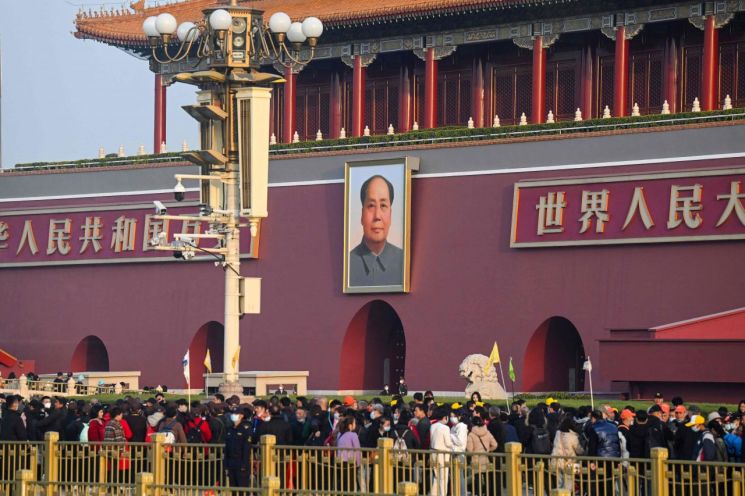
It is estimated that during the COVID-19 pandemic, China accumulated excess savings of up to 1,391 trillion won.
The report titled "Assessment of the Consumption Conversion Potential of Excess Household Savings in China," released by KB Financial Group on the 26th, analyzed the scale of "excess savings of Chinese households," which is pointed out as a major factor in the slowdown of China's consumption recovery, and examined the prospects for the Chinese and global economies accordingly.
The report estimated that the amount of excess household savings in China during the pandemic period from 2020 to 2022 ranged from a minimum of 4 trillion yuan (approximately 752 trillion won) to a maximum of 7.4 trillion yuan (approximately 1,391 trillion won). Here, household savings refer to the portion remaining after subtracting consumption expenditure from disposable income. Household savings that are not spent on consumption can be used for bank deposits, financial product investments, home purchases, overseas asset investments, and so on.
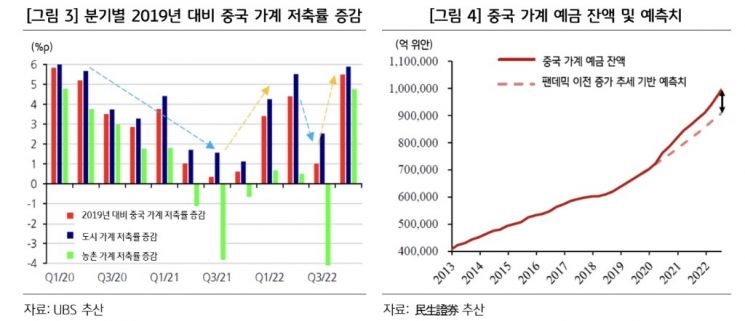
The report analyzed that the main reasons for such massive excess savings in China are the slowdown in the growth of household consumption expenditure, a decrease in home purchases, and a contraction in financial product investments. Regarding the outlook for China's consumption recovery, it stated, "Some signs indicate that consumption is likely to recover," and "the possibility that part of the excess savings of Chinese households will be converted into consumption has increased," but it predicted that the pace would not be fast.
According to the report, since the excess savings of Chinese households mainly arose from precautionary saving intentions and reduced consumption rather than additional household income, it is unlikely that consumption will be activated in the short term. In particular, consumption related to real estate is expected to remain sluggish for the time being. The report also predicted that the impact on the global economy would be limited. However, it advised preparing for "increased volatility in international crude oil prices" due to the expected rise in aviation fuel demand from increased Chinese travelers.
A representative from KB Business Research Institute said, "It is true that expectations have risen due to the recent reopening of economic activities in China, but it will take some time before the effects become visible," and added, "We will closely monitor the Chinese economic situation, which is closely linked to our country's economy, and make various efforts to provide accurate information to individuals and corporate clients."
© The Asia Business Daily(www.asiae.co.kr). All rights reserved.
![Clutching a Stolen Dior Bag, Saying "I Hate Being Poor but Real"... The Grotesque Con of a "Human Knockoff" [Slate]](https://cwcontent.asiae.co.kr/asiaresize/183/2026021902243444107_1771435474.jpg)
















