'The Time of K-pop' Interview with Writer Taeyangbi
Classifying K-pop Idols by Generations and Movements
"TVXQ and Big Bang Are Idols from the Same Era but Completely Different Genres"
Exploring the 'Spirit of the Age' in the K-pop Chronicle Reflecting Korean Society
"The life of a product is determined by its export potential. The influence of K-pop, which miraculously achieved globalization in an area that was almost a barren land, will impact and be remembered by people and industries for a long time to come. We focused on the history and value of K-pop that form the foundation of this phenomenon."
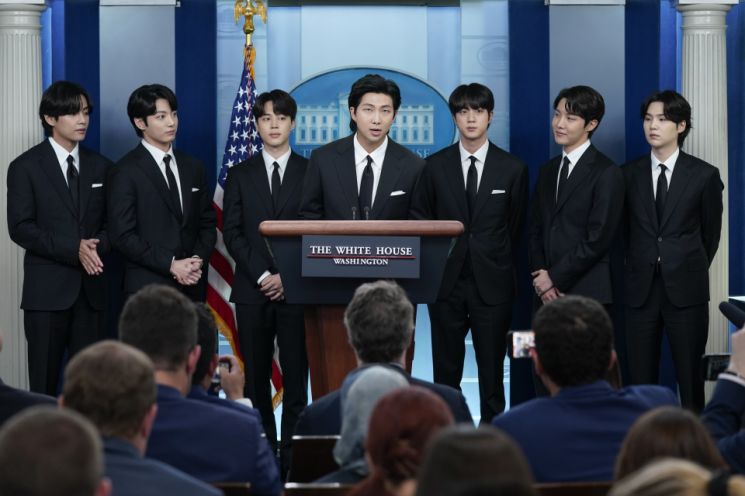 Group BTS's RM (center) is speaking with members in the White House briefing room in Washington DC, USA, on May 31 last year (local time). On this day, BTS reportedly discussed measures to counter anti-Asian hate crimes with U.S. President Joe Biden. From the left in the photo: V, Jungkook, Jimin, RM, Jin, J-Hope, Suga. Photo by AP
The flow of 'Hallyu' that began with first-generation idols and dramas has continued into K-content, rising to become a leading export industry in just four and a half decades. According to the '2021 Content Industry Survey' released by the Ministry of Culture, Sports and Tourism in January, the export value of the content industry in 2021 reached 12.45 billion USD, significantly surpassing Korea's representative export items such as home appliances (8.67 billion USD) and electric vehicles (6.99 billion USD).
While everyone focuses on the dazzling present, a book that unravels the flow of K-pop from a historical perspective centered on idols is gaining attention. Titled K-pop's Time with the subtitle "From Seo Taiji and Boys to NewJeans, a History-based Reading of K-pop," it covers idols, agencies, trends, and origins from the mid-1990s to the 2020s in chronological order. In an interview with Asia Economy on the 20th, author Taeyangbi said, "I wanted to explore the past, present, and future of K-pop along with the context of K-pop that runs through Korean society and its influence in the global market."
The author categorizes K-pop groups by ideological schools. Although he initially intended to write according to the common generational classification of K-pop groups, he found many conflicting points when considering the actual activity periods of the groups. He explained, "TVXQ and Big Bang were active around the same time but are completely different idols. TVXQ represents the perfected system-based idol, while Big Bang can be called the founder of musician-based idols." He added, "BTS and Block B were also active during similar periods, but Block B pursued naturalness as musician-based idols, whereas BTS has a strong community identity as leaders of the ARMY, classifying them as a community-based group." In the book, he organizes the history of K-pop groups into four ideological categories: ▲System-based ▲Musician-based ▲Community-based ▲Icon-based, summarizing idol activities accordingly.
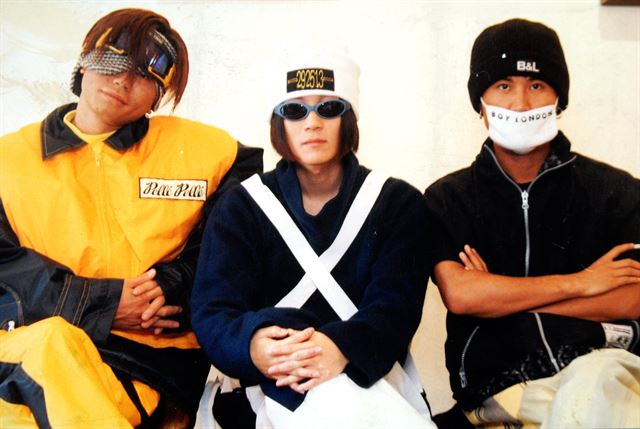
From a syntactic perspective, K-pop history is usually traced back to the 1960s, but the author sets the starting point at the emergence of one striking group remembered by the public. Regarding the most notable moment in K-pop history, the author said, "The debut stage on April 11, 1992, on MBC's Special TV Entertainment program by Seo Taiji and Boys was a moment of great shock," explaining, "That scene featured flashy costumes, astonishing breakdance, intense metal guitar sounds, and above all, sharp criticism from music experts such as 'It seems they didn't care about the melody' and 'The choreography overshadowed the singing'." He continued, "Though harsh for a rookie singer, the debut song 'I Know' achieved tremendous success, ranking among the greatest in Korean pop history. When recalling predecessors and pioneers of currently active representative K-pop groups like Stray Kids, NCT, and BLACKPINK, most people think of this moment and this one song."
Taeyangbi confessed, "Honestly, writing the early chapters covering Seo Taiji and Boys, Hyun Jin-young and Deux, and H.O.T. was the most enjoyable." He said that from today's perspective, the beginning was not perfect, and some songs showed clear limitations, but it was fascinating how that small element grew into a Big Bang, revealing distinct characteristics different from before.

The author defines current idol groups as no longer "puppets dancing on command" but as "idols and musicians." He emphasized, "In idol groups, especially boy groups, there is a producer among the members, and most members try to write their own lyrics. Starting with G-Dragon, the category of 'idol and musician' was established, and subsequent boy groups like BTS, Seventeen, DAY6, and Stray Kids are cases that have been trained to create and lead their own music."
Regarding former SM Entertainment chief producer Lee Soo-man, who holds significant weight in the book, the author described him as a figure like 'Hitchcock.' The book Hitchcock/Truffaut shows how Truffaut, a pioneer of art films, condensed everything about Hitchcock, the greatest box office director, into his own perspective to reveal his artistic world. Although recent controversies surrounding SM are nearing resolution, Taeyangbi said that the evaluations of producer Lee Soo-man and businessman Lee Soo-man discussed in the book should be considered separate domains.

He said, "H.O.T. is the first true K-pop idol group in the real sense. There was an agency, members who went through trainee systems, and a fandom that sometimes clashed and sometimes collaborated with the agency, building a tense relationship. Only by adding all these elements does one become a K-pop idol." He added, "From a commercial perspective, creating content for the public and sustaining a long, successful career that established the idol system is a phenomenon that will remain in cultural history. I think his influence will be imprinted as strongly as Hitchcock's impact on film history."
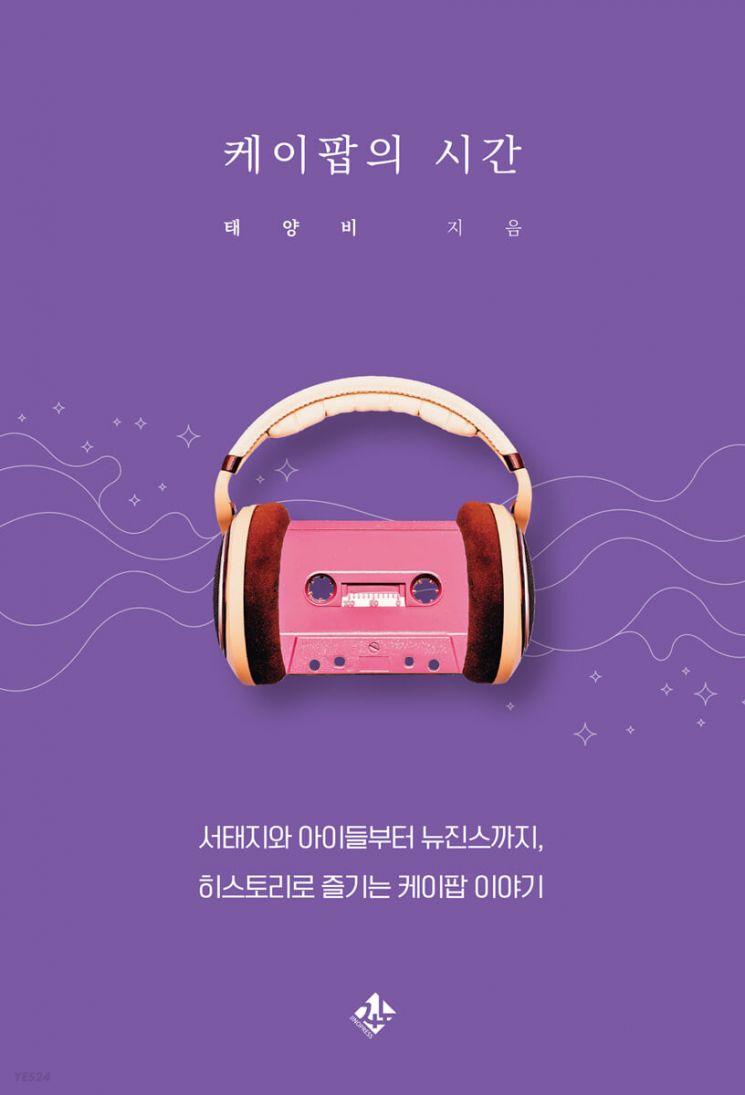 K-Pop Time_From Seo Taiji and Boys to NewJeans, a K-Pop Story Read Through History / Written by Taeyangbi / Gino.
 [Photo by Gino]
Taeyangbi, who was leading an ordinary office life at an IT company, received a publishing proposal after serializing various writings about K-pop in current affairs weekly magazines and music streaming sites, and transitioned to a full-time writer after recognizing the potential of the K-pop industry. He said, "In Korea, the life of any industry or profession is determined by export potential, and in that sense, K-pop is the most commercial yet art field that competes through technology." He added, "However, if technology lacks perspective or virtue, it remains mere gimmickry. Through this book, I sought to identify the ideological schools embedded in K-pop beyond simple technology and provide a unified viewpoint." Just as British pop is remembered through The Beatles and Britpop and many groups remain active today, he hopes K-pop will continue to have a significant influence in the global music market for a long time. At the end of the interview, he expressed his desire to remain someone who delivers 'good stories' about K-pop in the future.
© The Asia Business Daily(www.asiae.co.kr). All rights reserved.
![Clutching a Stolen Dior Bag, Saying "I Hate Being Poor but Real"... The Grotesque Con of a "Human Knockoff" [Slate]](https://cwcontent.asiae.co.kr/asiaresize/183/2026021902243444107_1771435474.jpg)

















