Yellow Dust from China... Fine Dust Concentration Soars to 430㎍ on Baengnyeongdo
Harmful Substances like Fine Dust Cause Trouble, But...
Calcium, Magnesium, Iron, and Phosphorus in Yellow Dust Also Play Beneficial Roles
Due to the first yellow dust of this spring, fine dust advisories were issued in most regions nationwide. Yellow dust, which carries fine dust and various harmful substances, is considered a 'bane' as it has fatal effects on respiratory and cardiovascular patients. However, substances such as lime, magnesium, iron, and phosphorus in yellow dust play a beneficial role for the Earth.
According to the National Institute of Environmental Research under the Ministry of Environment on the 24th, the yellow dust that flowed in the previous day has accumulated due to airflow convergence, resulting in high fine dust concentrations in most areas.
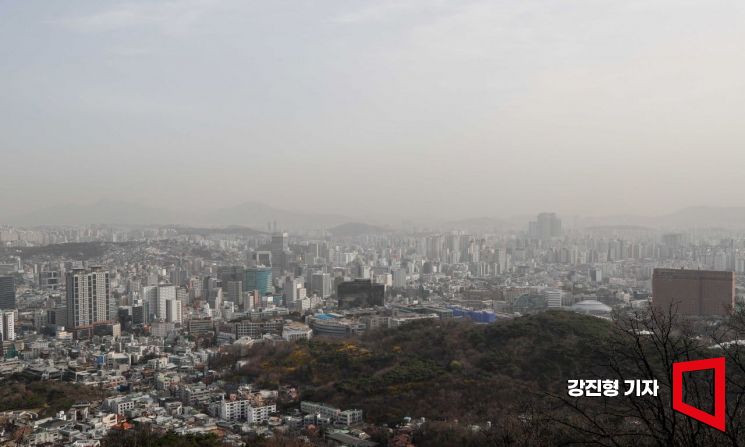 On the 24th, when the yellow dust from China arrived, the city center viewed from Namsan in Seoul was shrouded in fine dust accompanied by yellow dust. Photo by Jin-Hyung Kang aymsdream@
As the influx from China began, the fine dust concentration on Baengnyeongdo soared to 430㎍ per cubic meter at 12 PM on the 23rd. As of the 24th, Daejeon and Ulsan recorded fine dust concentrations exceeding 190㎍ per cubic meter, Seoul recorded 135㎍, and Jeonbuk Province recorded 171㎍. The fine dust concentration levels are classified as 'Good' (0~30㎍/㎥), 'Moderate' (31~80㎍/㎥), 'Unhealthy' (81~150㎍/㎥), and 'Very Unhealthy' (151㎍/㎥ and above).
Yellow dust is expected to be severe not only this weekend but also in the future. This is because drier weather than usual continues in major source areas this year, such as the Gobi Desert, the Inner Mongolian Plateau, and northeastern China. When airflow conditions are met, yellow dust from China crosses over to the Korean Peninsula and affects the region.
Yellow dust refers to particles smaller than 100㎛ composed of magnesium oxide, aluminum, iron, etc., generated in deserts and carried by the wind. It usually brings fine dust and various harmful substances or clouds the visibility with a yellowish tint, earning it the nickname 'springtime unwelcome guest.'
However, yellow dust does not only play a harmful role. It contains lime components that help neutralize acid rain and prevent soil acidification. Additionally, substances such as magnesium and potassium in yellow dust provide nutrients necessary for plant growth. When yellow dust flows into the sea, it supplies iron, phosphorus, and other elements that enrich plankton.
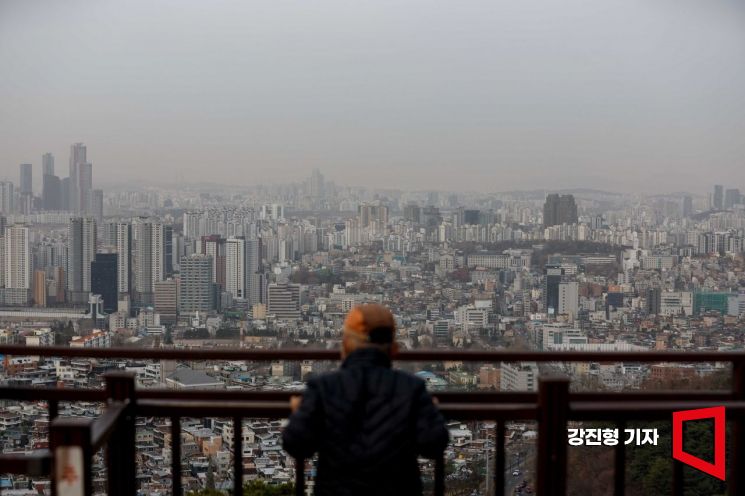 On the 24th, yellow dust originating from China covered the city center viewed from Namsan in Seoul, accompanied by fine dust. Photo by Jinhyung Kang aymsdream@
There are also research findings that atmospheric dust like yellow dust plays a role in suppressing global warming. In January, researchers at the University of California, Los Angeles (UCLA) collected and analyzed glacier cores, marine sediments, and peatland samples, publishing their results in the international journal Nature Reviews Earth & Environment. They found that atmospheric yellow dust increased by 55% since the late 1800s due to yellow dust events, which could have suppressed global warming by up to 8%.
According to the researchers, global temperatures have risen by about 1.2 degrees Celsius since 1850 due to human activities. Atmospheric dust has increased globally by 26 million tons, equivalent to the weight of about 5 million African elephants floating in the sky. However, the increased dust partially suppressed the rise in global temperatures. While dust can raise Earth's temperature, it plays a greater role in removing clouds that enhance the greenhouse effect, thereby ultimately limiting the rise in Earth's temperature.
Nevertheless, various harmful substances carried by yellow dust can directly harm humans, so caution is necessary. On days with severe yellow dust, outdoor activities should be minimized, but if going outside is unavoidable, wearing a health mask is recommended. Health mask packaging indicates particle blocking performance with ▲KF80 ▲KF94 ▲KF99. The higher the KF number, the higher the fine dust blocking rate: KF80 filters out more than 80% of fine particles averaging 0.6㎛ in size, while KF94 and KF99 block 94% and 99% or more of particles averaging 0.4㎛, respectively.
© The Asia Business Daily(www.asiae.co.kr). All rights reserved.
![Clutching a Stolen Dior Bag, Saying "I Hate Being Poor but Real"... The Grotesque Con of a "Human Knockoff" [Slate]](https://cwcontent.asiae.co.kr/asiaresize/183/2026021902243444107_1771435474.jpg)
















