First Public Display of Underwater-Launched Strategic Nuclear Weapon 'Haeil' Explosion Test
North Korea Diversifies Nuclear Delivery Platforms... Targets Major South Korean Facilities
Possibility of Developing Ultra-Large Nuclear Warhead Through 7th Nuclear Test
It has been revealed that a significant portion of the '5 Major Defense Tasks' ordered by North Korean State Affairs Commission Chairman Kim Jong-un has been realized. North Korea has recently demonstrated the operational capability of its nuclear weapons not only on land and in the air but also underwater, which is analyzed to reflect a counter-strategy aimed at neutralizing South Korea's Korean-style 3-axis system designed to strike North Korea's nuclear and missile capabilities.
On the 24th, the Korean Central News Agency unveiled the nuclear unmanned underwater attack vehicle 'Haeil' and described it as an "underwater nuclear strategic weapon." The purpose of Haeil is explained as "to covertly submerge into the operational waters and cause an ultra-powerful radioactive tsunami through an underwater explosion to destroy and annihilate enemy ship groups and major operational ports."
First Public Display of Underwater Nuclear Drone Explosion Test... Targeting Major South Korean Ports
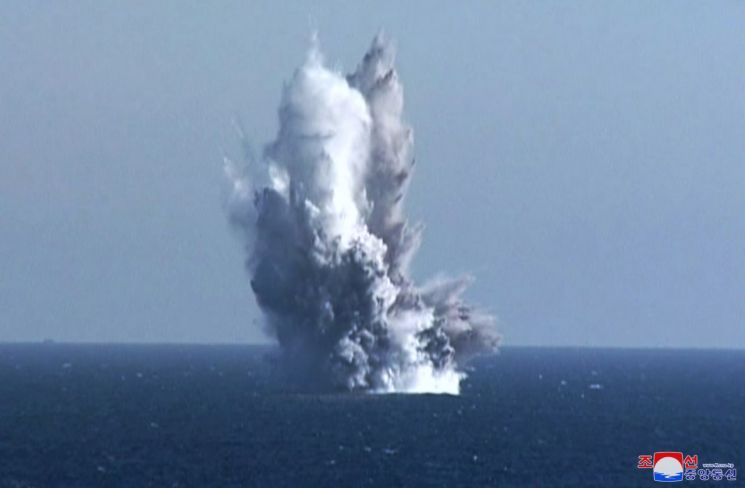 North Korea announced that from the 21st to the 23rd, under the observation of Chairman Kim Jong-un, it conducted an underwater explosion test of a "nuclear unmanned underwater attack vehicle" and a simulated airburst test of a strategic cruise missile nuclear warhead, respectively. [Image source=Yonhap News]
The nuclear unmanned underwater attack vehicle 'Haeil,' which North Korea conducted an underwater explosion test on the previous day, submerged for 59 hours and 12 minutes at depths of 80 to 150 meters along an elliptical and 'figure-eight' route set in the East Sea. This underwater nuclear drone, equipped with a simulated nuclear warhead (test warhead), reportedly reached the target area in the waters of Hongwon Bay, South Hamgyong Province (off the coast near Sinpo), which was simulated as an 'enemy port,' and detonated underwater. This is the first time an underwater nuclear drone explosion test has been publicly disclosed.
North Korea claims that this underwater nuclear drone covertly submerges into the 'operational area,' detonates underwater, and through this, destroys and annihilates 'enemy ship groups and major operational ports.' This is interpreted as directly targeting South Korean naval operational bases such as Busan, Pyeongtaek, Donghae, and Jinhae, as well as U.S. Navy reinforcement forces, including nuclear-powered aircraft carriers deployed to the Korean Peninsula in times of emergency.
Hong Min, head of the North Korea Research Division at the Korea Institute for National Unification, analyzed, "The disclosure of the 59 hours and 12 minutes submerged time is intended to flaunt the capability to attack the entire East Sea." Shin Jong-woo, secretary-general of the Korea Defense and Security Forum, said, "Like cruise missiles, the representative targets of nuclear unmanned underwater attack vehicles include coastal facilities and aircraft carriers," adding, "This also likely serves as a protest against the deployment of aircraft carriers to the Korean Peninsula linked to recent joint exercises."
"Achieve Within 5 Years"... Significant Progress in Nuclear Capabilities in 2 Years
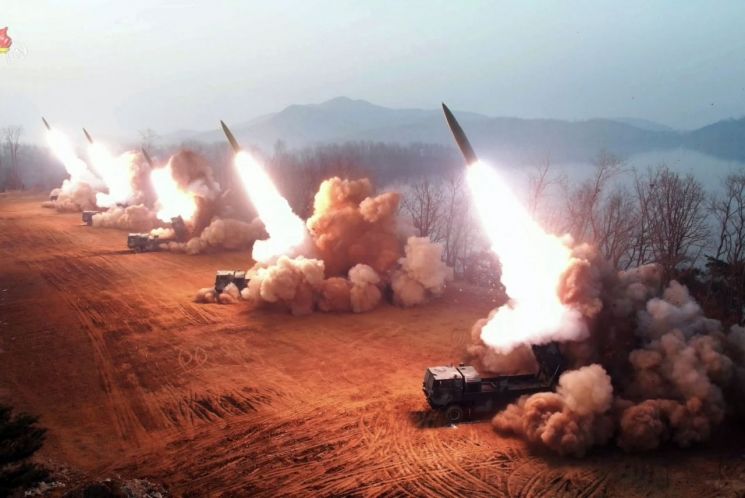 North Korea's Kim Jong-un observes tactical guided weapon training with his daughter 'Juae' [Image source=Yonhap News]
Earlier, Chairman Kim presented a five-year plan for defense development at the 8th Congress of the Workers' Party in January 2021 and ordered the 'core 5 major tasks' accordingly. These include ▲development of hypersonic weapons ▲production of super-large nuclear warheads ▲improvement of strike accuracy within a 15,000 km range ▲development of underwater and land-based solid-fuel intercontinental ballistic missiles (ICBMs) ▲possession of nuclear submarines and underwater-launched nuclear strategic weapons. The 'Haeil' unveiled on this day corresponds to the underwater-launched nuclear strategic weapon.
Chairman Kim ordered these five major tasks to be 'achieved within 5 years,' and it appears that considerable progress has already been made at this point, about two years later.
First, the 'development of hypersonic weapons' is evaluated to be virtually at the completion stage. North Korea first test-fired the hypersonic missile 'Hwasong-8' in September 2021 and conducted two more hypersonic missile test launches in January 2022. At that time, the maximum speed of the hypersonic missile was estimated to be around Mach 10, and North Korea hinted that left-right erratic maneuvering technology was applied.
Also, the recent frequent ICBM test launches are regarded as efforts to 'improve strike accuracy within a 15,000 km range.' Until now, test launches were conducted at higher angles than normal, but there are prospects that normal-angle launches toward the Pacific Ocean may occur soon.
Efforts are also accelerating in the 'development of underwater and land-based solid-fuel ICBMs.' North Korea claimed to have succeeded in the first ground static test of a high-power solid-fuel engine with a thrust of 140 tf (ton-force) at the Dongchang-ri West Sea Satellite Launching Station in Cholsan County, North Pyongan Province, last December. Furthermore, on the 8th of last month, during the 75th anniversary parade of the Korean People's Army, North Korea unveiled a solid-fuel ICBM for the first time. Although some analyses suggest that the ICBM is a model, the development of solid-fuel ICBMs, which can significantly reduce launch preparation time compared to liquid-fuel ICBMs, is considered only a matter of time.
Among the '5 major tasks,' the development processes of nuclear submarines and super-large nuclear warheads have not yet been publicly disclosed. Regarding nuclear submarines, Chairman Kim stated at the 2021 Party Congress that "the new nuclear submarine design research has been completed and is in the final review stage," but no clear developments have been identified since. However, just as the 'nuclear unmanned underwater attack vehicle,' whose development process had never been disclosed before, was suddenly test-launched on this day, it could emerge as a tangible threat at any time. Although there have been no related mentions of super-large nuclear warheads, there is speculation that development could be accelerated through a seventh nuclear test.
Provocations Regardless of Location... Aimed at Neutralizing South Korea's Kill Chain?
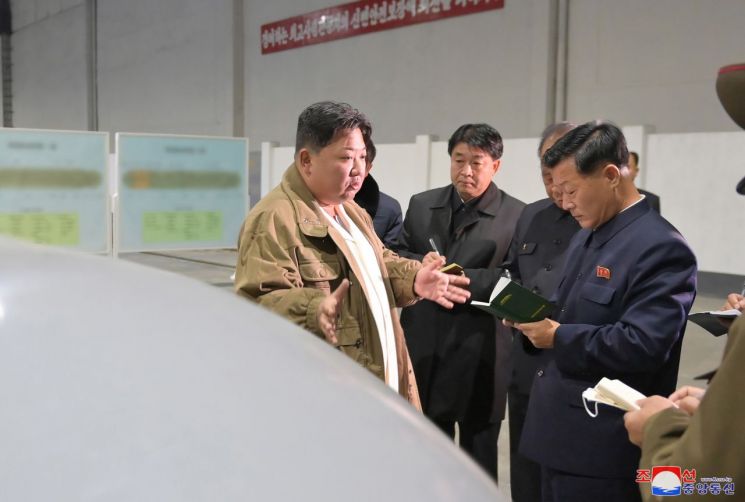 North Korea announced that from the 21st to the 23rd, under the observation of Chairman Kim Jong-un, it conducted an underwater explosion test of a 'nuclear unmanned underwater attack vehicle' and a simulated airburst test of a strategic cruise missile nuclear warhead, respectively.
 [Image source=Yonhap News]
There is an analysis that North Korea's strengthening of defense capabilities focuses on neutralizing the Korean-style 3-axis system. On the 22nd, North Korea conducted a test explosion of a strategic cruise missile at an ultra-low altitude of 600 meters, with a simulated nuclear warhead (test warhead) mounted on the warhead. This followed a tactical ballistic missile (KN-23, Iskander) explosion test at 800 meters altitude on the 19th, lowering the altitude by 200 meters.
Detonating a nuclear bomb at an altitude close to the ground maximizes lethality, with a kill radius extending several kilometers. The United States detonated a 16 kt atomic bomb over Hiroshima, Japan, at an altitude of 570 meters in August 1945, resulting in 140,000 deaths.
Moreover, the recent test of the nuclear unmanned underwater attack vehicle aligns with the context of ballistic missile launches from underground silo launch facilities, interpreted as diversifying nuclear-armed weapons and platforms. North Korea has demonstrated the capability to launch ballistic missiles from various locations, including mobile launch vehicles (TELs), trains, underwater reservoirs, and golf courses, attempting to neutralize the 'kill chain.'
Lee Sang-gyu, an active researcher at the Korea Institute for Defense Analyses (KIDA), explained, "According to North Korea's claims, the 'Haeil' can be loaded onto any North Korean vessel," adding, "If Haeil is deployed in actual combat, the number of targets detected by kill chain forces will increase to include many North Korean vessels."
A Joint Chiefs of Staff official stated, "We have continuously tracked North Korea's weapon development trends and are evaluating various possibilities regarding the substance North Korea has announced."
© The Asia Business Daily(www.asiae.co.kr). All rights reserved.
![Clutching a Stolen Dior Bag, Saying "I Hate Being Poor but Real"... The Grotesque Con of a "Human Knockoff" [Slate]](https://cwcontent.asiae.co.kr/asiaresize/183/2026021902243444107_1771435474.jpg)


















