UNFCCC Technology Mechanism Board Meeting from 24 to 29, 2023
Major countries around the world are gathering in South Korea to discuss the development, exchange, and cooperation of climate change response technologies.
The Ministry of Science and ICT announced that the United Nations Framework Convention on Climate Change (UNFCCC) Technology Mechanism Board will be held in Songdo, Incheon from the 24th to the 29th.
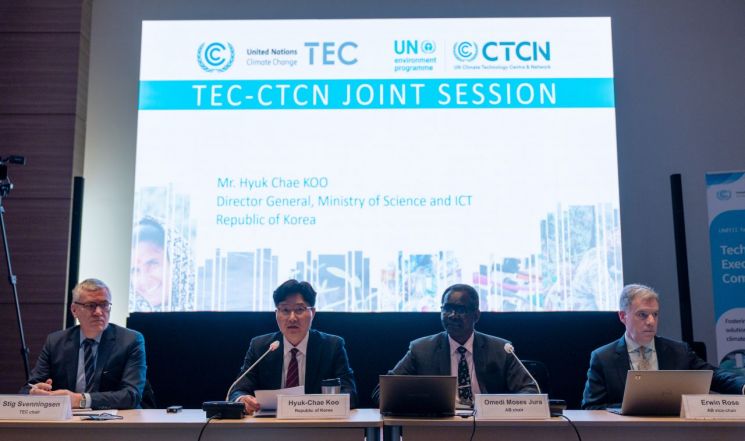 On the 24th, at the 2023 UNFCCC Technology Mechanism Board opening in Songdo, Incheon, Koo Hyuk-chae, Director of Basic and Fundamental Research Policy at the Ministry of Science and ICT (second from the left), delivered a welcoming speech. Photo by the Ministry of Science and ICT
The UNFCCC was established in 1992 to reduce greenhouse gas emissions. It is the most influential framework with participation from a total of 198 countries, holding an annual conference of the parties. In particular, at the 16th Conference of the Parties in 2010, the importance of science and technology for climate change response was agreed upon, leading to the establishment of the Technology Mechanism. The Technology Mechanism consists of the Technology Executive Committee (TEC), which supports the development of climate change response technologies and provides policy recommendations for technology transfer to demand countries; the Climate Technology Centre and Network (CTCN), which supports technology cooperation activities; and the National Designated Entities (NDEs) for each country.
These organizations operate to implement decisions related to technology development and transfer made at the UNFCCC Conference of the Parties. They especially carry out activities to support developing countries affected by rapid climate change and hold approximately two board meetings annually.
South Korea’s Ministry of Science and ICT was designated as the country’s National Designated Entity (NDE) in 2015. In 2018, South Korea became a board member of the Technology Mechanism and was selected as the NDE that contributed the most to technology cooperation activities that same year, actively participating. Considering the country’s climate technology capabilities, contributions to technology cooperation, and geographical accessibility in the Asia-Pacific region, South Korea hosted and established the world’s first CTCN Korea Cooperation Liaison Office in July last year. The office supports inter-country climate technology cooperation projects and conducts practical technology dissemination activities such as capacity-building programs and networking events for government officials from technology-demand countries.
In light of the establishment of the CTCN Korea Cooperation Liaison Office and South Korea’s contributions to climate technology cooperation, it was decided to hold the board meeting in Korea for the first time outside Europe, inviting CTCN board members from various countries to Korea. About 90 participants from approximately 36 countries, including the chair country the United States, Japan, Canada, Kenya, Nigeria, and Saudi Arabia, will attend.
At this board meeting, various measures will be discussed to enable substantial cooperation activities in the eight key technology support areas decided at the 27th UNFCCC Conference of the Parties (2022), including the establishment of flagship projects, scaling up technology support programs, and cooperation with financial institutions such as the Green Climate Fund (GCF).
In particular, the board will focus on discussing technology cooperation plans in the technology roadmap and digitalization sectors among the eight key technology support areas. It will provide guidelines for each country to establish technology roadmaps so that developing countries can respond to rapid climate change through technological innovation, and finalize the procedures and key contents for publishing a policy report on climate change response measures through digital transformation such as machine learning.
In his welcoming remarks as the host country, Koo Hyuk-chae, Director of Basic and Fundamental Research Policy at the Ministry of Science and ICT, stated, “We have established the CTCN Korea Cooperation Liaison Office to lead climate technology cooperation in the Asia-Pacific region and are promoting various technology cooperation activities.” He added, “We will continue to actively promote technological innovation in carbon neutrality fields such as hydrogen and CCUS, and support research and development, demonstration, and human resource exchange of technologies between countries through cooperation with related UNFCCC organizations to ensure that developed technologies can be applied in the Asia-Pacific region.”
© The Asia Business Daily(www.asiae.co.kr). All rights reserved.
![Clutching a Stolen Dior Bag, Saying "I Hate Being Poor but Real"... The Grotesque Con of a "Human Knockoff" [Slate]](https://cwcontent.asiae.co.kr/asiaresize/183/2026021902243444107_1771435474.jpg)















